
Get all your news in one place.
100’s of premium titles.
One app.
Start reading
Golf Monthly
Golf Monthly
Sport
Mark Townsend

Any Amateur Golfer Can Get Up And Down More Often (If They Do This With Their Wedges)

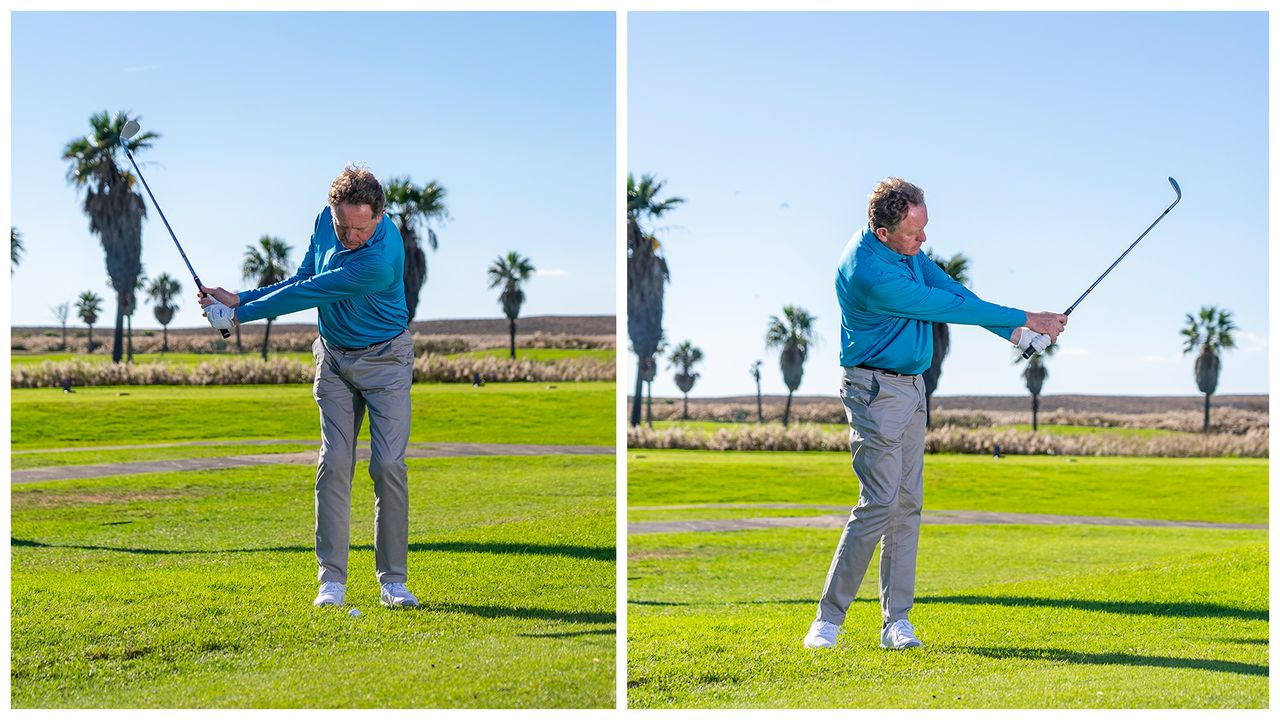
Keith Wood demonstrating the importance of practicing with matched backswing and follow through lengths to control distance with wedges and get up and down more often.

As amateur golfers we are all searching for a sharper short game, as quality and consistency in this area is often a key distinction between lower and higher handicap players.

Our curated list of the 20 best short game tips for amateur golfers are a great place to start, which is a resource Golf Monthly Instruction Lead Baz Plummer has used heavily as part of his successful winter golf improvement plan.
One of the most common pitching faults that amateur golfers make is linked to the 60-yard pitch shot, so understanding and improving how to control distance inside this crucial scoring zone is essential for shooting lower scores.

So, in the interest of helping you play better golf in 2026, we reached out to Top 50 Coach Keith Wood for his expert advice on how to dial in your wedges and get up and down more often...

Understand And Improve Distance Control With Wedges In Golf

According to the latest Shot Scope data, scratch golfers get up-and-down from inside 50 yards around 54% of the time, but for other amateur golfers at 15 or higher on the handicap index spectrum achieving this a third of the time would place them above average. So, in order to help you buck the trend and sharpen up your short game, we asked one of our Top 50 Coaches for their expert advice...

Backswing length will dictate how far you can hit it, but we focus too much on what happens in the backswing, then react to that.

To improve from around 20 to 60 yards, think about controlling the length of your swing both ways.

Two different mid-length swings with each of three or four wedges mean six to eight different yardages. Then you just decide how far you want to swing the club, not how far you want to hit it.

Backswing length is important for distance control with wedges but we must also consider the follow through length (Image credit: Howard Boylan)

We don’t have a good idea about how to control the follow-through as we’re just not moving our bodies.

We swing our arms at it and either the club stops itself so there’s no momentum, or we throw the club at it with our arms and hands.

Our backswing length may not be long enough, so we panic. Then there’s a speed change and we try and do everything in the follow-through.

Practice waist to waist and shoulder to shoulder swings with each wedge to get some firm distances for each shot (Image credit: Howard Boylan)

Focus on just practising your body movement rather than hitting the ball a certain distance, keeping the upper body moving and your arms in sync with your torso.

Arriving to practise without a plan is one of the seven things you should never do at the driving range, and the same goes for short game tune ups.

Start with one length of swing both ways (e.g., waist to waist) then try something slightly longer and perhaps shorter.

Holding the follow-through is a great way of improving commitment and registering the length of each swing.

Sign up to read this article
Read news from 100’s of titles, curated specifically for you.
Already a member? Sign in here
Related Stories
Top stories on inkl right now
One subscription that gives you access to news from hundreds of sites
Already a member? Sign in here
Our Picks
Fourteen days free
Download the app
One app. One membership.
100+ trusted global sources.