Get all your news in one place.
100's of premium titles.
One app.
Start reading
The Conversation
The Conversation
Environment
Paul Bierman, Fellow of the Gund Institute for Environment, Professor of Natural Resources and Environmental Science, University of Vermont

Ancient poppy seeds and willow wood offer clues to the Greenland ice sheet’s last meltdown and a glimpse into a warmer future

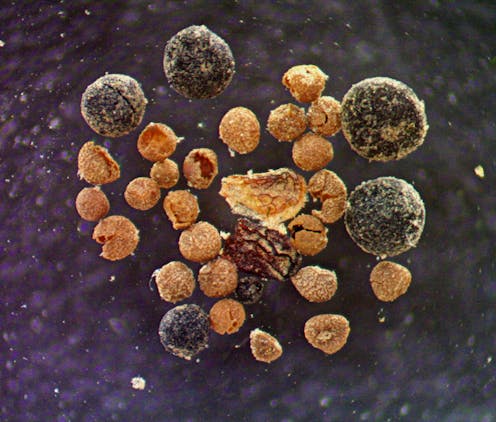
Under a microscope, a tiny elongate poppy seed, small tan spikemoss megaspores and black soil fungus spheres found in soil recovered from under 2 miles of Greenland's ice. Halley Mastro/University of Vermont, CC BY-ND

As we focused our microscope on the soil sample for the first time, bits of organic material came into view: a tiny poppy seed, the compound eye of an insect, broken willow twigs and spikemoss spores. Dark-colored spheres produced by soil fungi dominated our view.

These were unmistakably the remains of an arctic tundra ecosystem – and proof that Greenland’s entire ice sheet disappeared more recently than people realize.
Sign up to read this article
Read news from 100's of titles, curated specifically for you.
Already a member? Sign in here
Related Stories
Top stories on inkl right now
One subscription that gives you access to news from hundreds of sites
Already a member? Sign in here
Our Picks
Fourteen days free
Download the app
One app. One membership.
100+ trusted global sources.