
Get all your news in one place.
100’s of premium titles.
One app.
Start reading
Space
Space
Science
Julian Dossett

Ancient Chinese texts reveal new clues about the 1st recorded solar eclipse

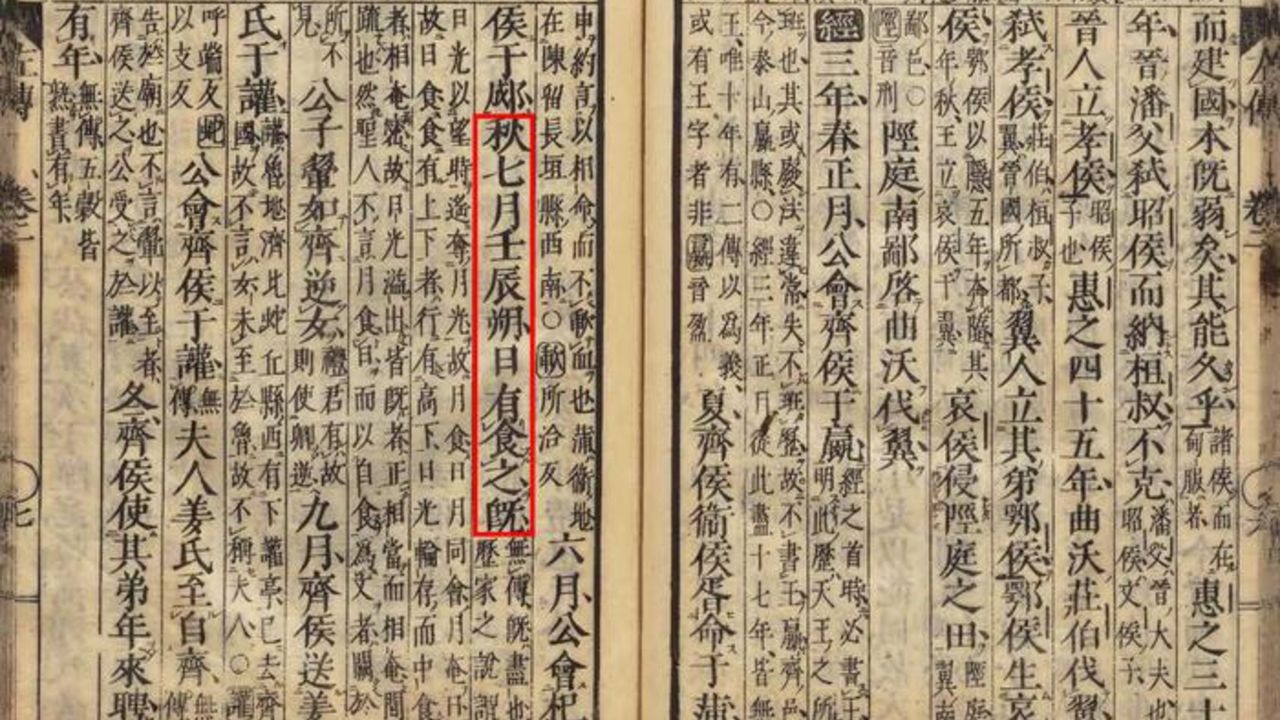
A photograph of an ancient Chinese text with vertical characters with a column circled in red.

A team of international researchers say they've uncovered new data on the world's first recorded solar eclipse using a surprising source — ancient Chinese texts. These findings could help us understand more about the progression of the Earth's rotation through the centuries.

The eclipse in question took place on July 17, 709 BCE, according to a chronicle titled "Spring and Autumn Annals." The caveat here is that this record was compiled around two or three centuries after the eclipse happened. The chronicle comes from the court of Lu Duchy, a vassal state that existed during the Zhou dynasty.

"What makes this record special isn't just its age, but also a later addendum in the 'Hanshu' (Book of Han) based on a quote written seven centuries after the eclipse. It describes the eclipsed sun as 'completely yellow above and below," lead author Hisashi Hayakawa, a researcher from Nagoya University in central Japan, said in a statement.

According to Hawakawa, this description has been historically associated with a solar corona — the outermost layer of the sun, which peaks out around the edges of the moon as the moon passes between the Earth and sun during an eclipse. "If this is truly the case, it represents one of the earliest surviving written descriptions of the solar corona," he said.

The team tried verifying the record of the eclipse by modeling the Earth's rotation speed during this time. But they figured out that the eclipse wouldn't be visible from Qufu, the capital city of Lu Duchy, where the chronicle was compiled.

A photograph of the text in question. (Image credit: Image courtesy of the National Archives of Japan)

So, they looked at historical geography and archaeological excavation reports. They found out that previous studies used coordinates that were about 4.79 miles (8 kilometers) away from the ancient capital.

"This correction allowed us to accurately measure the Earth's rotation during the total eclipse, calculate the orientation of the Sun's rotation axis, and simulate the corona's appearance," Hayakawa said.

This newly improved dataset, the researchers say, fixes errors in previous studies that looked at the Earth's rotation. "Additionally, it improves the accuracy of dating and reconstructing historical astronomical events," coauthor Mitsuru Sôma, a researcher from Japan's National Astronomical Observatory, said in a statement.

The one reason why this centuries-old record of an eclipse exists is due to an ancient belief that celestial events carry omens that were related to events of the time. "They believed strange sky phenomena indicated political wrongdoing by emperors, which motivated careful tracking of eclipses, auroras, and other astronomical events," the release states.

The authors say that their work supports solar cycle studies from dating radiocarbon in tree rings that give scientists data on the levels of cosmic rays from this time period.

"Some of our ancestors were very skilled observers," coauthor Dr. Meng Jin, Lockheed Martin Solar and Astrophysics Laboratory, said in a statement. "When we combine their careful records with modern computational methods and historical evidence, we can potentially find new information about our planet and our star from thousands of years ago."

The paper was published Dec. 2 in the Astrophysical Journal Letters.

Sign up to read this article
Read news from 100’s of titles, curated specifically for you.
Already a member? Sign in here
Related Stories
Top stories on inkl right now
One subscription that gives you access to news from hundreds of sites
Already a member? Sign in here
Our Picks
Fourteen days free
Download the app
One app. One membership.
100+ trusted global sources.