Anaïs Daly, an artist and researcher, has spent her life following a question about connection and the unseen forces that weave people into communities. That curiosity has become the guiding arc of her work, an attempt to understand emotion as something that moves, accumulates, and reshapes the spaces between people. Her work is an inquiry into how feeling becomes form, and how that form can be attended to, listened to, and sketched into shared mapping.
Her path unfolds through converging interests. Early encounters with collective emotional strain raised the question of whether affect, the observable expression of emotion, might behave like something measurable rather than a fleeting inner state. "I was searching for a diagram that could hold the pieces of me in place long enough to move," she says. "What I wanted was a working map that could change as people changed, drawing from the curiosity of ordinariness that drives the research into the applied sciences." From that inquiry emerged a practice blending the art of visual storytelling, sound, and computation, capturing gestures, recording tones, and modeling interactions to explore how affect moves through living systems.
The work she now calls affective ontology grows from that mapmaking impulse. What drives it is loose mathematical thinking paired with hands-on, creative methods. "I think that emotions act like elements in chemistry," Daly states. "They can combine, react, and set off new patterning. By using network thinking, I can trace how those reactions move through relationships, neighborhoods, and even digital communities."
Rather than offering fixed predictions, her models seek to reveal fields of probability, topology where certain patterns are more likely to emerge, and where novelty tends to arise. "I believe imbalance or apparent inefficiency is the fertile ground where new patterns are likely to appear," she remarks.
This idea resonates with the Pareto Principle, traditionally seen as the 80/20 rule, which describes how a small set of variables drives most outcomes. Reinterpreted through Affect Theory, Daly's work aligns with Pareto-Affect Theory (PAT), reframing imbalance not as failure but as "affective surplus." This refers to the excess energy through which systems evolve socially, biologically, and emotionally. In her practice, these uneven intensities become the very conditions that spark creativity, trust, and transformation.
Her method blends analysis with improvisation. On one hand, computational tools give her a framework for turning qualitative experiences into patterns that can be visualized or transformed into sound. On the other hand, improvisation, rooted in a philosophy she admires from contemporary musicians, keeps the process flexible and responsive.
"For me, improvisation is a way of knowing," Daly says. "By embracing vulnerability and unscripted responses, I open space for unexpected possibilities to emerge." This back-and-forth between computation and musical experimentation, between structured mapping and spontaneous performance, is how she tests her ideas in real-time and within real relationships.
A key theme in her practice is the idea that emotion circulates like matter within a field. She frames affect as an energetic force whose intensity and speed across a network shape the field it creates. "This is not a journey of laboratory certainty but an exploratory way to think about how trust, attention, and care move through social graphs," she notes. Her tools include data visualization, sound composition, and participatory creative experiments designed to make these movements perceivable, so people can witness how small gestures accumulate into larger shifts.
Personal history threads through the intellectual scaffolding of Daly's project. Stories about her grandmother, who worked with signal analysis in wartime communication, left a lasting impression. The practice of detecting anomalies in metadata became a lens for imagining affective patterns as readable signals. That pattern recognition informs her fascination with how subtle variations reveal underlying structures of coordination and meaning. "My grandmother taught me to look for the tracks beneath the message," Daly says. "Sometimes what matters most is the way signals gather, not the words they carry."
The methodological language she uses draws from different fields, including philosophy, network science, and elements of applied mathematics, but always with an artist's attention to ambiguity and nuance. She emphasizes, "I don't claim the mantle of a formal scientist. My work is an empirical artistry that navigates between numbers and felt experience."
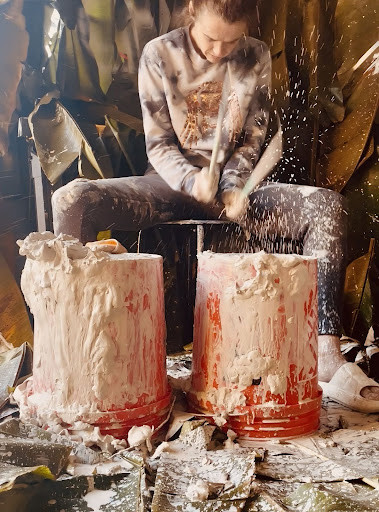
Her project's outputs range from generative sound pieces to maps that suggest where trust might be building or fraying, from choreographic explorations that let bodies enact shifting affects to tools meant to help peer groups notice their own dynamics. By translating affect into accessible visual and sonic forms, Daly hopes people can better recognize patterns of trust and vulnerability, and experiment with interventions that cultivate resilience. Her research also treats emergence as something to be invited rather than forced: by specifying context and conditions, she attempts to make space where new emotional formations can occur.
Anaïs Daly's work envisions a future where emotion is mapped, shared, and transformed into collective insight. By blending art, computation, and improvisation, she hopes to create tools that help communities perceive trust and vulnerability as evolving patterns. She says, "I hope to open spaces for resilience, creativity, and deeper connection to emerge across social fabrics."