
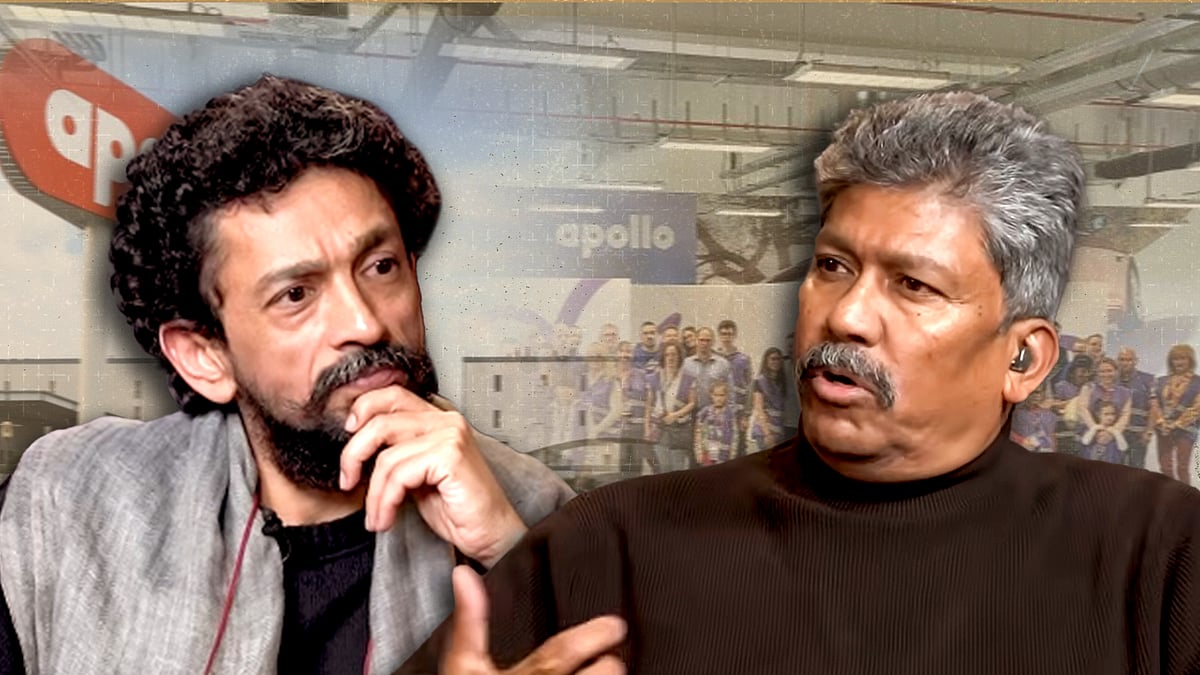
From the Licence Raj to liberalisation, labour unrest to global expansion – how did an Indian tyre company rise, fall, and rise again?
In this conversation, entrepreneur Udayan Dravid joins Abhinandan Sekhri to discuss his new book, Rise of the Phoenix: The Apollo Tyres story, an insider’s account of how Apollo Tyres transformed from a struggling manufacturer of the 1970s into a global brand. Dravid also unpacks India’s tryst with manufacturing and why it missed that bus.

Delving further into how Apollo Tyres turned its fortunes around, Dravid offers a crucial insight into how they redefined their business. Instead of selling tyres, Apollo sold “consumer vehicle finance”, recognising that truck tyres were sold on credit. This brought financing companies into the business, attracting more capital.
Dravid recalls, “When we started selling tyres, and we were largely in the truck tyre business, we said, we are not selling tyres. We are selling consumer vehicle finance. The moment you say we are selling consumer vehicle finance, you change the rules of the game completely because everyone else was selling tyres.”
The company also hired young professionals from outside the tyre industry to bring fresh perspectives, requiring each employee to generate one actionable idea annually. He argues that corporate managers today prefer to hire ready-made talent rather than train young employees at a higher cost, which is precisely the opposite of what they did at Apollo Tyres.
On manufacturing, Dravid notes, “No sector can absorb the kind of labour force and improve the quality of life other than manufacturing. India is probably the only country that actually missed the manufacturing bus,” heading straight to a service revenue economy.
So, why did India miss the manufacturing bus? According to Dravid, “Without an ecosystem of capital availability, manufacturing cannot revive... You had (state-run) development financial institutions (DFIs), which took a very long-term view of investment… At that time, the IDBI‘s role was so critical. They supported the company (Apollo) despite taking crores in losses. And they continued to support [us]; they would give money to pay salaries.”
He argues that the collapse and reinvention of DFIs like IDBI and ICICI in the eighties and nineties into private sector banks played a role in the collapse of manufacturing.
Industrial areas where MSMEs thrived, like Faridabad, Ghaziabad, and Noida, “were all created by these people who are taking smaller loans, setting up smaller factories”.
“And the backbone of these state financial institutions came from IDBI and ICICI. They were partners in all of this. So when they went down, everything went down,” he adds.
Once-thriving industrial hubs like Faridabad and Ghaziabad are now “industrial deserts”. “Thirty years ago, they were teeming with factories, and there were thousands and thousands of people employed over there in manufacturing. But they are graveyards today.”
Tune in for the full interview.
Abhinandan: [00:00:00] Hello and welcome to News Laundry Interviews. Today in our series where we interview authors, we are interviewing the author of Rise the Phoenix, the Apollo Tire Story by ra, who is here with us. Thank you so much joining us.
Udayan Dravid: Thank you. Thank you ab.
Abhinandan: Mr. D Tribe. Full disclosure, Mr. D also is my cousin. So, uh, I'm not used to calling him Mr.
Ade, but for the purpose of the interview, that's what we will do. Um, Ian is an alumni from Bits Ani, and you were the Mark, uh, the Chief Marketing Officer of Polar Tires. And now. Uh, he runs a consultancy called Cyber, um,
Udayan Dravid: connect Hub,
Abhinandan: cyber Connect Hub, and, um, uh, healthcare, uh, company logistics you manage.
But we'll get to that later. But this book is about the turnaround of, uh, brand, which was hailing or kind of. Stagnant. [00:01:00] Uh, and, uh, I've read the book. I'll ask you specific questions on that later. But first I wanna ask you, now you work, I know you worked as a consultant on digital projects, on healthcare.
Of course you work on logistics. But you were part of, uh, an important part of the turnaround of a bricks and mortar manufacturing company. Uh, and of course in the book it's clear the importance of relationships with your sales people and distributors is a very important aspect of your turnaround. Why is manufacturing so important even today in where every big company is on data and digital?
Udayan Dravid: So you've gotta understand that, uh, in the journey of an economic, uh, achievement, you have what you call as a primary economy, which is largely agriculture based. Agriculture mining is a very primary economy, and then comes the secondaries, which is manufacturing and the tertiary [00:02:00] economies, which are services, but no sector can absorb the kind of labor force.
Improve the quality of life other than manufacturing.
Both: Okay,
Udayan Dravid: so the services industry is, uh, while it has the highest value creation and undoubtedly most, uh, evolved economies want to move towards the service, uh, uh, economies. India probably is the only case which actually missed the manufacturing bus. We missed it to China, and, uh, we straight away become a very large, uh, service revenue economy.
But for the kind of workforce that we have and the size of workforce we have, I think manufacturing is very critical because it also does two things. Not only does it create producers, it also creates consumers.
Both: Hmm.
Udayan Dravid: Because the goods we produce here can actually get consumed in India, and it is very [00:03:00] critical that India manufactures at a very large scale.
Yeah. And you will, uh, because the problem with the service economy is it the movement of, uh, value can move very fast across continents.
Both: Hmm.
Udayan Dravid: So if you have a data center in India tomorrow, or a call center in India tomorrow, English skills are available in Vietnam. They just have to move out.
Both: Hmm.
Udayan Dravid: You can't do that with manufacturing so easily.
And when I talk manufacturing, I'm not talking the nuts and bolts, screwdriver, kind of assembly line manufacturing. I'm talking of hardcore manufacturing. You can't uproot a steel plant. You can't uproot a tire manufacturing facility. You can't easily uproot a a, a automobile manufacturing plant. These are things which are needed and they need large investments and therefore it's important to look at manufacturing.
Uh, in a very different manner, and that's why in this book, there is a whole chapter [00:04:00] on the role of financial institutions.
Abhinandan: Hmm.
Udayan Dravid: Because without, uh, an ecosystem of capital availability, manufacturing cannot revive.
Abhinandan: But that, I mean, is a more recent phenomenon. Now there is some, you know, space where there is some availability of capital.
When you were part of this industry, you know, right. In the capital wasn't so easily available.
Udayan Dravid: Oh, capital in fact, for manufacturing, was more really easily available than it, than it is that right now. Is that right? Yeah. Because you had the development financial institutions, which took a very long term view of investment.
Both: Mm-hmm.
Udayan Dravid: See. Most manufacturing is asset waste and assets in an inflationary economy become cheaper over a period of time.
Both: Mm-hmm.
Udayan Dravid: So if you, the first R factory, which was set up cost around 32, CORs a rupees way back in 77, the same size of plant today will cost you around 400 crows. So in an asset business, [00:05:00] even if you're incurring losses, you keep putting in capital at some stage, it'll start generating returns as long as you're efficient.
At that time, the financial, in fact the ID b's role is so critical. They, they supported the company in spite of the fact that
Abhinandan: chapter on that in the economics book.
Udayan Dravid: Yeah. Back in the
Abhinandan: day, six,
Udayan Dravid: six, uh, six Crows of Equity, 32 crows of Losses, and they continued to support. They would give money for, banks would give money for paying off salaries.
Abhinandan: But did not that, I mean, would you say it was that culture that led to the kind of huge defaults that we had of industrialists. Taking huge loans, not repaying them. Every year there is this list of non-performing assets, which seem almost malicious in how that capital was raised. Did it have a downside as well?
Udayan Dravid: See, every economic model has downsides. You look at equity markets, it's not that people don't lose money in equity. Somebody loses money even in equity.
Abhinandan: Yeah. But that is chance I'm talking about when you know capital, especially with private banks, I mean you see the case of YES Bank, where you know the ED is actually investigating.
There's so many [00:06:00] other banks. IDBI understand was. The, it was different, the incentives are different. The reason the setup was different, but the ease of capital to large industrialists. Has it, you think in, let's say post liberalization, or even in the 21st century, has it had more downside or has that capital actually served the country in building the assets that you think are important?
Udayan Dravid: So you gotta understand the, the financial structures of that time. There was IDBI, IFCI, I-C-I-C-I. There were three large development financial institutions. And they were also the state financial institutions with hana, industrial Development Corporation, raan Industrial Corporations. The state industrial corporations funded the MSME sectors.
Mm. So the farida and the Sunnis and the Gaia bas and the Noida, they were not created by DVI. They were all created by these small, uh, people who are taking smaller loans, setting up smaller factories.
Both: Hmm.
Udayan Dravid: And the backbone of these state financial institutions came from the I dbis and the [00:07:00] I-C-I-C-I. They were partners in all of this.
So when they went down, everything went down. So today you don't see, you see Far Gava, they are industrial deserts.
Both: Hmm.
Udayan Dravid: 30 years ago they were teaming with factories and there are thousands and thousands of people employed over there in manufacturing, but they're graveyards today. So. The fact of the matter is that you got to understand the mindset of a development financial institution.
The mindset of a bank. A bank fundamentally has a more short term, uh, horizon, uh, to understand the usage of capital. And I'll tell you why it is. So you wanna go and buy a car, you'll get it at an interest rate of nine, 8.5%, 9%.
Both: Hmm.
Udayan Dravid: You wanna set up a factory, you won't get it at 9%. And if you wanna set up a factory, you will not only pay the higher interest, you'll also give a personal guarantee.
You'll go also give a collateral, uh, guarantee. You [00:08:00] don't give a collateral guarantee when you buy the car.
Abhinandan: Sure.
Udayan Dravid: The only reason why you get a lower rate of interest because the car may re repossessed, right?
Abhinandan: Mm-hmm.
Udayan Dravid: And their horizon in five years, they're making money in five years. In a factory it could take 10 years, 20 years.
A lot of large businesses in the initial phase never made money.
Abhinandan: So it's basically how long your time horizon is. Okay. That's a macro picture. We'll get back to that little, let's get back to your book of the Apollo Tire story. So, uh, we'll get back, we'll get to the bit of, you know, how you created this sales network incentivizing and keeping them high morale relationships that were built, et cetera.
But, um. For a brand like this, like Sachin's, MRF bat, sometimes when we see the amount brand spend on just visibility, why is it so important? I mean, how does it actually significantly [00:09:00] impact how that company's performing?
Udayan Dravid: So there's a direct correlation between, between stock market valuations and advertising and brand record.
Um, so you would notice that every time there's an IPO companies start advertising their brand. Mm, it makes sense because you want people to, they think, oh, this is visible, this will sell, and therefore we can put money behind the company. But it also depends on the nature of business. So, uh, if you're a consumer facing brand, for example, if you are selling a a a a cosmetic
Both: Mm,
Udayan Dravid: you need, because these are impulse purchase products, you go to a hyper market, you see a brand there to say, oh, I saw that on tv.
I'll pick it up, low value. Impulse purchase. Repetitive purchases need huge investments in branding, uh, products, which are, uh, more long term. The purchase is more considered purchase. There's more research behind the purchase. Uh, you need more [00:10:00] elements, uh, to decide on consumer behavior and advertising will have a limited role there.
Abhinandan: So a car tire will fall in that category, right? A
Udayan Dravid: car tire or a scooter tire will fall in the category of high level of advertising.
Abhinandan: Oh, as an impulse purchase. But these are expensive
Udayan Dravid: things. Yeah. Because what happens is that you are, you are picking up a scooter tire, which is costing you 400, 400 rupees or maybe a thousand rupees at best.
But when you're buying a truck tire, it's costing you 20,000 rupees. The whole equation is different.
Abhinandan: But the brand that is making both is the same.
Udayan Dravid: Yes. But there is, there's probably a very few companies which straddle both end. It's like, uh. If you are buying a very expensive car
Abhinandan: mm-hmm.
Udayan Dravid: You would have a very different, uh, consideration for purchase than if you are buying a scooter.
Abhinandan: I see. So today's management professionals who are entering the workforce, what can they learn from your experience of, you know, creating a brand that then outperformed others from a fairly stagnant position? Is the [00:11:00] story of what you did back then relevant to today's professionals? Has the market changed so much?
Technology and media changed so much that the rules have completely changed.
Udayan Dravid: So there is a, uh, the essence of business is what I talk about in this bus. In this book, we always talked about the four wheels of business. So the four wheels of any business is consumers, shareholders, employees, and suppliers.
The four wheels have to be equally inflated. Otherwise, what happens is the vehicle will stall or it won't move as fast. Most companies commit this mis this mistake. Either they're too focused on shareholders, so they compromise the suppliers, they squeeze the suppliers, uh, or they would be completely focused with consumers and not bothered about shareholder value.
At the end of the day, everyone has to succeed in the game.
Both: Hmm.
Udayan Dravid: You know, uh, a shareholder needs to make a reasonable return. A consumer needs to get a good [00:12:00] contemporary product. Uh, an employee needs to be satisfied to be motivated to do the right thing, and a supplier needs to make adequate return to be continuously being able to upgrade technology to keep pace with the product.
Innovations. With the user ones, you keep squeezing suppliers. At some stage, the supplier will stop investing. You keep, uh, uh, squeezing customers don't upgrade your product. They will stop buying. You keep squeezing shareholders, taking them for granted. Your lenders or your financial uh, supporters, they will no longer give you more money and you keep taking your employees for granted.
At some stage, they'll leave you.
Abhinandan: Hmm.
Udayan Dravid: They won't do the right thing.
Abhinandan: So what did you find when you were given charge of this turnaround and what did you do to change it?
Udayan Dravid: So actually. We, you know, there's something which I always hear is this is bookish.
Abhinandan: Hmm.
Udayan Dravid: You know, you will hear that with most managers.
Okay. He's talking theory. But theory is actually [00:13:00] years and years of practice.
Both: Hmm.
Udayan Dravid: And experience is actually a limited amount of time, multiplied that when you number of times. If what you're doing in news laundry, you probably did it in the first two years. Hmm. Now it's a little bit of repetition, a little bit of additions here and there.
So it's important for, uh, people to, uh, be able to absorb younger thought. And I always believe that in world history, no old man has built an empire.
Both: Hmm.
Udayan Dravid: Alexander was 32. He conquered the world and died. Jesus was 32, established the greatest religion. Shankar chare was 30, 32.
Both: Hmm.
Udayan Dravid: Uh, Akbar became emperor at the age of 13.
Hmm. Because the young people dream and the old people look at the past.
Both: Hmm.
Udayan Dravid: What Apollo did was, the first thing we did was we relied on younger people. We brought in younger people to work with us, um, and we brought people from other industries. So in fact, one of the criteria which we put there was we did not hire [00:14:00] anybody from the tire industry above a certain level.
Abhinandan: And that helps. How?
Udayan Dravid: Because if, let's say if I'm in Apollo and hiring somebody from another tech company, that guy will keep talking about what they did in that company. But we are not creating that company.
Both: Hmm.
Udayan Dravid: We are creating a completely different company. If News Laundry hired from another media company, they will talk about what the other media company does because that's their experience.
Hmm. But News Laundry is not that media company.
Both: Hmm?
Udayan Dravid: News Laundry is creating its own identity and its own thought. Hmm. So these younger people, other people who were given only one task, they had to create one actionable idea every year, which could be executed.
Abhinandan: And that idea would be in,
Udayan Dravid: could be anything packaging.
It could be in pricing, it could be in distribution, on anything. So if you have 300 employees, each one generating one idea, you cannot execute the number of ideas. You have 300 ideas in a year. No company can absorb that many [00:15:00] number of ideas. So here was this company throwing up different ideas. So you'll see in that book, every single thing we did, we would not do if another tire company was doing it.
So if they did something, we would not do it. We will do only something which nobody else is doing. Hmm. And that built a differentiator. So here was a company which had no, no money, no brand, no differentiator as such, but it became different and people buy into differentiation. So you see a movie. And you see a group dance, you'll saw all the extras in one color of clothes.
But the hero. And the hero and will be in another color of clothes. Hmm. Because that's when everyone focuses on them.
Both: Hmm.
Udayan Dravid: And it became a differentiated product. Differentiated product. And beca, because it became a differentiated company, it became a differentiated product. People saw that happening on the ground.
Abhinandan: That, how difficult is it to change that kind of culture? You know, inertia or established ways in, in working for any [00:16:00] company, especially when it's large and it's legacy. I mean, it's not like it's creating a startup, you know, startup. You create the culture, you create everything new, but something that's already existed.
Changing is already difficult, more difficult than creating,
Udayan Dravid: right? Yeah. It, it was not, it wasn't short term. It took years, it took a lot of years. It took a lot of commitment from, uh, so what you see, uh, in the rise of the Phoenix, when we went for the unilateral price increase, that whole process took something like, uh, four to five years till we reached that stage where we could challenge and take a individual position.
It didn't happen overnight.
Abhinandan: Hmm. That means you have to have that kind of consistency, which means. In today's day and age where thinking is quarter to quarter, is it more difficult to think long term for any company? I mean, I've absolutely heard this criticism and this frustration from many of the professionals I deal with today, uh, or I meet, whether it's socially or at, at different events, that even though you know the right thing to do from the long term perspective [00:17:00] is, is X, but the consideration will always be.
Quarter to quarter.
Udayan Dravid: So the stock market only looks at, uh, profits. Hmm. I don't, I don't think Apollo ever lost out on the profit game. It always delivered better returns in spite of the fact that you're doing things differently. So I don't think there is a conflict there. Hmm. Uh, if you try to do the same thing the same way, it's like a paradigm.
And I'll, I'll explain the paradigm. A normal human being can walk, uh, can, you know, uh, walk at the rate of. Four kilometers an hour, you were to do a slow jog. You do eight kilometers an hour. If I told you, you have to do eight kilometers an hour consistently for the next six hours, unless you're a marathon right now, you can't do it.
Both: Hmm.
Udayan Dravid: But if you had a bicycle cycle, you could move eight kilometers an hour. And if you pedal very hard, you lose it at 20, 25 kilometers an hour.
Both: Hmm.
Udayan Dravid: But I tell you to do 25 to 30 kilometers r consistently for the next eight hours. You [00:18:00] can't do it. But if I give you a two wheeler, you can do it.
Both: Hmm.
Udayan Dravid: And then you can do 90 kilometers an hour for eight hours.
If I give you a four wheeler, this is a paradigm shift. The difference is that you are not walking, you are defining your business as locomotion or movement. And once you define your business correctly. You will be able to do better in classical cases. The watch industry.
Both: Hmm?
Udayan Dravid: The watch is a timepiece, but Titan defined it as a fashion accessory the moment it defined it as a fashion accessory.
You didn't need one, you needed six. HMD used to sell one watch, which was given at the time of your wedding, probably by a father-in-law.
Abhinandan: And now it's jewelry now. Now people positioned as
Udayan Dravid: jewelry. Jewelry because the watch is the role of the watch and the timepiece is being done by the mobile phone.
Abhinandan: Hmm.
Udayan Dravid: So when we started selling triers and we were largely in the truck tire business, we said, we are not selling tires. We are selling consumer vehicle finance. The moment you say we, we are selling [00:19:00] consumer vehicle finance, you change the rules of the game completely because everyone else is selling tires.
Abhinandan: Explain that to our audience.
Udayan Dravid: So in the tire truck tire business, the tire is always sold on a credit.
Abhinandan: Hmm.
Udayan Dravid: So the dealer takes the old tire, let's say the tire prices, the one 10,000 rupees, the old tire will fetch you 3000 rupees. So he takes the old tire, he gives you a new tire, and you have to pay him over a period of six months.
Takes a trip and gives you some money because he's short on capital
Abhinandan: takes on installment.
Udayan Dravid: So he's basically financing the trucker, right?
Abhinandan: Mm-hmm.
Udayan Dravid: Now, the moment you define this business as financing the trucker interest rates plays a very important role in the business economics. The nature of dealers are not people who understand tires.
They're people who understand vehicle finance. That's how we started getting financing companies into the business, art's into the business.
Abhinandan: Mm. You changed the kind of the profile of the
Udayan Dravid: people who came in and they were completely new people and more capital was chasing us. [00:20:00] So there is this chapter on, uh, recurring advanced scheme.
Mm-hmm. So there was a time when we were running short on capital and we increased the interest rate to I think 36 or 48%. Everyone thought we were going bankrupt. We weren't going bankrupt because we were born, we were taking 48% from you on interest, and I had increased my prices. So on the price side, I was getting a better arbitrage.
Hmm. You were giving me money. Now that you're given me money, you'll buy from me. So I had no worry of collections and bad debts.
Abhinandan: So you already had certain
Udayan Dravid: amount sold? Yeah.
Abhinandan: On your balance sheet
Udayan Dravid: you had. And in that, in that model, what was done is that for the finance team, what was the difference was treated as a discount.
So if they were borrow, let's say 12%, and I was taking a deposit at 13 per 30%, 18% was put as discount in my kitty.
Both: Hmm.
Udayan Dravid: So sales discount. So they were okay. I was being monitored on the discount that I was [00:21:00] giving. And because I was able to sell more, rotate my inventory better, I was actually selling more and therefore making more money.
Than anyone else. And at one stage what started happening was that people used to buy from other companies, sell it off in the deli market, raise money, give it to us. So the other tech companies started financing us.
Both: Mm-hmm.
Udayan Dravid: So I think one has to understand where you are making money. We were making money on selling tires.
Other people thought that we were making money or losing money because we were taking deposits. Now. It would've gone completely south. If we had borrowed that money and not been able to sell tires, then it would've been a disaster.
Abhinandan: So both have to be in tandem. You have to have that kind of sales happening so that you can offset this advances that you're taking.
Okay, now, uh, coming to competition in a market, which is, you know, you, you [00:22:00] see famous Tendu, Kabat, you see lots of ads. Uh. As a marketing officer or you know, CXO potential people are watching, how much of your involvement or anyone's involvement is there and how the brand is positioned out in the market.
'cause ad agents are pretty much dead now, now even goes by influencers. You know, the, the entire way where you went to market with any product has completely changed. What was involvement then? What do you imagine is the involvement of that marketing officer today?
Udayan Dravid: See one of the misnomers of marketing is marketing has been most marketing officer, I'm sorry to say that, think that marketing communication is marketing.
Both: Hmm.
Udayan Dravid: It's not. It's a very small subset of marketing. Marketing really starts from understanding the consumer and the involvement of marketing people in product design makes a huge difference to success. For example, the reason why Apollo went down was it was manufacturing lead. At that [00:23:00] time, there were premium on the tire, so they just got designs from us and whatever, and they, and they started putting, putting tires in the market, in the field till uh, the people started getting actually involved in designing the product.
So there's a chapter on how we reconfigured the product, uh, load star and M star X three seven. We realized that there is a consumer segment, which is overload. They will. They just want that. Just imagine a 20 ton truck on two axle, a single axle overload truck, which used to happen in those days.
Both: Mm.
Udayan Dravid: And the tire falling flat, the guy can't even put it on the jack.
He doesn't want the tire to fail, right?
Abhinandan: Mm-hmm.
Udayan Dravid: So he was willing to pay a premium for it. That consumer insight is very important. If you have that consumer insight, you will do the right pricing, you'll do the right positioning. Communication is only about conveying what the product is offering. What Sachin brings to the brand is the [00:24:00] trust that Sachin brings as a cricketer.
Both: Hmm,
Udayan Dravid: that you put Sachin in the field and you will hopefully win the match, and more likely than not, he will deliver. Hmm. Whether others deliver or not. The trust factor is what he brings to the brand. The brand in itself is more than just the trust, the product performance, the product relevance. Each one of those things are important for a consumer.
And if you don't do that entire gamut of activities, it won't work. You have brands backed by celebrities which have failed.
Abhinandan: Mm-hmm.
Udayan Dravid: It doesn't work.
Abhinandan: Finally, um, I wanna get to the big picture. Your experiences since then in logistics planning in the healthcare industry, in Connect Hub Consulting for other companies.
What is the significant difference between the landscape of. Industrialists or the companies that are seen as the top performing companies or the most relevant companies in India then [00:25:00] and today, what has fundamentally changed, in your view?
Udayan Dravid: What I might say will sound blasphemous?
Abhinandan: Mm-hmm.
Udayan Dravid: Is that the valuation game, which all businesses today look at is, in my view, the Acli seal for industrial growth.
Hmm. A business has to be fundamentally efficient, fundamentally profitable, fundamentally relevant. Then when you get a valuation, makes great sense. It'll always succeed. But if I can't ever imagine that a business has losing 3000, crows has a revenue of 10 crows, or 20 crows, or a hundred crows, and you create a valuation of a billion dollars, that's why some of these big, uh.
Companies have gone under
Abhinandan: BYU as being the most comfortable of them. Yeah.
Udayan Dravid: If you look in those days, the top executives of the company always visited their manufacturing [00:26:00] locations. They visited their consumers, they visited their dealers, they visited their, uh, uh, the stock is, I don't think many people do that today.
They're happy looking at a spreadsheet and looking at valuations
Abhinandan: and what does that actually achieve? '
Udayan Dravid: cause they, they don't get a firsthand feel a classical case of how a brand can be built because you, you go and listen to a customer insight is that famous campaign of Coke, Coca-Cola.
Both: Hmm.
Udayan Dravid: You know, when you go to Ana, if you have traveled on the ANA roadway bus, people don't go and ask for Cocoa Pepsi.
There's a. Mm. And the NDA has put in an ice box at the bottom with ice lying on top of it.
Both: Mm-hmm.
Udayan Dravid: That insight is what created K Coca-Cola.
Both: Mm-hmm.
Udayan Dravid: So that consumer insight will only come if you go and sit there. There were days when, you know, I used to have a dealer from TI who used to come to me every day as miracle.
I said, what do you mean, why do you need so many tires? I actually went and [00:27:00] sat at his counter. From nine o'clock in the morning till seven o'clock in the evening, just sitting there having endless cups of tea, and I saw how he was selling tires, how many consumers came to him, and the next day I came and increased his allocations because he was actually, what he was doing was buying from Dehi and selling in because nobody went to, Hmm.
They thought.
Abhinandan: Hmm.
Udayan Dravid: It didn't happen.
Abhinandan: So you think visiting that last mile, the last person who's actually dealing with your consumer can really change how things work at the top?
Udayan Dravid: Yeah.
Abhinandan: And that has fundamentally changed you think in today's,
Udayan Dravid: yeah. In Apollo
Abhinandan: culture,
Udayan Dravid: in Apollo, those days, the entire top leadership used to be sitting in a meeting with dealers where dealers would stand at a podium and say, your tire is useless.
We sell the the tire. This problem is that problem, that problem. People would be taking notes, going back, fixing the tire, and coming back. You know, [00:28:00] Rahi Marman, he's not, he's unfortunately no more used to come to, uh, r Road sitter dealers shop as the managing director of the company, fixing his understanding, consumers, what are they telling him?
Went back and fixed the product. MRF became a great company.
Both: Hmm.
Abhinandan: And why do you think that's not happening today?
Udayan Dravid: Because today there's an interesting arbitrage. If you run a business where there's a dollar arbitrage, you are paid at eight rupees, $8 a day, vis-a-vis $8 an hour in the us.
Abhinandan: Hmm.
Udayan Dravid: There's no reason for you to be more efficient?
No. Just the currency gap gives you that, the profit.
Abhinandan: Right. So you think.
Udayan Dravid: And that is why manufacturing people, in my view, and I might, a lot of people may not like me saying it, have a better understanding of cost in a cement business. Just, you know, uh, [00:29:00] you go to a, a cement distributor in the evening, you will see him collecting that cement.
When you throw the bouri, the bag, there's some cement which comes out. They collect it in the salad. You go to a jeweler's, uh, shop. They'll be beggars sitting outside who will be collecting that mud and taking out dust. The, the, the dust, the filings or whatever the contract for the jewelry, uh, exchange, you know, complex in Bombay is given for a couple, couple of crows of rupees because they take out that metal out of sewage.
So cost consciousness in a manufacturing business is far greater. Because that little thing can make a huge difference. Now, that doesn't mean to say it doesn't work in service industry. So airline industry in the US is a classical case. They took out one olive and they saved billions. So cost is something which either people focus on cost at a time when they're going under, when they nothing left, or they focus on [00:30:00] cost because you don't focus on cost.
You won't survive anyway. But wherever there is a pure valuation exercise where you're chasing. Uh, a vision which people call us vision. Somebody would call it a dream. There, there is no logic to it. There's no lo there's no economic logic to what you're doing.
Abhinandan: So let me get back to the beginning.
Something you said in the beginning. Of we missed that bus to China. And you're still involved in brick and mortar businesses, whether it's healthcare, um, and you consult for others as well. Why did we miss that bus? What is it? Is the red tape of making anything happen here too? Great. So people are just fatigued.
They will not get into it. What was the cause when we had a population, we had a good start.
Udayan Dravid: So I think it's a collective, uh, collapse. Across the spectrum. So there's clearly, if you see the nineties, the eighties and the nineties is when the development financial [00:31:00] institutions kind of disappeared and they reinvented themselves in the form of banks.
Two of them did I-C-I-C-I and IDBI. That resulted also in the collapse of the, uh, state financial institutions.
Both: Hmm.
Udayan Dravid: So financing became a very different game. That was also the period of globalization. And because of our large English speaking population and a very large, uh, uh, uh, engineering base, not in terms of, uh, no, let me correct my very large ENG English speaking population.
There was a huge market which was coming up for, uh, KPOs and BPOs, which is where the labor force really went. And because they were white collars. Simultaneously, you could see a collapse in the skill centers. So there was a layered skill structure to support manufacturing. They were the its, they were the polytechnics and they were the engineering [00:32:00] colleges.
So the itis are no more, and the polytechnics are no more. You don't see them. Right, and that is probably the reason why the government had to come back with Skill India and all those programs because those are all that they needed was to revive these institutions. And they were producing fitters, welders, electricians.
The ideas were doing precisely that. And when you look at engineering, the most preferred engineering disciplines became it computer sciences. They were no longer. The hardcore manufacturing civil,
Abhinandan: well now apparently there's a comeback on robotics because now with ai, robotics being an important part, apparently there's a comeback of computer engineering and, and mechanical, which was the least desired in the middle.
Udayan Dravid: So, so the quality of talent which was available was going down the market was moving towards the service industry. And because those, those are more glamorous. See, [00:33:00] blue collar environments are tough.
Abhinandan: Hmm.
Udayan Dravid: Factory environment is tough. It's hard. Uh, air conditioned BPO environment is good.
Abhinandan: Hmm.
Udayan Dravid: It's glamorous.
Right, right. So the younger force also want to do it. It was a good, good thing going for India. There nothing wrong with it. I'm not saying that
Abhinandan: why wasn't sustainable.
Udayan Dravid: How can it be Because the day you increase prices, someone else is coming up. No. So Philippines is Catholic catching up. Vietnam is catching up.
They will all catch up. I still remember. Uh, and also, you know, even today we have this thing about where a hundred percent FDI should come in and where investment should not be allowed to come in. One of my father's friends, he was a communist. Hmm. And he once told me, he says, what's the problem? He should allow them to come and invest a hundred percent factory.
Both: Mm-hmm.
Udayan Dravid: As sectors you can, you can really get all the foreign [00:34:00] guys to come in and do whatever they like. And there sectors where should not allow them to come in. Hmm. So I think a lot of things, the wheels had to come together, which, which China did beautifully. If you see what China did, they allowed everyone to come in.
Abhinandan: Hmm
Udayan Dravid: Ha Factory LA
Abhinandan: right now. As a case study, you know, which manage, I mean, you studied after engineering, you did management as well. When you study management that, you know, one of the things that you said about polytechnics and the many, uh, come, come, I can tell you from, um, the people who I have encountered last a couple of decades, many of them are unemployable.
You know, it's, I, I mean, I, I think that India turns out the highest number of unemployable people with degrees. They may have a degree, but they just don't have the basic discipline [00:35:00] of working. I mean, I'm, I may sounding like an uncle, but I've heard many other people express this exasperation. Uh, a simple example, uh.
If you go overseas, it's not a very educated person who's handling the counter of, let's say a breakfast deli. He or she's taking the order, he or she's cooking, he or she's taking the money, giving he or she's serving you. One person, and I've seen this and often I think, would I entrust three tables, small counter gas stove, and one person doing it here.
Even if you go to the smallest daba. There are five people. There's one guy sitting, taking the money, one little, violating all norms, serving you, someone cooking fourth guy cleaning. It's, it's just at, and I'm saying at a very basic level, even at a, you know, more so-called educated level, what is the reason that, uh, did you find this, uh, frustration back in the eighties and nineties?[00:36:00]
There are too many people who have the degree, who have been to the college or you know, whatever. But in a work environment, incompetence is significant.
Udayan Dravid: See, you have to understand one thing. Uh, it's wrong on our part to expect the education system to provide everything to people. They no debate about the fact that the education system has not kept pace with the requirement of the industry.
Both: Hmm.
Udayan Dravid: No debate, but it's also a fact that when we started our careers, our managers were mentors. Hmm. I've been taught by my bosses. I've been fired by my bosses. No doubt they were rough. They were the kind of bosses I worked, I was privileged to work with some of the best brains in Indian industry. And, uh, they taught you, they taught you, and companies were learning grounds.
DCM you know, it used to be the management train scheme of DCM [00:37:00] used to be better than, uh, I'm Amba. If you became a management trainee in DCM was a feather in the cap. And the interview process itself was so rigorous with, uh, Dr. Chara sitting on the panel with the entire board interviewing and then deciding they would be an entrenched test and so on.
And once those people came in, they were groomed. One year, two year, they were put in departments. They were mentored by people, they were watched, they were taught, and they became giants. At one stage, the entire top leadership of, uh, manufacturing in Delhi at least came from CM. So today's managers, and which I, I can say out of experience, do not want to teach.
This is one quake trained one another, though. Hmm. You gimme a person who knows and because of that, what happens? Your cost structure goes up. '
Abhinandan: cause you'll pay more for that person.
Udayan Dravid: You'll pay more. What we did with Apollo was exactly the reverse. We [00:38:00] worked with raw material. We groomed them in our own culture and therefore cost low.
They were all younger, they were all willing to learn and because they were younger. See, young people need mentoring. Hmm. You can have the biggest but marsh in a class. Actually being the best kid. That's the way youth is.
Abhinandan: Hmm. '
Udayan Dravid: cause youth by its very nature is inquiring youth is by very nature, is questioning,
Abhinandan: is it still, I mean,
Udayan Dravid: intrinsic
Abhinandan: people have to want to learn as well, right?
Because I mean, let's talk about. Your generation, you know, they were tough people when you didn't perform. They were tough. They were not always, Molly coddling you while teaching you, uh, you think today's youth are also
Udayan Dravid: willing to learn. I think, I think and I, this, I don't buy that argument that all rich kids don't want to work hard and all poor kids want to work hard.
No, I have had it, my experience, people from [00:39:00] very good families. Working their butt off.
Both: Hmm.
Udayan Dravid: Not because they needed that money, but because they were, they really were passionate about what they were doing. Uh, people from small towns wanting to, and girls particularly wanting to come from the, and the campers.
And when you ask them an interview, why do you want to come to, you know, he says, we want to be independent. Uh, they want to move away. They want to work on their own. Struggle on it's tough. But I think we have let this, uh, these kids down. Hmm. We have not done enough to, uh, give them the environment for success.
It's easy for us to say algi generation. That's not, that's not a completely true statement because the, today's generation has evolved out of the previous generation.
Abhinandan: Mm-hmm. Right. And before we close, coming back to your experiences in the Apollo tie story Rise of the Phoenix, uh, give me an example, a story, an [00:40:00] anecdote that stays with you, which you think was a big teacher for you personally that really left an imprint on and defined much of what.
You left behind when you, when you moved on from Apollo,
Udayan Dravid: an event in Apollo Tires
Abhinandan: while you were working there, while you were, you know, operating this entire management network, Salesforce, et cetera, et cetera. Something specific that happened that made you see, okay, that is, that, that has taught me so much.
You don't like the example you gave of anything?
Udayan Dravid: So there was a phase in, in the company where, um. There was a family fight going on, capital was scarce, expansion has started, and every day something or the other used to come in the press.
Both: Mm-hmm.
Udayan Dravid: And you'll be surprised that that was the time when of we had the lowest attrition in the company.
Every day in the morning [00:41:00] I would come. My office used to give me the cuttings of the newspaper. I would take my team on call and tell them, this is what the paper is saying, this is what is our stance. This is what is the official position. Every single employee was speaking on behalf of the company.
There was no spokesperson. Every employee became the spokesperson. And at one stage, because there was so much of cash flow pressure, uh, I personally started, uh, losing it. And one day my secretary, he came to me. He says that, I want to tell you something. I said, yeah, tell me. He says, yeah, tell me. He says, you started losing it very much.
People are scared to come to you. That's when I realized that when the things are tough, the bosses need to be cool. Hmm. The easiest thing that can happen is that, uh, the leadership starts coming under pressure and the pressure starts going down. Mm-hmm. And that's why it's important. If the ship [00:42:00] is in a storm, the captain should be cool.
Both: Hmm.
Udayan Dravid: And you don't have to flounder. That taught me something.
Abhinandan: And finally, if, um, you were to today have some advice for news laundry as a brand, uh, the news environment is so cluttered. It is. Uh, and you know, of course most of your work has been in logistics and supply chains, et cetera, et cetera. That's area of expertise.
But you've advised people on other stuff as well. In a news environment that is as cluttered, as confused with fake news is also a thing. What would be a differentiator in your long experience and your expertise for a news brand to to stand out and stand apart? What were a few, you know, suggestions or rice you'd give?
Udayan Dravid: I think you'd need to understand that, uh, one shoe fit all is not the right strategy for any media company.
Abhinandan: Hmm.
Udayan Dravid: Because you're talking to different audiences. So if you're [00:43:00] looking at, uh, let's say there are people who are just not interested, let's say in politics and current I affairs.
Both: Hmm.
Udayan Dravid: They're only interested in fashion.
Both: Hmm.
Udayan Dravid: They can be part of the, even in fashion there is something to be said. Through media. And that also is not very honest, by the way. Okay. And similarly, something to be done. So basically your job is market share mm-hmm. As the CEO of the brand.
Both: Mm-hmm.
Udayan Dravid: Your job is to expand the market, grow the market, create more revenue streams.
Mm. And build a bigger portfolio. And, and I'll give you an example of how this has evolved. Where the market evolves, segmentation becomes very important.
Both: Hmm.
Udayan Dravid: In the 1960s, there was only one shampoo brand. It was Tata shampoo, only one shampoo. There was Sabu and there was shampoo. Mm-hmm. And then in the eighties, you had Sun silk egg shampoo, anti DDR shampoo.
This shampoo, that shampoo. Today, the market has evolved completely. And you have some 20 types of [00:44:00] shampoos, hair repair, shampoo, oily shampoo this, shampoo that, because each of those segments is viable on a standalone basis because the usage of shampoos has grown up so much.
Both: Hmm.
Udayan Dravid: At that time, not many people were using shampoos and therefore the business case was not relevant.
Yeah. Business case was not relevant.
Abhinandan: Right.
Udayan Dravid: Same thing is with media. The way to cut through the clutter is to create specialist properties. And if you build specialist properties, you can cut through the clutter that makes the business more viable. And then you decide, pick and choose. Cherry pick.
Abhinandan: Right.
Thank you for your time Ra, the Phoenix, the prioritized story. The link is in the show notes below, like there is for all our books and authors who we interview. I do hope you learn from it. And management students, you also go teach management students?
Udayan Dravid: Yeah, I do. Not in the recent past, but I do. I used to at one point of time.
Abhinandan: And what was your takeaway from them? I mean. Was there a change since you were management student or [00:45:00] not really?
Udayan Dravid: So I studied in a university structure, which was more academic. Hmm. I was part of the university business school at Punjab University. The more, uh, contemporary management schools are not so academic.
They're more case driven.
Abhinandan: Hmm.
Udayan Dravid: They're more oriented to the job market.
Abhinandan: So the pedagogy has changed.
Udayan Dravid: Yeah. To that extent. There is a change, but they respond well if, if you, if you can talk to those kids. Uh, and are able to arouse their interest. They respond, they're key.
Abhinandan: Alright, thank you for your time and all the best for your
Udayan Dravid: Thank you.
Abhinandan: Bye.
Newslaundry is a reader-supported, ad-free, independent news outlet based out of New Delhi. Support their journalism, here.