Get all your news in one place.
100’s of premium titles.
One app.
Start reading
Fit & Well
Fit & Well
Health
Lou Mudge

An expert trainer says her five-move kettlebell workout will strengthen your whole body and build endurance

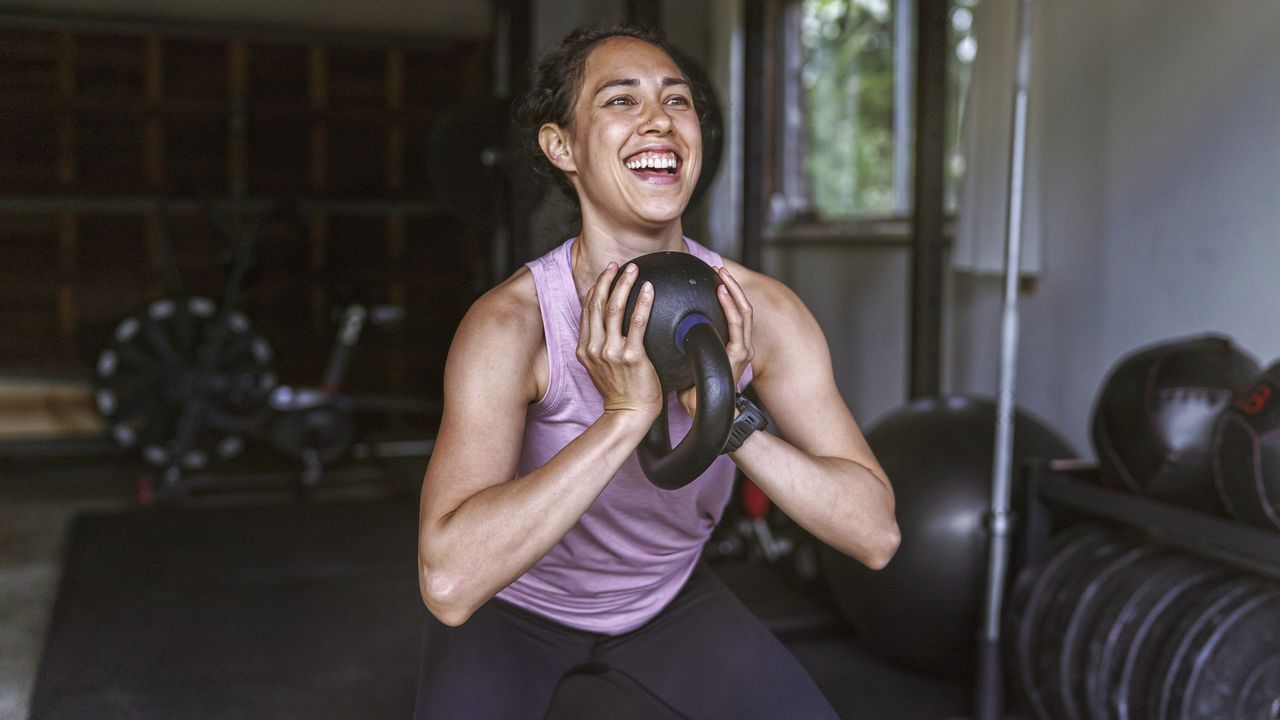
Smiling woman exercising with kettlebell.

If you’ve not got much time to train but want to build strength and endurance, pick up a kettlebell and give this 15-minute routine a try.

NASM-certified personal trainer and owner of Bodyfit by Amy, Amy Kiser Schemper, designed this workout to hit every major muscle group while building endurance and developing your ability to generate power.

She has chosen a series of compound exercises—movements that engage multiple muscles and joints—to give you the most efficient workout possible.

How to do this 15-minute kettlebell workout

Perform this workout as a circuit, doing each exercise after the other to complete one round. Schemper suggests performing three rounds in total.

Perform each exercise for 40 seconds, rest for 20 seconds, then move on to the next

You might need a selection of kettlebells so you can adjust the weight you use for each exercise. Choose a weight that will make the last few reps of each set a challenge, but don’t force you to compromise your form.

The workout in brief

  1. Kettlebell lunge hand off
  2. Kettlebell alternating row
  3. Kettlebell clean, squat and press
  4. Plank pull-through
  5. Kettlebell swing

Exercise guides

1. Kettlebell lunge hand off

Work: 40sec Rest: 20sec

“This move builds lower-body strength while challenging balance and core stability through the hand transfer,” says Schemper.

How to do it:

  • Stand upright with your feet hip-width apart, holding the kettlebell in your right hand by your right side.
  • Engage your core then step your right foot back and bend both knees to lower until your right knee is just above the floor.
  • Pass the kettlebell under your left thigh to your left hand.
  • Push through your left foot to stand upright.
  • Repeat on the other side.
  • Continue, alternating sides with each rep.

Primary muscles worked: Glutes and quads.

Secondary muscles worked: Hamstrings, core (especially obliques and transverse abdominis) and hip stabilizers.

2. Kettlebell alternating row

Work: 40sec Rest: 20sec

“This strengthens the back and improves posture while challenging core control,” says Schemper.

How to do it:

  • Stand with your feet wider than shoulder-width apart with the kettlebell on the floor underneath you.
  • Hinge forward, driving your hips back with a flat back and slight bend in the knees.
  • Engage your core and pull your shoulders back and down.
  • Reach down to grasp the kettlebell in your right hand, then lift the kettlebell to your right hip, squeezing your shoulder blades together and drawing your elbow past your torso and behind you.
  • Lower the kettlebell to the floor with control.
  • Keep your hips and shoulders level and avoid rotating with each rep.
  • Repeat on the other side.
  • Continue, alternating sides with each rep.

Primary muscles worked: Lats, rhomboids and mid traps.

Secondary muscles worked: Rear delts, biceps, core (especially anti-rotation stabilizers), hamstrings and glutes.

3. Kettlebell clean, squat and press

Work: 40sec Rest: 20sec

“This is our full-body strength driver, drawing power from the hips, strength in the legs and overhead stability,” says Schemper.

How to do it:

  • Stand with your feet hip-width apart with the kettlebell between your feet.
  • Engage your core then hinge forward and grasp the kettlebell in both hands.
  • Push your hips forward explosively to stand upright, lifting the kettlebell straight up to your chest and moving your hands to the sides of the handle in one fluid motion.
  • Push your hips back and bend your knees to kower into a squat, keeping the weight close to your chest.
  • Push through your heels to stand up and press the kettlebell overhead.
  • Lower the kettlebell to your chest with control, lower the kettlebell and adjust your grip to the top of the handle and hinge at the hips to go straight into the next rep.

Primary muscles worked: Glutes, quads and hamstrings.

Secondary muscles worked: Shoulders (deltoids), triceps, lats and upper back (during clean). Core engaged for stabilization throughout.

4. Plank pull-through

Work: 40sec Rest: 20sec

“This movement trains deep core stability and shoulder control while resisting rotation,” says Schemper.

How to do it:

  • Start in a high plank position, with both hands flat on the floor, placed shoulder-width apart, your feet wider than shoulder-width apart and your body in a straight line from head to heels. Set up the kettlebell to the right of your torso.
  • Reach under your body with your left hand and grasp the kettlebell by the handle.
  • Pull the kettlebell under your body to the left side of your torso, keeping your body as still as possible.
  • Reset and repeat on the other side.
  • Repeat on the other side.
  • Continue, alternating sides with each rep.

Primary muscles worked: Transverse abdominis and obliques.

Secondary muscles worked: Shoulders (anterior delts) and serratus anterior. Your glutes and quads should also engage to prevent hip sway.

5. Kettlebell swing

Work: 40sec Rest: 20sec

“This is my favorite full-body power move. It builds explosive power through the hips and strengthens the entire posterior chain,” says Schemper.

How to do it:

  • Stand upright with your feet shoulder-width apart and the kettlebell slightly in front of you.
  • Hinge at the hips, keeping a slight bend in your knees, and grasp the kettlebell in both hands.
  • Engage your core and pull the kettlebell back between your legs.
  • Drive through your hips to stand up, swinging the kettlebell to chest level.
  • As the weight descends, hinge at your hips and swing the kettlebell between your legs and go straight into the next rep.

Form tip: Remember this is a hinge and not a squat. The movement comes from the lower body and posterior chain, not by lifting with your arms.

Primary muscles worked: Glutes and hamstrings.

Secondary muscles worked: Lower back (erectors), core, lats (for tension) and grip muscles.

Sign up to read this article
Read news from 100’s of titles, curated specifically for you.
Already a member? Sign in here
Related Stories
Top stories on inkl right now
One subscription that gives you access to news from hundreds of sites
Already a member? Sign in here
Our Picks
Fourteen days free
Download the app
One app. One membership.
100+ trusted global sources.