Get all your news in one place.
100’s of premium titles.
One app.
Start reading
Fit & Well
Fit & Well
Health
Sam Rider

An expert coach shares the weekly split of strength training, intervals, long runs and rest days that he says should form the bedrock of anyone's running routine

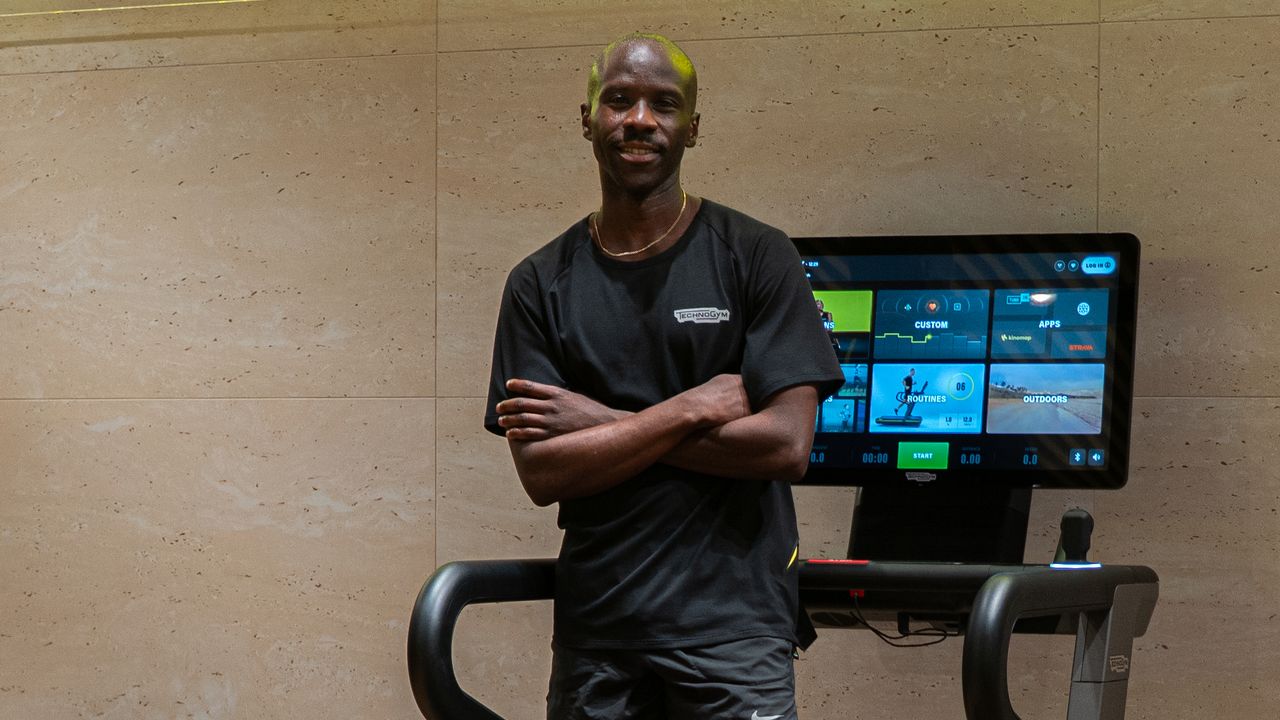
Man standing on treadmill with arms folded looking at camera.

Welcome to Workout Diaries, a series where we ask expert trainers to talk us through what a week of exercise looks like for them, helping you figure out how to develop and maintain an effective workout routine.

Emmanuel Ovola is an expert running coach, physiotherapist, the founder of London Select running community and a Technogym ambassador.

“I’m a passionate advocate of sport, exercise and activity. I think it’s so powerful—it changes people’s lives,” he tells Fit&Well.

Since a promising career in professional soccer was cut short by an ankle fracture, his interest has turned to injury prevention, rehab and helping others be as active as possible.

“I worked as a physiotherapist in the NHS for 10 years, working in acute medicine and orthopedics, before moving into the private sector,” says Ovola.

Along the way he earned a degree in sports therapy and a master’s in physiotherapy, all while moonlighting as an expert running coach.

“This led me to become a Nike running coach and a Technogym ambassador,” he says. “I want to always improve people’s access to sport and enable people to be the best version of themselves.”

At the time of our interview in mid-November, Ovola was deep in a training block, including punishing Norwegian 4x4 interval drills, aiming to shave almost a minute off his 5K PR.

“I love running 5K—it’s short and sweet and the pain is just about bearable,” he says, adding that his previous best is an astonishing 16min 40sec.

“That was a while ago. I’m actually building up to try and break 16 minutes in the next few weeks and months.’

At the same time, he’s built London Select into a community of over 700 runners, working together to “build speed and boost confidence.”

“We have a group of people who are running 15-minute 5Ks, which is super fast. We’re trying to give people the tools and understanding to develop their speed.’

Here, the running coach provides a snapshot of his typical training week, reflecting the even split of strength training, track work and long runs that he says should form the bedrock of any running routine.

Emmanuel Ovola's weekly workout routine

Monday 12pm
Rest or light recovery run.

Tuesday
8am: 30min strength workout
2pm: 60min run—Norwegian 4x4 intervals

“I coach a track session on Tuesday nights with my London Select community, but in the day I'll usually do some sort of intervals,” says Ovola.

“At the moment I'm doing the Norwegian 4x4 method—four minutes of fast intervals four times, with three minutes of rest between each. I”m trying to do that three times a week for 12 weeks, which the research shows is really effective for increasing VO2 max.

Wednesday 12pm
60min long run

Thursday 8am
60min run—Norwegian 4x4 intervals

Friday 8am
30min strength workout

Saturday 9am
60min run—Norwegian 4x4 intervals or hill repeats

Sunday 10am
1-2hr long run at a conversational pace

“On Sundays, I'll do a long run to build my aerobic base,” says Ovola. “That might be anywhere from 18 to 22km, so one to two hours. I try to keep it nice and gentle, to enjoy it, to even have a few stops if necessary. Time on feet is the focus, and to enjoy getting out there with no pressure.

“One of my favorite places to run is the Seven Sisters hills. The expanse of space, leaving London, getting out of the city, it’s a really invigorating feeling and really good for my mental health.”

Emmanuel Ovola’s tips for building a workout routine

Allow flexibility in your routine

You don’t always need to think of your training routine as a seven-day series, says Ovola, which means you should be able to adapt it around life events.

“You could extend [your plan] to 10 or 12 days, depending on what’s going on in your life,” he explains.

“The key is to be able to auto-regulate your training. Understand that some days you’re not going to be feeling the best, but doing something is always better than nothing.”

Keep your hard days hard

“I like to keep my hard days hard,” says Ovola, pointing to the example of the Norwegian intervals and strength work he performs on Tuesdays, Thursdays and Saturdays.

Structured wisely, ensuring he never pushes himself to breaking point, it means his body can work hard when required, and recover fully on lighter rest days.

“If I feel like I need to, I will always have a rest day to avoid burnout.”

Give yourself time to adapt

When undertaking a new training plan, Ovola prefers to start easy, and finish fast, just like he would a race.

“If in a 12-week training block, I tend to be a bit more conservative in the first four to six weeks,” he says.

“From weeks six to 12, that’s where I will train more fatigued—when I’m more sore—to develop overload and ensure I’m progressing,” he says.

“I find people go too aggressive initially and then have aches, pains, injuries. As a physio, I’m always trying to encourage specificity and progression.

“[The workouts] have to be specific to what you’re training towards and really progressive, rather than too aggressive, so you don’t struggle to finish [the plan].”

Sign up to read this article
Read news from 100’s of titles, curated specifically for you.
Already a member? Sign in here
Related Stories
Top stories on inkl right now
One subscription that gives you access to news from hundreds of sites
Already a member? Sign in here
Our Picks
Fourteen days free
Download the app
One app. One membership.
100+ trusted global sources.