Get all your news in one place.
100's of premium titles.
One app.
Start reading
The Economic Times
The Economic Times

An ancient warning hangs over the Trump-Xi summit bonhomie

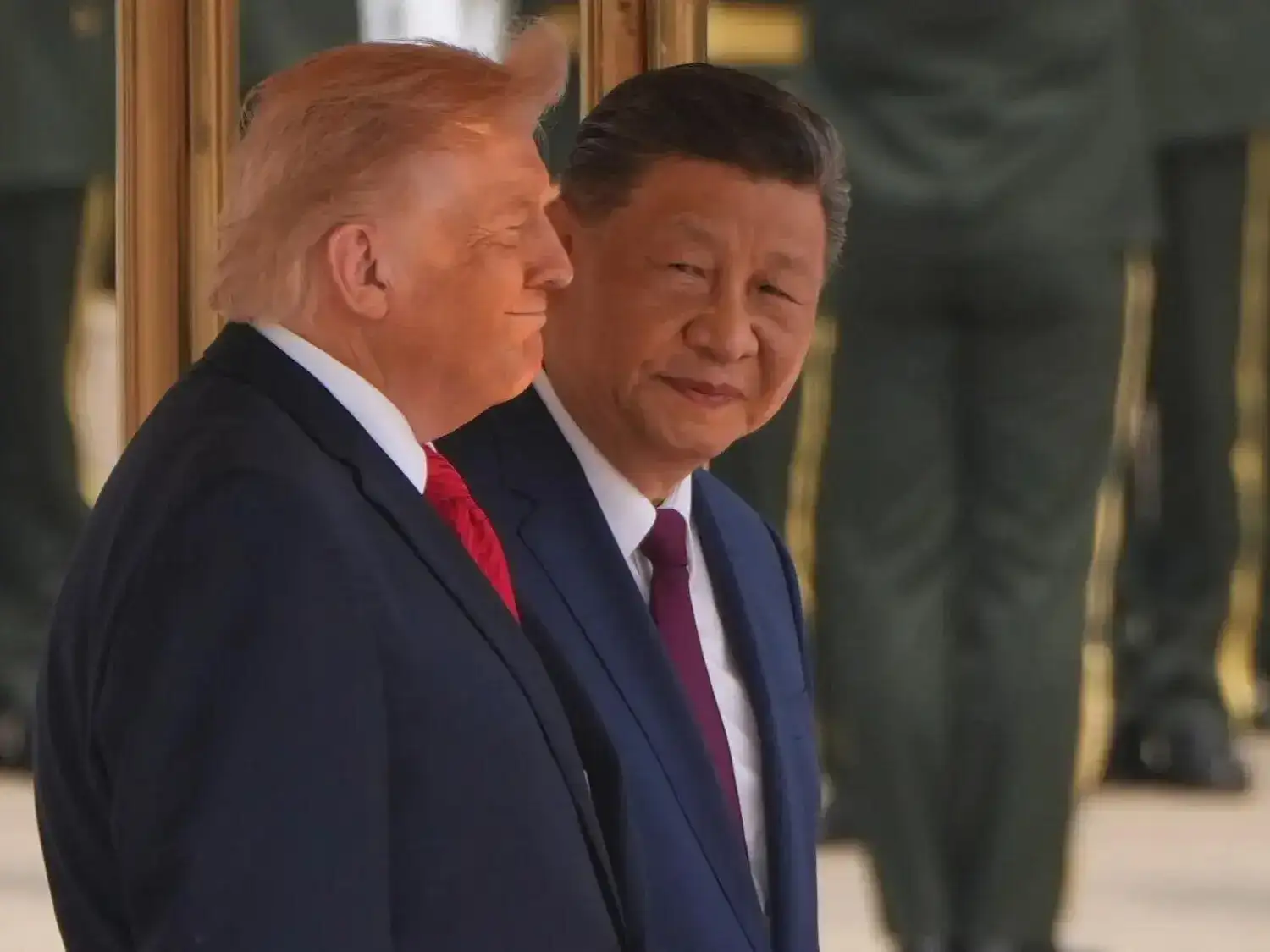
Chinese President Xi Jinping’s invocation of the “Thucydides trap” at his summit meeting with US President Donald Trump is a carefully chosen warning about the central strategic question of the 21st century -- can an established superpower and a rising challenger avoid sliding into war? As the two leaders met in Beijing for the first time in seven years, amid trade disputes, Taiwan tensions, technology rivalry and war in the Middle East, Xi said, “The whole world is watching our meeting.”

Also Read: A proper Trump-Xi summit would deal with nukes

“Can China and the United States overcome the Thucydides trap and create a new paradigm of major country relations? Can we meet global challenges together and provide more stability for the world? Can we, in the interest of the well-being of our two peoples and the future of humanity, build a brighter future together for our bilateral relations?” Xi said.

The summit itself may not transform US-China relations overnight, but it has reopened a crucial debate over whether competition between the world’s two biggest powers must inevitably end in conflict.

Xi’s warning and the return of the “Thucydides Trap”

The phrase “Thucydides trap” comes from the ancient Greek historian Thucydides, who chronicled the Peloponnesian War between Athens and Sparta in the fifth century BCE. Thucydides famously wrote that “it was the rise of Athens and the fear that this inspired in Sparta that made war inevitable.” In modern strategic thought, the phrase has come to describe the danger that arises when a rapidly rising power threatens to displace an established dominant power.

The term was popularised by Harvard political scientist Graham Allison in his influential 2017 book 'Destined for War'. Allison examined 16 historical cases over the past 500 years in which a rising power challenged a ruling one. In 12 of those cases, the rivalry ended in war. The analogy has since become central to discussions about the future of US-China relations.

Also Read: Trump wants China's help on Iran. Beijing may have other ideas

Xi has referred to the concept repeatedly over the past decade. Chinese leaders have long used the phrase to argue that conflict between the US and China is not inevitable if both sides manage the relationship prudently. But the formulation also subtly shifts responsibility onto the US by implying that the established power must accommodate the rise of the challenger rather than resist it.

At this summit, Xi revived the phrase at a moment of exceptional global instability. The international system is being reshaped simultaneously by economic fragmentation, technological competition, military tensions over Taiwan, and conflicts stretching from Ukraine to the Gulf. Xi arrived at the summit projecting confidence while Trump entered negotiations under growing domestic and geopolitical pressures.

How Graham Allison sees the danger today

Allison himself has become more pessimistic in recent years about the trajectory of US-China relations. In an interview with ET last year, he warned that the echoes of the pre-World War I rivalry between Britain and Germany are becoming louder. Recalling conversations with his late mentor Henry Kissinger, Allison said that catastrophic conflict remains “quite possible”, though not inevitable. Yet Allison’s argument is often misunderstood. He does not claim that war between the US and China is predetermined. Rather, he argues that structural stress between a rising and an established power creates intense pressures that can spiral into conflict through miscalculation, nationalism, alliance commitments or crises. The danger lies less in deliberate aggression and more in escalation dynamics neither side can fully control.

Critics of Allison’s thesis argue that historical analogies can oversimplify contemporary realities. Many scholars point out that the US and China are deeply economically intertwined in ways Athens and Sparta never were. Nuclear deterrence also fundamentally changes the calculus of great power conflict. Others argue that the concept exaggerates China’s inevitability as a replacement hegemon when the international system is now far more diffuse and multipolar.

Still, even sceptics acknowledge that the relationship increasingly exhibits classic symptoms of strategic rivalry. A major strategic study on US-China competition described the relationship as a “security dilemma” in which both powers view their own actions as defensive while interpreting the others as aggressive. The study warned that economic, technological and military competition are becoming fused into a broader systemic struggle over global order itself.

Why Taiwan remains the most dangerous flashpoint

If the Thucydides trap has a geographic centre today, it is Taiwan. At the summit, Xi reportedly warned Trump that mishandling Taiwan could trigger direct confrontation between the two countries. Taiwan is the most sensitive issue overshadowing the talks.

For China, Taiwan is not simply a territorial issue but a core question of sovereignty and national legitimacy. For the US, Taiwan sits at the heart of its Indo-Pacific alliance system and semiconductor supply chains. As military activity around the Taiwan Strait intensifies, both sides increasingly see deterrence through displays of strength as necessary. But this also increases the risks of accidents and escalation. This is precisely the type of dynamic Allison warns about. Historical great power wars often erupted not because leaders actively sought catastrophe, but because crisis management mechanisms failed under pressure.

Beyond trade: A wider strategic rivalry

Although trade dominates public messaging around the summit, the underlying rivalry now stretches far beyond tariffs. The talks are taking place amid an emerging tech war involving semiconductors, artificial intelligence and export controls. China wants relief from restrictions on advanced chips, while the US seeks greater access to Chinese markets and critical rare earth supplies. Leading American business executives, including technology chiefs, have accompanied Trump to Beijing as both countries explored limited economic stabilisation. But the deeper trend is one of managed decoupling rather than renewed integration.

Many analysts argue that the emerging US-China equilibrium is not reconciliation but a managed competition designed to prevent uncontrolled escalation while preserving strategic competition. The rivalry has also become increasingly geopolitical. Trump sought Chinese help in restraining Iran and stabilising energy routes through the Strait of Hormuz. But China’s priorities are not identical to those of the US. While Trump wants Chinese cooperation on Iran, China may instead view the regional crisis as leverage against the US. This reflects a broader reality of both powers increasingly cooperating selectively while competing structurally across multiple theatres.

Can this summit really reduce tensions?

The Beijing summit is unlikely to produce a grand bargain between the two countries. Expectations on both sides were deliberately kept modest. The primary objective is stabilisation rather than breakthrough. Still, summits matter in periods of strategic rivalry because they reduce the risks of miscalculation. Personal diplomacy between Trump and Xi may help preserve communication channels during future crises. The symbolism of the meeting itself was important. Both leaders consciously projected warmth and stability despite deep disagreements underneath.

The summit may also produce limited practical outcomes such as extending the trade truce, easing some export restrictions, restarting military communication channels and coordinating on global hotspots like Iran. These measures do not end rivalry but can help manage it. The current phase of US-China relations is not moving toward partnership in the traditional sense. It is evolving toward competitive coexistence. Both countries recognise that complete confrontation would be economically devastating and strategically dangerous, yet neither is willing to abandon core ambitions.

Escaping the trap without ending the rivalry

The deeper question raised by Xi’s remarks is whether the US and China can build a stable relationship despite structural competition. History offers mixed lessons. Some great power transitions have ended in catastrophe. Others have been managed peacefully through accommodation, deterrence, economic interdependence and institutional restraint. The challenge today is complicated by ideological distrust, nationalism and accelerating technological competition.

Yet the modern world also differs fundamentally from earlier eras. The costs of direct war between nuclear powers would be catastrophic not just for the two countries involved but for the entire global economy. That creates powerful incentives for restraint.

The Beijing summit does not resolve the underlying tensions driving the rivalry. Taiwan remains explosive. Technological competition is intensifying. Mutual suspicion runs deep. But Xi’s invocation of the “Thucydides trap” was significant precisely because it acknowledged openly what both sides understand privately, that the greatest danger is not rivalry itself but losing control of it.

Whether the US and China can avoid that trap may ultimately depend less on friendship or trust than on whether both sides can accept a long-term relationship defined by competition without allowing competition to harden into inevitable conflict.

Sign up to read this article
Read news from 100's of titles, curated specifically for you.
Already a member? Sign in here
Related Stories
Top stories on inkl right now
One subscription that gives you access to news from hundreds of sites
Already a member? Sign in here
Our Picks
Fourteen days free
Download the app
One app. One membership.
100+ trusted global sources.