Get all your news in one place.
100's of premium titles.
One app.
Start reading
Newslaundry
Newslaundry
National
Sumedha Mittal

Amid Bengal voter roll uncertainty, activists flag ‘disproportionate’ exclusions

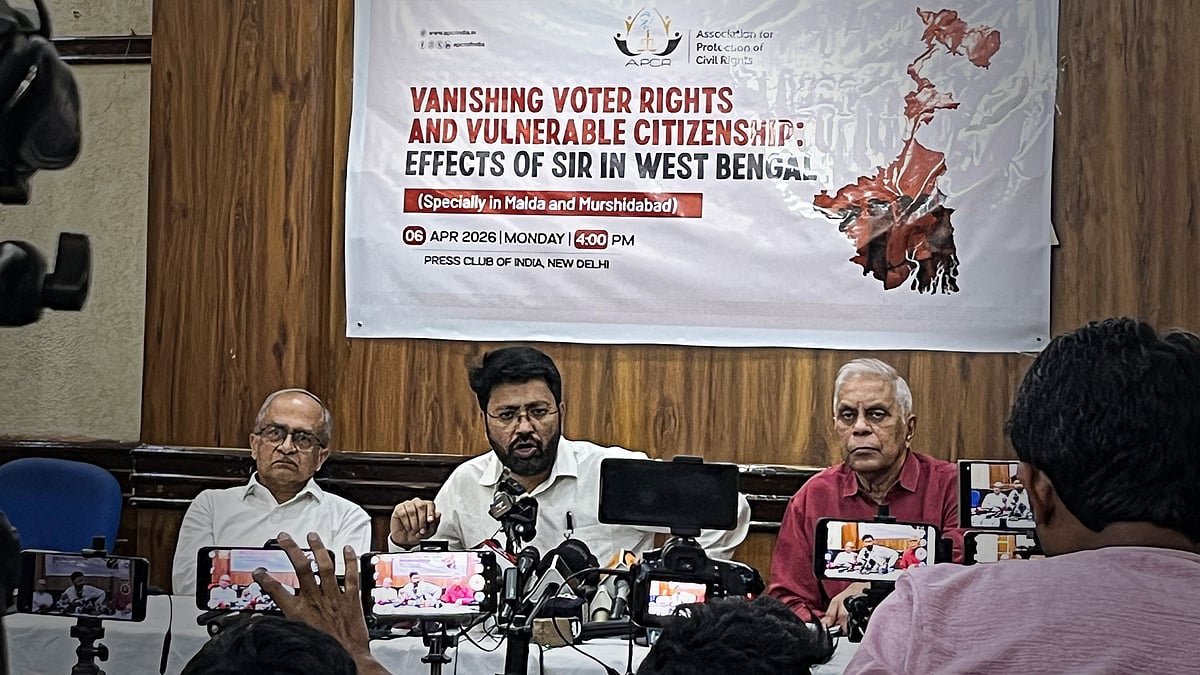
As West Bengal’s Chief Electoral Office prepared to publish the final supplementary voter list under the Special Intensive Revision, the Association for Protection of Civil Rights, a non-profit working on civil liberties, organised a workshop at the Press Club of India titled “Vanishing Voter Rights and Vulnerable Citizenship: Effects of SIR in West Bengal”.
Around 27 lakh people in West Bengal will be unable to cast their vote in the upcoming election after their names were removed from the electoral rolls following decisions by judicial officers.

At a late-night press conference on Monday, West Bengal Chief Electoral Officer Manoj Kumar Agarwal announced that the voter list for the first phase would be finalised at midnight. He said that nearly 45 percent of the 58 lakh cases disposed of by judicial officers till Monday evening would be struck off the voters’ list. This translates to approximately 27 lakh voters.

Moderated by political researcher Banojyotsna Lahiri, the session at the press club featured senior advocate Prashant Bhushan, professor Ajit Jha, human rights activist Nadeem Khan, former Congress MP Mausam Noor, TMC candidate Nazrul Islam, social activist Prasun Bhowmik, social worker Mohbul Hoque, and Sabir Ahamed, director of the Sabar Institute.

West Bengal is the only state where lakhs of voters remain under adjudication – meaning election authorities are yet to decide whether to retain or delete their names – even as polling is scheduled for April 23 and 29. Multiple petitions had been filed before courts seeking review or modification of the rolls, including demands for time‑bound disposal of pending cases and greater transparency around deletions.

Opening the discussion, Lahiri screened videos of voters whose names did not appear in the first supplementary list. Translating from Bengali, she said: “This is the voter whose father’s name was in the 2002 voter list, but still her name has been struck off the rolls. Despite the fact she has all the documents.” Referring to another clip, she added: “This is Mohammad Salvej, a BLO (booth-level officer) in Murshidabad. He and his father have not been able to make it to the rolls despite having all the documents.” In another case, she noted, six members of a family had been removed from the rolls, while the mother’s name remained.

“We have just shown you a glimpse,” Lahiri said. “This is happening to lakhs of voters.”

Mohbul Hoque pointed to the documentation burden. He pointed out that out of 12 documents the commission had demanded, most voters had only Aadhaar card. “Only 25 percent of the voters had other documents. On what basis the commission had decided to go ahead with the exercise is something only they know.”

Drawing on Sabar Institute’s own analysis, Sabir Ahamed said Muslims, women, and members of the Matua community appeared to be disproportionately affected. In Ballygunge assembly, he noted, Muslims make up about 50 percent of the population but accounted for 77 percent of those flagged in the logical discrepancy list.

The institute’s analysis of deletions in Nandigram assembly found that 95.5 percent of those removed were Muslims, despite constituting roughly 25 percent of the population.

Nadeem Khan highlighted the scale of deletions in parts of Murshidabad. He said there are nine booths in Murshidabad where 98 to 100 percent of voters have been deleted. “People have come out on roads to protest why the burden to prove their citizenship has been shifted on them. These are people from the poorest districts of the country. And since their vote has been deleted by the tribunal, their only option is to approach the high courts now. Those people who could not afford food, how can we expect them to knock on the doors of the court?”

Echoing these concerns, Mausam Noor said: “Voters across Bengal are anxious. They are scared that they might end up losing their citizenship.”

In his concluding remarks, Ajit Jha said: “In a democracy, voters chose their government. But the SIR government is selecting their voters.”

Elections are not just about who wins, but about the questions that often go unasked – and this time, they matter more than ever. Support our new NL Sena on the five upcoming assembly polls to help us follow the missing voters, the shifting politics, and the stories that could shape India’s future.

Newslaundry is a reader-supported, ad-free, independent news outlet based out of New Delhi. Support their journalism, here.

Sign up to read this article
Read news from 100's of titles, curated specifically for you.
Already a member? Sign in here
Related Stories
Top stories on inkl right now
One subscription that gives you access to news from hundreds of sites
Already a member? Sign in here
Our Picks
Fourteen days free
Download the app
One app. One membership.
100+ trusted global sources.