
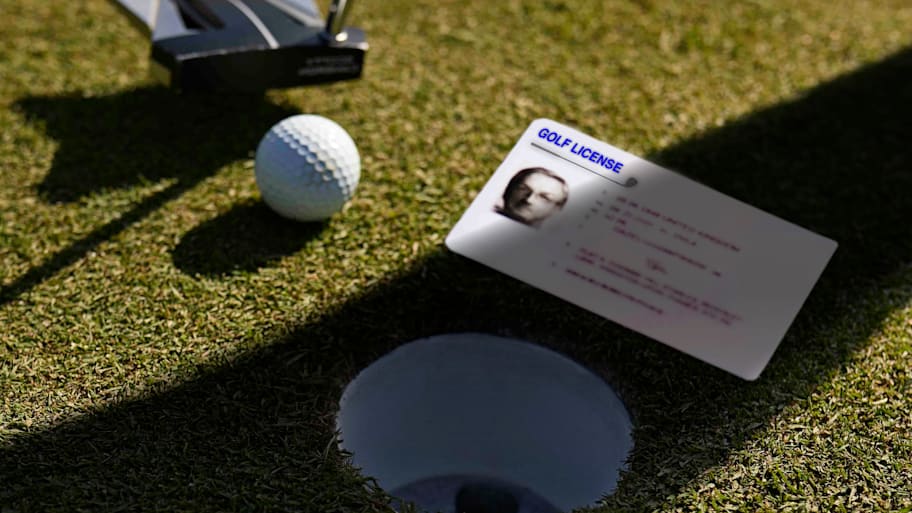
Welcome to SI Golf’s Bad Takes Week, where we suggest wild ideas to improve the game. Check out our other takes here and let us know if you agree or disagree on our X account.
To play most golf courses in Germany, you need a Platzreife—a literal license that is earned, and it’s not easy.

A rigorous five-day course is administered for it, with hours of training on rules and etiquette. An on-course test is also taken, where applicants must show they can play a bit and have the ability to keep pace.
If you pass the written tests and show an ability to shoot 108 or better for 18 holes, and pay about $300, congratulations! You will be licensed to play golf in Germany.
Wouldn’t it be nice if a similar program existed in the U.S.?
I’d like to think this entry for SI Golf’s 2025 Bad Takes Week isn’t that bad, perhaps you’ll agree if you have suffered through five-hour rounds, putted on pitch-mark-pitted greens and watched players tee off from boxes that in no way match their skill level.
American golf is healthy and booming with millions of old, new and rediscovered-the-game players who are certifiably crazy about it. Now let’s get everyone certified with the American Golf License—or "AGL" for short, because golf loves acronyms.
This nationwide licensing program could be administered by state golf associations, with some help from the USGA and professional tours, at a reasonable price and in just a couple hours.
You took a test for your driver’s license, right? With perhaps just a little bit of prep? Same concept with the AGL.
I am not proposing this with the air of a golf snob because unlike the Platzreife, the AGL will not require a playing test. That sounds like a logistical nightmare but more importantly, no one cares what you shoot as long as you do it quickly, right? We all know people who shoot 78 at a snail’s pace and others who shoot 110 like they’ve got a dinner reservation a half-hour after the round. And let’s not terrorize anyone in the throes of chipping yips or swing changes or the like with a playing test; I imagine that has ruined some Platzreife candidates over the years.
But to obtain the AGL you need to recognize pace-of-play principles, plus have a basic understanding of the rules and be up on etiquette and sportsmanship. And all that can be accomplished with an online test.
The USGA regularly administers rules quizzes so parts of those can be adapted for the AGL test. For etiquette and pace-of-play questions, pro golfers could pitch in for video segments to illustrate concepts (oh wait, maybe the pros shouldn’t help with pace of play). This would add buzz and make the test far less of a drag than the one you take for your driver’s license.
The cost will be $30, similar to a round of golf at many municipal courses, which should cover the infrastructure (the AGL tests will be taken on an app) for the state golf associations—with enough left over to help fund youth golf programs once scaled.
What’s the incentive to be licensed? Your AGL ID number will give you preferential treatment to reserve tee times at public courses. Tee-time-booking bots have been a problem from California to Bethpage, so this could be another level of security. Private clubs may also require members to have the license. Perhaps retailers could even give small discounts to licenseholders, as if an AGL card was an AAA card.
What will the license not be? A nonnegotiable requirement to play golf. This Bad Take is realistic—Germany has about 1,100 courses while the U.S. has roughly 16,000. The National Golf Foundation reports that 28.1 million people played on a golf course last year. It’s not feasible to think that every golfer could be licensed.
But if many were, having taken a refresher on golf’s rules and etiquette, it would make our wonderful game even better.
More Golf from Sports Illustrated
This article was originally published on www.si.com as American Golfers Should Be Licensed.