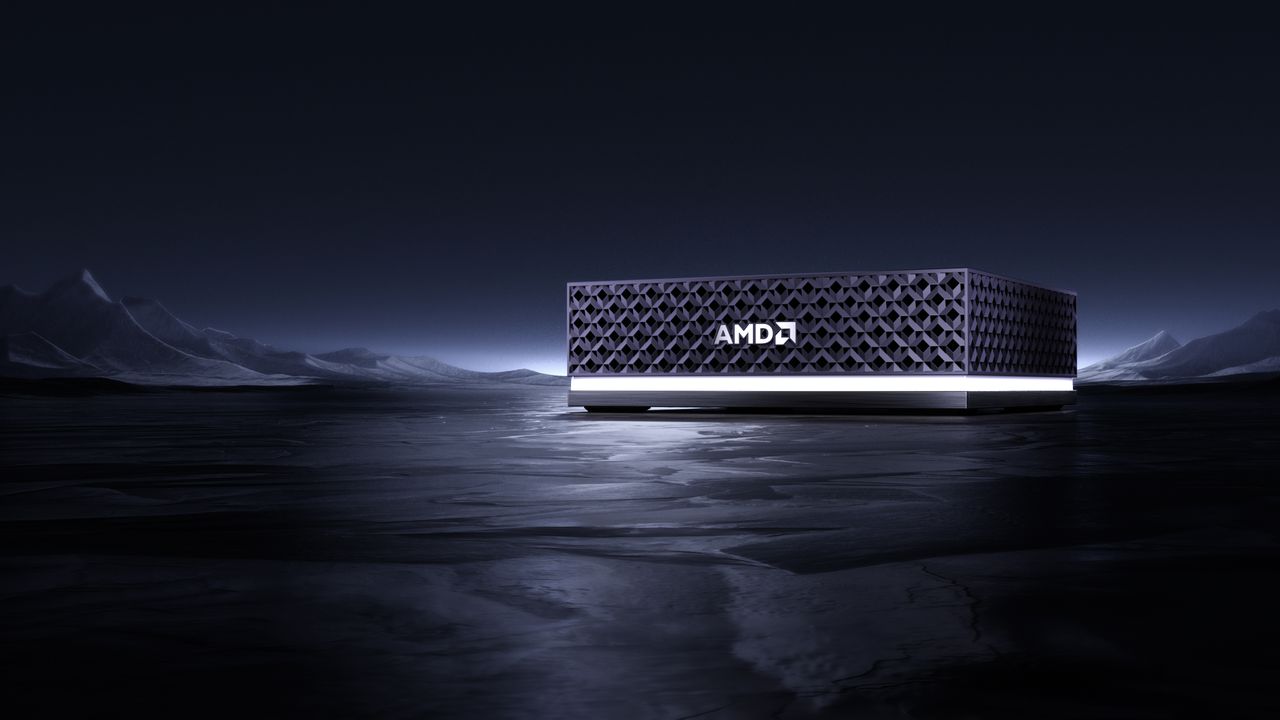
- The AMD Ryzen AI Halo is powered by AMD's 16-Core 'Zen 5'-based Ryzen AI Max+ 395
- It also offers 128GB of unified memory, matching that of the Nvidia DGX Spark
- With an advertised MSRP of $3999, it aims to challenge both Nvidia's offerings and solutions that currently rely on a higher-end Apple Mac Mini for localized AI
AMD is finally set to release its Ryzen AI Halo, a compact AI development full-stack offering that aims to compete directly with Nvidia's DGX platform and Apple's Mac Mini.

The Platform offers a memory configuration similar to the former and allows developers to install Windows or Linux as their operating system of choice.
But AMD's entry comes almost two years after the entries of it's rivals, prompting the question: is it too little too late?
A relatively late entry?
The AMD Ryzen AI Halo Developer Platform was announced by CEO Dr. Lisa Su over 4 months ago, during her CES keynote. It finally received a tentative release date, with preorders (exclusive to Microcenter in the US) beginning this June.
AMD's answer to Nvidia's dominance of the current AI developer market, however, will arrive nearly 5 months after its announcement, even as other similarly configured enterprise-class options already exist to fill the void.
All eyes on the DGX Spark
AMD has not directly competed with Nvidia's DGX Spark since its release in mid-October 2025, even as it has leveraged 3rd-party industrial partners such as HP (Z2 Mini G1a) and Minisforum (MS-S1 Max) to fill the void.
Despite its late launch, the Ryzen AI Halo aims to level the playing field for Team Red against Nvidia's deep-rooted and formidable offering.
While AMD's own slides show a slight lead when it comes to certain AI models, with leads ranging from 4% to 14% in terms of token generation, while touting support for Windows, a lower power cost per token generated for leading LLMs, and an NPU under the hood, things are considerably closer than one might like, all things considered.
Hardware rundown: Ryzen AI Halo vs DGX Spark
AMD's onboard AMD Ryzen AI Max+ 395 has a TDP of 120W vs the Nvidia GB10 onboard the Spark (140W), even as both units come with a 240W PSU to cover the overhead of their motherboards, SSDs, and cooling.
Both have the same amount of RAM available to users (128GB), and while AMD's offering comes with Wi-Fi 7 and Bluetooth 5.4 (like the DGX Spark), it only offers a 10GbE ethernet port versus Nvidia's ConnectX NIC that offers up to 200Gbps speeds, making it ideal for users to hook up 2 DGX Sparks together to work with twice the parameters locally versus AMD's offering.
The DGX Spark also holds its own against AMD's offering in terms of raw compute, delivering up to 1 petaFLOP of FP4 compute, compared to AMD's advertised 60 TFLOPs of FP16. It also offers a 4TB configuration for an on-site price of $4700, doubling the storage that AMD currently offers.
Physically, the Ryzen AI Halo is slightly smaller than the DGX Spark, even as both units externalize their power supply requirements to maintain their respective form factors.
A bit too late?
One could argue that the AMD Ryzen AI Max+ 395 that the Ryzen AI Halo currently offers is a bit underwhelming for a release this late in the game.
HP has already been delivering the Z2 Mini G1a to most of its enterprise-class customers, offering a similar configuration: 128GB of unified memory, the same APU, and 2TB of storage, albeit in a much larger form factor than what AMD is currently offering.
Despite this, AMD's offering aims to broaden the options available to users who were previously looking for a smaller form factor, access to a validated tech stack, or simply the ability to purchase a solution with broader support than similar offerings off the shelf.
One thing is clear, however, for users wanting to run CUDA applications or larger models ( > 200B parameters): Nvidia's DGX Spark and its superior networking still pack a formidable punch that AMD has yet to provide an alternate for, at least in this form factor.