Update 4/25/2022, 10:41 am PT: AMD has responded to the numerous reports of chip failures with a short statement acknowledging that claims do exist and that the company is investigating. The statement confirms that AMD is working with its ODM partners (motherboard makers) to ensure safe voltage settings are applied to its Ryzen 7000X3D CPUs, but doesn't name the specific actions that it is taking:
"We are aware of a limited number of reports online claiming that excess voltage while overclocking may have damaged the motherboard socket and pin pads. We are actively investigating the situation and are working with our ODM partners to ensure voltages applied to Ryzen 7000X3D CPUs via motherboard BIOS settings are within product specifications. Anyone whose CPU may have been impacted by this issue should contact AMD customer support." -- AMD Spokesperson to Tom's Hardware.
Notably, the statement does not acknowledge the multiple reports of failures with standard Ryzen 7000 processors. ASUS has also issued a statement, clarifying that it will issue firmwares that limit SoC voltage to 1.3V. We're following up for more detail with AMD and will update as needed. Our original coverage with deeper details about the issues follows:
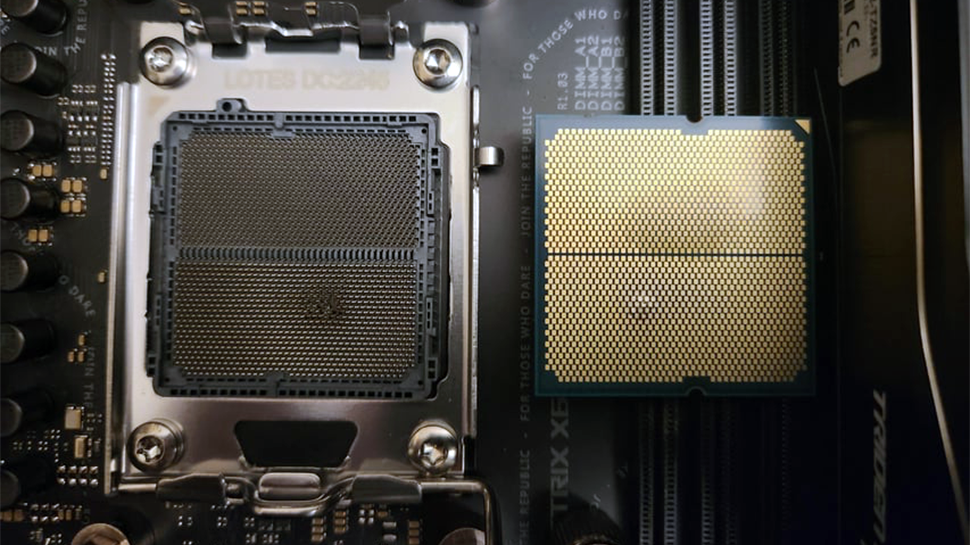
Original Article 4/24/2022, 9:49 pm PT: Multiple reports of Ryzen processors burning out have burst onto the internet over the last few days. The damaged chips have not only bulged out and overheated to the point they have become desoldered, but they have also done significant damage to the motherboards they are installed in. We reached out to our industry contacts and learned some new information about the nature of the problem and the scope of AMD's planned fix. Our information comes from multiple sources that wish to remain anonymous, but the info from our sources aligns on all key technical details. As with all unofficial information, we should take the finer details with a grain of salt until AMD issues an official statement.
First, we're told this condition can occur with both standard Ryzen 7000 models and the new Ryzen 7000X3D chips, though the latter is far more sensitive to the condition, and the root cause could be different between the two types of chips. AMD will issue a fix soon, but the timeline is unknown. We're told that failures have occurred with all motherboard brands, including Biostar, ASUS, MSI, Gigabyte, and ASRock.
According to our sources and seconded by an ASUS statement to Der8auer, the problem stems from SoC voltages being altered to unsafe higher levels. This can be imposed from either the pre-programmed voltages used to support EXPO memory overclocking profiles or when a user manually adjusts the SoC voltages (a common practice to eke out a bit more memory overclocking headroom).
Our sources also added further details about the nature of the chip failures — in some cases, excessive SoC voltages destroy the chips' thermal sensors and thermal protection mechanisms, completely disabling its only means of detecting and protecting itself from overheating. As a result, the chip continues to operate without knowing its temperature or tripping the thermal protections.
AMD's modern chips often run at their thermal limits to squeeze out every last drop of performance within their safe thermal range — it isn't uncommon for them to run at 95C during normal operation — so they will automatically continue to draw more power until it dials back to remain within a safe temperature. In this case, the lack of temperature sensors and protection mechanisms allows the chip to receive more power beyond the recommended safe limits. This excessive power draw leads to overheating that eventually causes physical damage to the chip, like the bowing we've seen on the outside of several chip packages, or the desoldering reported by Der8auer.
The chip continues to receive excessive current through the motherboard socket during this death spiral of sorts, thus leading to the visible damage we can see in the socket to the vCore pins and the bulging on the chip's LGA pads. However, less visible damage also extends to the CPU SoC, CPU_VDDCR_SOC, and CPU VDD MISC rails/pins — they just don't pull enough current to leave visible scorching like we see with the vCore pins.