Get all your news in one place.
100's of premium titles.
One app.
Start reading
The Times of India
The Times of India
World

Amazon's boiling river: The near-100°C wonder that can cook animals alive

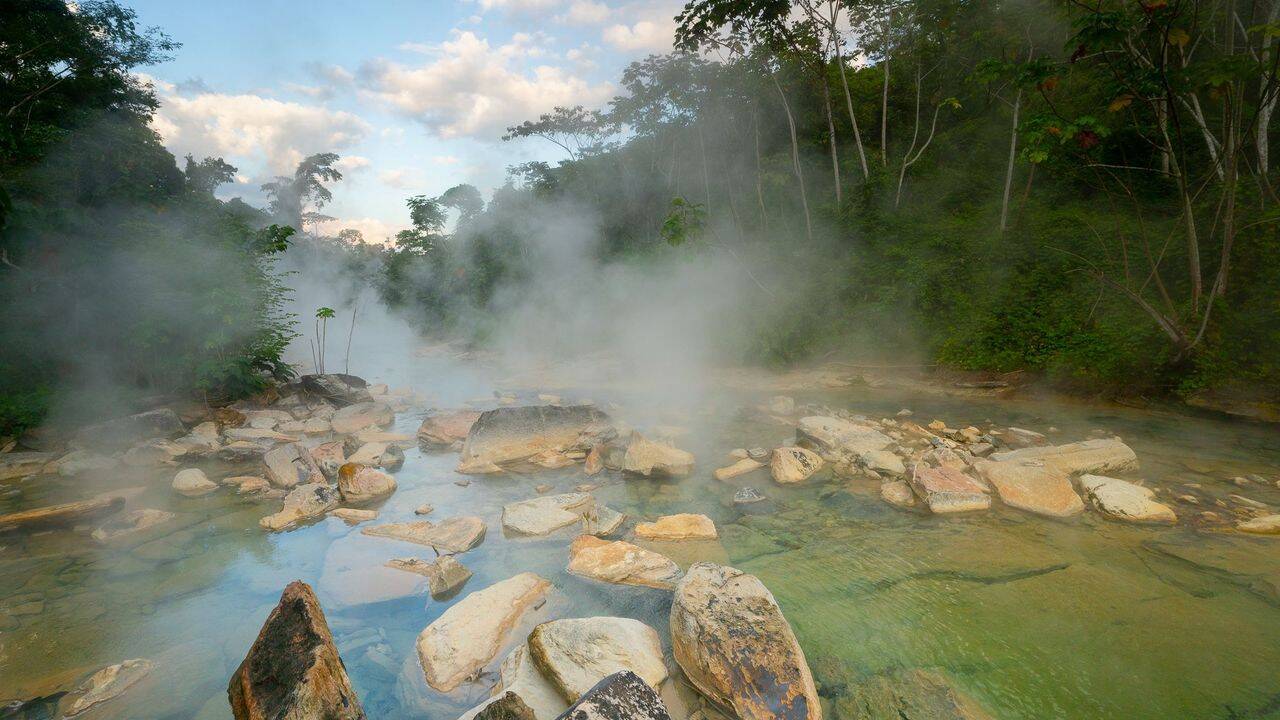
A boiling river in the heart of the Amazon sounds like something out of a legend. Yet deep inside Peru's rainforest, the Shanay-Timpishka, or “boiling river”, is very real. Fed by geothermal heat rather than volcanic lava, parts of the river regularly reach temperatures of around 86°C, with some spots measured at over 90°C – hot enough to cause severe burns and kill small animals that fall into the water. It is one of the world's most unusual geothermal systems because it lies hundreds of kilometres from the nearest active volcano.

Get breaking news anytime, anywhere. Download the TOI app now!

The river many believed was only a myth

For generations, Indigenous Asháninka communities spoke of a sacred river whose waters were so hot they could boil living things. The river, known locally as Shanay-Timpishka, roughly translates to “boiled by the heat of the Sun”; a name rooted in tradition rather than scientific explanation. Outside the region, however, many geologists dismissed such stories as folklore, believing a river could not naturally reach near-boiling temperatures unless it was close to an active volcano.

That changed in 2011 when Peruvian geoscientist Andrés Ruzo, inspired by stories he had heard from his grandfather as a child, travelled into the Amazon to investigate. What he found exceeded expectations: a steaming river stretching for about 9 kilometres, with sections reaching temperatures high enough to scald skin within seconds. Ruzo has since dedicated much of his career to studying and protecting the site through the Boiling River Project and later documented his findings in the book The Boiling River .

“It was impossible, according to everything I'd been taught,” Ruzo recalled in his TED Talk, explaining how the discovery challenged conventional geological thinking.

Why is the river so hot?

Unlike the geothermal rivers of Iceland or Yellowstone National Park, the Shanay-Timpishka is not heated by nearby volcanic magma. The closest active volcanic system is more than 650-700 kilometres away, making its existence particularly unusual.

Researchers believe the river is heated through a combination of deep geological faults and groundwater circulation. Rainwater seeps far beneath Earth's surface, where it is warmed by the planet's natural geothermal heat. Pressurised underground, the hot water then rises through fractures in the crust before mixing into the river, creating long stretches of near-boiling water. According to Ruzo, the water gradually cools as it continues downstream and eventually joins the Pachitea River.

Although the exact underground pathways are still being studied, geologists broadly agree that the river is an exceptional example of a non-volcanic geothermal system, something rarely seen at this scale anywhere in the world.

Hot enough to cook, but not everywhere

The river's reputation has given rise to dramatic stories, many of them grounded in reality. Water temperatures generally range between 45°C and 90°C, while the hottest pools recorded by researchers have approached 100°C under specific conditions. Anyone entering the hottest sections could suffer severe burns within seconds.

Ruzo has described witnessing birds, frogs and small mammals accidentally falling into the river. In his account, “the first thing to go are the eyes. Eyes, apparently, cook very quickly. Flesh follows soon after.” The description has since become one of the most widely cited reminders of just how dangerous the river can be.

Scientists point out, however, that the entire river is not at a constant boiling temperature. Some stretches are warm enough to touch briefly, while others are dangerously hot. Local communities have long understood these variations and traditionally use cooler sections for bathing, cooking and healing rituals while avoiding the hottest pools.

A sacred place and a scientific treasure

For the Indigenous communities living near Mayantuyacu, the boiling river is far more than a geological curiosity. It is regarded as a sacred landscape intertwined with spiritual traditions and traditional medicine. Ruzo has repeatedly emphasised that his research has been carried out in partnership with local communities, who have protected the site for generations.

The river has also become an important natural laboratory. Scientists are studying its unique microorganisms, known as extremophiles, which thrive in temperatures that would kill most life. Researchers hope these microbes could offer new insights into evolution, biotechnology and even the possibility of life in extreme environments elsewhere in the solar system.

“After you study the waters, pour them onto the ground, wherever you are in the world, so the waters can find their way back home,” Asháninka healer Maestro Juan Flores told Ruzo before allowing him to take water samples for research; a reminder that for many, the river is as much a cultural heritage site as it is a scientific wonder.

Sign up to read this article
Read news from 100's of titles, curated specifically for you.
Already a member? Sign in here
Related Stories
Top stories on inkl right now
One subscription that gives you access to news from hundreds of sites
Already a member? Sign in here
Our Picks
Fourteen days free
Download the app
One app. One membership.
100+ trusted global sources.