
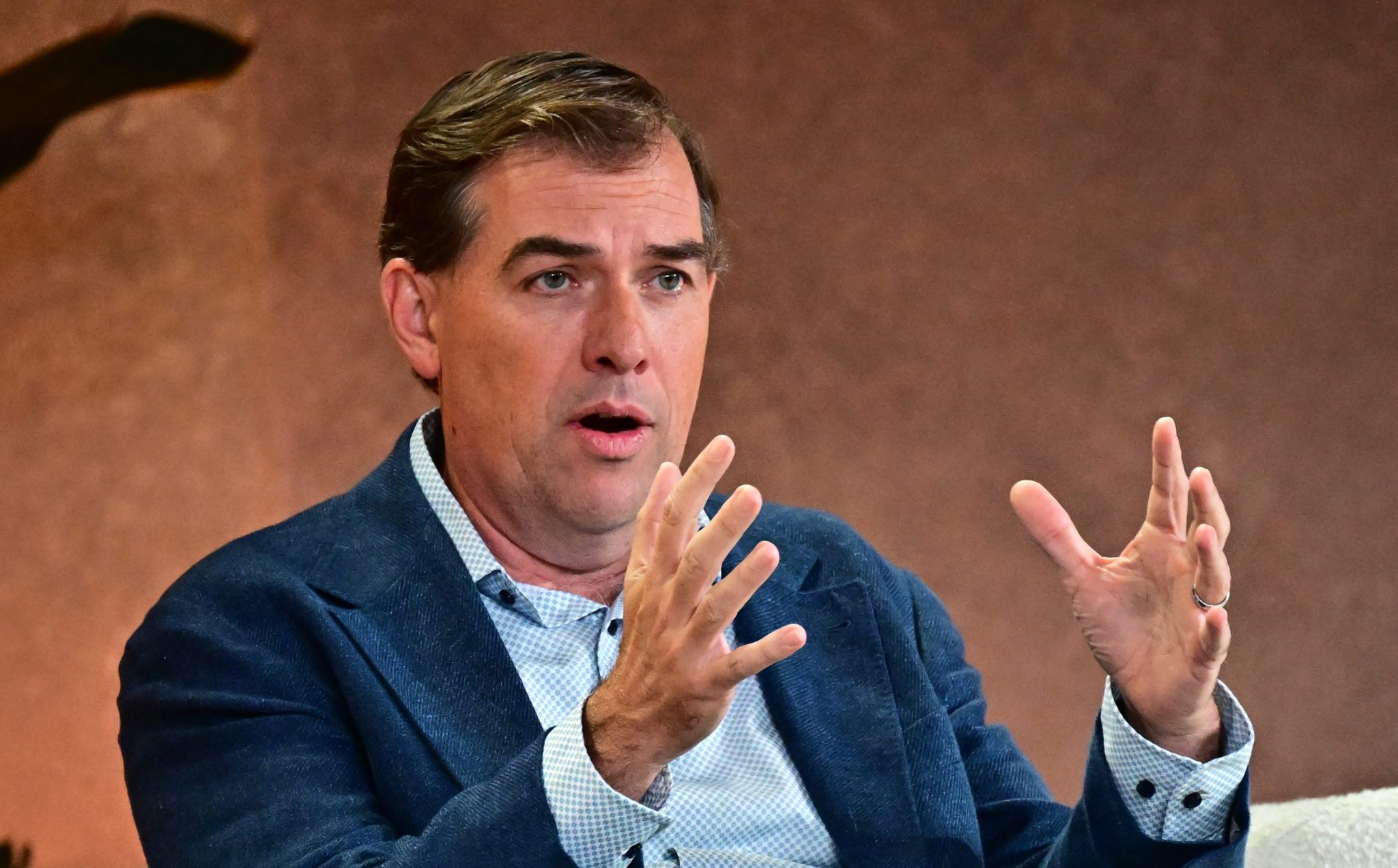
As Silicon Valley debates whether AI will replace millions of office workers, one of the executives building the technology’s underlying infrastructure says Gen Z shouldn’t buy into the apocalyptic job displacement predictions. Matt Garman, CEO of Amazon Web Services, argued that forecasts of mass white-collar job losses—including warnings from Anthropic CEO Dario Amodei that AI could eliminate up to half of entry-level office jobs—don’t hold up under scrutiny.
“If you believe that half of jobs get wiped out, the whole economy collapses on itself,” Garman said on an episode of the Platformer podcast released Tuesday. “Everything goes away. You’re not going to have AI, and then you have to go back to those other jobs at some point. The math doesn’t work out.”

Instead, Garman said AI will reshape work rather than eliminate it outright. While some jobs may not exist in the future, new jobs will emerge, he argued, because economies simply depend on workers earning money and spending it.
He likened the current AI boom to the arrival of Microsoft Excel, which largely replaced workers who spent their days performing calculations by hand. Those jobs changed, but workers adapted by learning new tools.
“I do think that half of white-collar jobs may change, but wipe out and change are different,” Garman added.
Amazon, he noted, is continuing to invest in young talent. The company plans to hire 11,000 interns and recent graduates this year, and Amazon employs more software developers today than it did two years ago—even as AI coding tools have become dramatically more capable.
The transition hasn’t been painless for the No. 1 company on the Fortune 500, however. Amazon CEO Andy Jassy has said AI-driven efficiency gains will eventually shrink parts of the company’s corporate workforce, and last year, 14,000 corporate jobs were cut. At the end of 2025, Amazon employed roughly 1.58 million full- and part-time workers worldwide, including about 350,000 corporate employees.
What the AWS CEO looks for in hiring talent in 2026
Garman has a personal stake in the debate over entry-level hiring. He joined Amazon in 2005 as an MBA intern while studying at Northwestern University’s Kellogg School of Management and spent nearly two decades climbing the ranks of the company’s cloud business before becoming CEO of AWS in 2024.
The experience may help explain why he remains bullish on young workers, as many companies use AI to automate routine tasks often assigned to new graduates.
“[When] you talk about entry-level jobs, number one, they’re your cheapest employees,” Garman said. “They haven’t learned bad habits, you can teach them the culture, they’re willing to learn the new tools, they’re some of the very best employees you can possibly have.”
Beyond cost, he said, younger workers bring something many established organizations struggle to maintain: fresh perspectives.
“They come in with an energy and excitement, a new view on things,” Garman said. “If you just have the exact same people that you’ve had for the last 15 years, you don’t get that energy and excitement and new ideas.”
But what it takes to become an Amazon intern has shifted in recent years.
Rather than focusing solely on a candidate’s existing technical skills, Garman said the Seattle-based company increasingly values adaptability, curiosity, and the ability to learn quickly as AI transforms how work gets done.
“One of the things we start to look for in employees is not the skill set you have, but do you have the ability to learn?” Garman said. “Do you have the willingness to dive in and learn new things and the agility to reason about problems?”
Workers who embrace that mindset, he said, will thrive—as will the companies that choose to embrace that younger talent.
“When you have employees that have that mentality—that I want to learn, I want to lean in and do new things—there’s a crazy amount of opportunity in front of us,” Garman said. “To run really fast, build new businesses, deliver value to our customers, [and] reduce costs.”
In a statement to Fortune, Amazon said it “remains committed to our internship program as an important pathway to finding the next generation of leaders and builders.”
Like Amazon, leaders at IBM and Cognizant are bullish on entry-level talent in the AI era
As entry-level jobs continue to reshape, Garman isn’t the only executive who’s vocally backing up Gen Z talent.
Ravi Kumar S., the CEO of IT firm Cognizant, recently told Fortune that in 2025 alone his company hired 20,000 entry-level college graduates—and expects that number to grow in 2026.
“There was a little bit of fearmongering from reading about the fact that there’s going to be a collapse of jobs,” Kumar said at Fortune’s COO Summit earlier this month. “I think there will be more jobs.”
IBM has similarly said it plans to triple its entry-level hiring after concluding that relying too heavily on AI-driven efficiencies isn’t a sustainable long-term talent strategy.
“The companies three to five years from now that are going to be the most successful are those companies that doubled down on entry-level hiring in this environment,” Nickle LaMoreaux, IBM’s chief human resources officer, said earlier this year.
“If we don’t continue to invest in entry-level hires, what happens in 3–5 years?” LaMoreaux added. “There’s no pipeline; the well simply dries up.”
Even Anthropic’s Dario Amodei and OpenAI’s Sam Altman—who have previously made bold predictions about young talent being at risk of mass displacement—have since tried to walk back their claims.
“I’m delighted to be wrong about this,” Altman said earlier this year. “I thought there would have been more impact on entry-level white-collar jobs being eliminated by now than has actually happened.”