Get all your news in one place.
100's of premium titles.
One app.
Start reading
LiveScience
LiveScience
Kristina Killgrove

'Extremely rare' English coins meant to ward off Vikings found in Denmark — because the Vikings wore them as jewelry

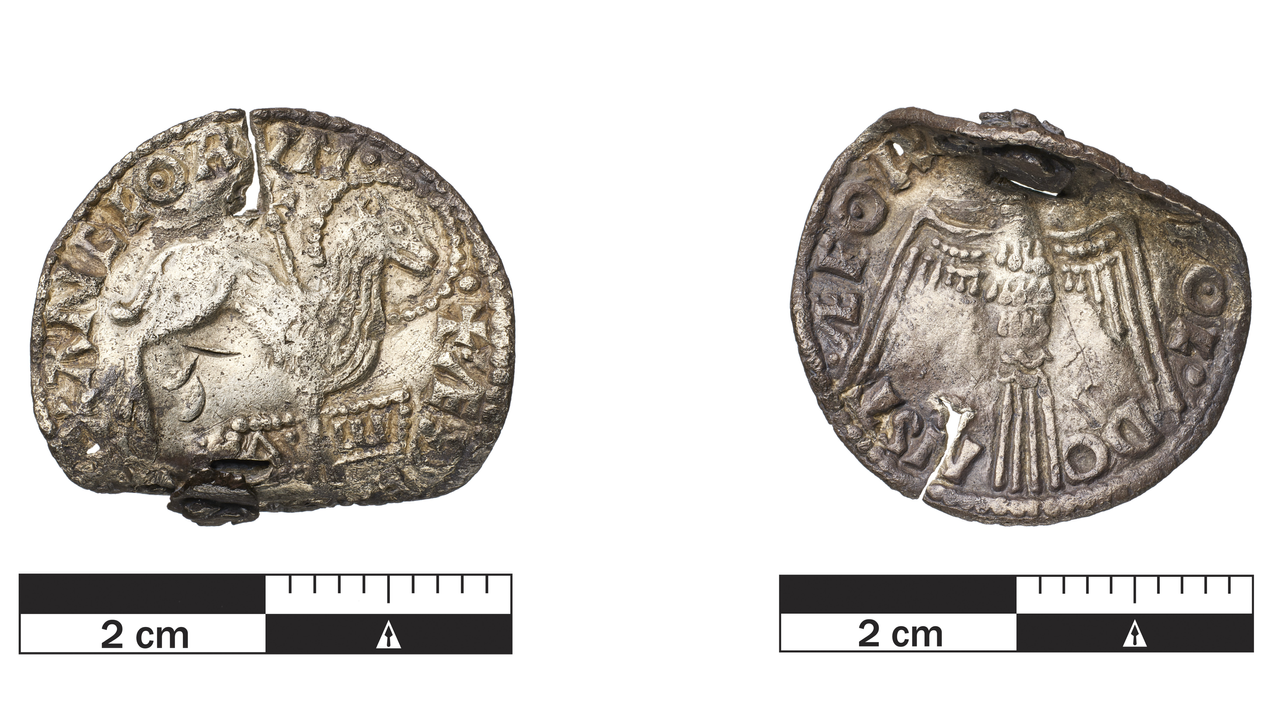
Composite image of two sides of a medieval silver coin featuring a "lamb of God" and a dove.

Two rare silver coins discovered by metal detectorists in Denmark reveal that the Vikings made jewelry out of Christian coins that were originally designed to prevent Viking raids, according to experts at the National Museum of Denmark.

The coins were minted around 1009, during the reign of English king Æthelred II, nicknamed "Æthelred the Unready," and featured religious motifs that he hoped would protect his people from the Viking scourge. But he didn't count on the Vikings' appreciation of the coins' aesthetics.

"It gave me goose bumps, because these coins are extremely rare," Gitte Ingvardson, a curator at the National Museum of Denmark, said in a statement. "They were made to obtain protection against the Vikings, but ended up instead as jewelry or amulets worn by Vikings. That is almost tragicomical."

Gitte Ingvardson looks at the two coins using a magnifying glass. (Image credit: John Fhær Engedal Nissen/National Museum of Denmark)

Experts have dubbed this style of anti-Viking coin "Agnus Dei," or "Lamb of God," because the front of the coin features a lamb pierced by a cross, which is a symbol of Christ's sacrifice. Alpha and omega — the first and last letters of the Greek alphabet — also appear on the coin's front side, symbolizing that God is the beginning and end. On the back of the coin, a dove symbolizing the Holy Spirit takes flight.

Contemporary English coins also feature a cross on the back but lack the imagery of the lamb, and the fronts of those coins typically include a profile of the king.

Only 30 such "Lamb of God" coins have been found to date, and most were discovered in Scandinavia; they were likely plundered by Vikings who were not actually warded off by the religious symbols. Most of the Scandinavian examples feature metal loops that had been soldered on, presumably so the Vikings could wear the coins on necklaces or as amulets.

"The Vikings soon realized that it was far more practical to use coins than to hack the silver into pieces for trading purposes," Ingvardson said. The rare coins are important artifacts linking English kings, Danish kings, Christianity and the Vikings.

The Viking Age ended in 1066, and people in what is now Denmark began converting to Christianity around then as Norse paganism declined. For example, archaeologists previously found more than 70 burials dating to the 1100s in a medieval Danish cemetery, and it's likely that these Norse people were Christians, although some may have retained some Norse pagan beliefs.

See how much you know about ancient Norsemen with our Viking quiz!

Sign up to read this article
Read news from 100's of titles, curated specifically for you.
Already a member? Sign in here
Related Stories
Top stories on inkl right now
One subscription that gives you access to news from hundreds of sites
Already a member? Sign in here
Our Picks
Fourteen days free
Download the app
One app. One membership.
100+ trusted global sources.