Get all your news in one place.
100’s of premium titles.
One app.
Start reading
Motorsport
Motorsport
Sport

All the key moments from the 23XI/FRM vs. NASCAR trial

The 23XI Racing and Front Row Motorsports v NASCAR antitrust trial is raging on as the two sides do battle inside a North Carolina courtroom with the future of the sport likely to be reshaped by the outcome.

Here, you can find a recap of some of the most important and interesting moments from each day of the trial, with links back to more in-depth stories from our Senior NASCAR Editor Matt Weaver, who is inside the room as the trial unfolds.
Day 9 - Settlement reached, trial over

In a stunning development, NASCAR reached an agreement with 23XI and FRM to end the trial and settle their differences. The jury has been dismissed, joint statements have been released, and permanent or evergreen charters will now be utilized going forward.

However, the financial terms of the settlement will not be announced. The France family will continue to run the sport, and the charters taken from 23XI and FRM will be returned to them as part of this deal.

You can read the full joint statement from all parties involved below:

Day 8 - 23XI/FRM rest their case as NASCAR begins defense

NASCAR Chief Financial Officer Greg Motto was on the stand, spending most of his time discussing the $400 million in distribution to the France family trust. Jeffrey Kessler, representing the teams, said NASCAR could have afford $720 million a year in charter payments instead of the $431 million distributed in 2025, but Motto believes that would have bankrupted the sport.

Kessler countered that the $544 million NASCAR made by selling the land Auto Club Speedway sat on could have gone to paying the teams instead of paying down debt from the International Speedway Corporation merger in 2019. He went on to say NASCAR and the France family trust is just moving money from one palm of the family hand to another.

But after 23XI/FRM finished calling all of their witnesses and resting their case, the ball was now in NASCAR's hands as they began their trial defense. The first witness called by the Sanctioning Body was John Probst, senior vice president of innovation and racing development for NASCAR. He focused on the development of the Next Gen car and the argument that teams having a ‘reckless’ spending problem.

NASCAR also wanted to use Probst to illustrate what happened with the American Open Wheel Split, as a reason to not have a competing series, but those questions were objected to by Judge Bell and sustained.

On cross-examination from Kessler, he pointed out that there is no way that NASCAR would allow teams to use the Next Gen in a non-NASCAR series, but Probst said back that "we would discuss it."

NASCAR CEO Jim France also finished up his testimony, and was asked about permanent charters.

“I don’t know how you can set anything in this changing world we’re in as permanent,” France said. “I’m just not comfortable making agreements that go on forever.”

Day 7 - France and Phelps evasive, Richard Childress animated in eventful day of testimony 

Tuesday was a big day in court as NASCAR CEO Jim France, NASCAR Commissioner Steve Phelps, and longtime team owner Richard Childress took the stand.

Both Phelps and France answered many questions with 'I do not remember' or something along those lines. Kessler even commented on how peculiar it was they couldn't recall so many details. He asked about France's refusal to give the team's permanent charters, and that was one question France was happy to answer as he reiterated the fact that he is against the idea. 

When Phelps was asked about an email he sent to Rick Hendrick when he said ‘we wish we could give you permanent charters but Jim doesn’t want that,’ the Commissioner wasn't able to remember that exchange.

Phelps was questioned about NASCAR's anger towards Phelps, and Phelps commented that they were contacted by NBC's executive producer Sam Flood, who complained that SRX was causing confusion in the marketplace.

"Frustrated our owners were racing in a series using sponsors and colors and liveries that looked a lot like NASCAR," Phelps added.

Phelps was asked by Kessler if teams should trust Jim France 'to be a benevolent dictator,' but withdrew the question after an objection by lead NASCAR attorney Chris Yates.

At one point, Phelps claimed the Next Gen car was the 'safest in motorsports,' which drew a clear reaction from the three drivers in the room (Denny Hamlin and the Dillon brothers). He was asked about Kurt Busch in response, who suffered a career-ending concussion in 2022 while driving for 23XI.

Phelps was also asked about why 2017 NASCAR Cup champions Furniture Row Racing went out of business one year after their title victory. Phelps explained that they spent upwards of $45 million to win the championship, including $3 million on a Joe Gibbs Racing technical alliance. However, after winning the championship, JGR increased the charge to $10 million.

When France took the stand, he was confronted with several messages and emails, but seemed unable or unwilling to recall most of it. France says he couldn't see himself telling the Joe Gibbs 'if I only get 20 charters back, I get 20 charters back,' as Heather Gibbs testified the other day. However, he did not clearly deny it. Kessler couldn't even get a straight answer on how much Jim France is paid.

France used some variation of 'I do not recall' for the majority of his testimony.

Childress has been in the news recently after messages from NASCAR leadership were unsealed that showed them disrespecting the longtime team owner. The messages said Childress ‘needs to be taken out back and flogged. He’s a stupid redneck who owes his entire fortune to NASCAR.' RC is now considering legal action in response.

On the witness stand, he asserted that he was among the teams that wanted permanent charters. NASCAR's attorney Chris Yates asked him about the conversations Childress had with former NASCAR driver Bobby Hillin Jr. about exploring purchasing a part of the organization. The deal would have seen a group put together by Hill acquire shares owned by both Childress and his 40% private equity partners. The failed deal included a possible purchase of a third charter.

Childress refused to answer, but was told by Judge Bell that he had to. "He had talked about that," Childress said. "I gave him a termination letter because because the way they wanted to do things, they didn't have the money, period."

As for why this was relevant to the case, Hillin's group had audited financial statements that showed RCR had turned a positive EBITA (Earnings before interest, taxes, depreciation and amortization) every year over its 55 years of existence.  

This agitated Childress, believing it violated a signed NDA.  “I have other businesses to pay our bills for NASCAR,” he said in response. “I’d be broke if I was just doing the Cup teams.”

After the jury was dismissed, 23XI/FRM lawyers requested that NASCAR turn over the documents they have about Hillin’s claims and uncover the source who provided them. 

Day 6 - An expert economist calculates damages, analyzes anti-competitive claim

The second week of the trial centered mostly around economist Edward Snyder, who was brought in as an expert on behalf of the teams. Before he took the stand, NASCAR wrapped up its questioning of RTA executive Jonathan Marshall, focusing on the particulars of charter negotiations.

Snyder claimed that NASCAR has "created barriers" to hinder and prevent competition from rising to challenge them as the premier stock car racing league. He also stated that NASCAR was paying the teams below normal market value for their participation in the sport. He tried to show examples of anti-competitive behavior, such as the exclusivity of venues, restrictions on what other series they can compete in, and not allowing the Next Gen car to be used in other forms of racing.

Snyder calculated that NASCAR owes 23XI and FRM about $364.7 million in total damages, with $215.8 million owed to 23XI and $148.9 million owed to FRM.

He utilized F1 as the closest comparison with their Concorde Agreement. Snyder faced cross-examination from NASCAR attorney Lawrence Buterman, claiming Snyder got his facts wrong in some parts, essentially trying to paint him as an unreliable witness who didn't have the expertise needed to properly analyze this case.

Day 5 -- Michael Jordan and Heather Gibbs testify

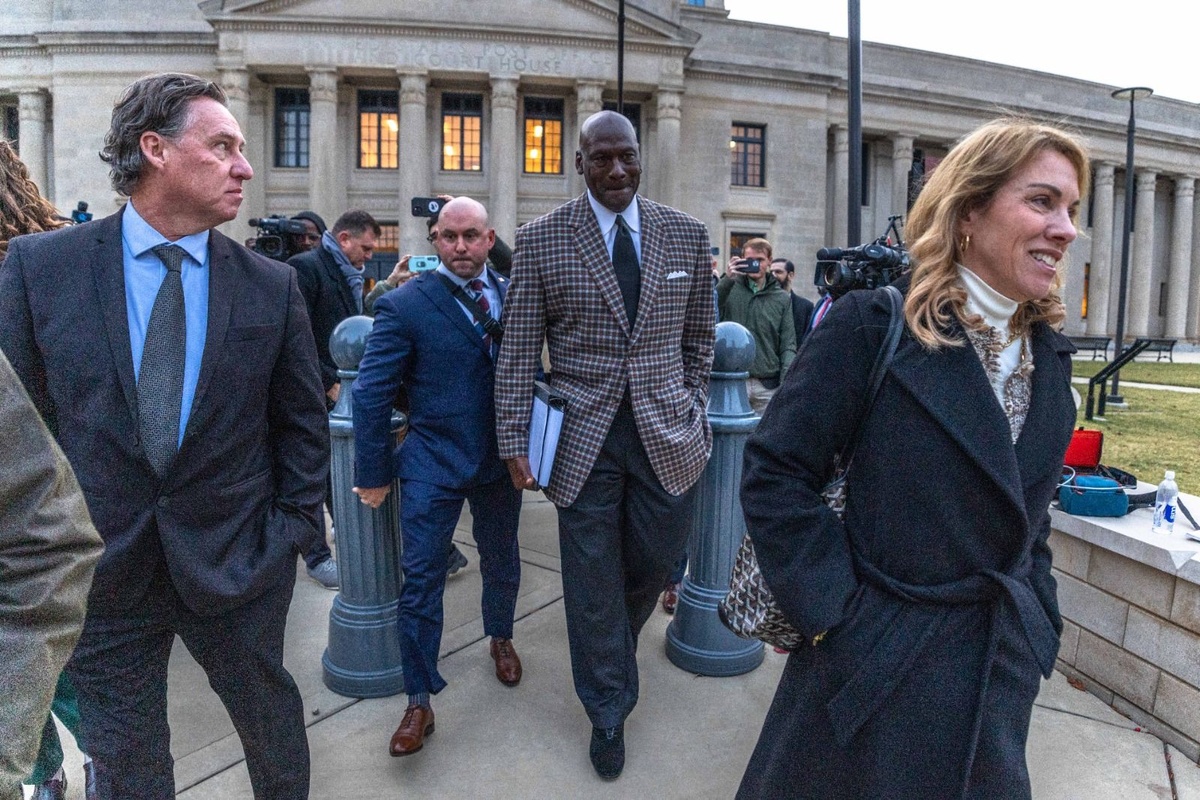
The NBA legend and 23XI Racing co-owner was on the witness stand for one hour on Friday, where he characterizes his ownership as being '100 feet up,' but said he pays close attention to every race as a lifelong fan of NASCAR, and attends about 10 to 12 event per year. Jordan asserted that he is "very invested" in the sport, and his longtime financial advisor Curtis Polk keeps him apprised of the daily happenings at the race team.

When asked why 23XI chose to buy a third charter in the middle of the antitrust lawsuit, Jordan replied: "There was a discussion between me and Denny about being successful… People who know me know I like to win and I will pursue anything to win and getting a third charter improves our chance to win the championship."

Jordan compared NASCAR to the NBA and noted how both the league and players share responsibility of growth of basketball with a 50/50 split. MJ found the "nature of the business to be unfair" within NASCAR, and believes the teams and the Sanctioning Body should be 'equal partners.' 

"We never thought we would get what basketball gets but we thought we could get closer to 45 percent," said Jordan, later adding: “If you share responsibility, the healthiness of the sport can grow,” Jordan said. “It needed to be looked at from a whole different perspective. That’s why we’re here.”

Jordan also faced cross-examination, but it wasn't nearly as contentious as when Denny Hamlin was on the witness stand. 

“Someone had to step forward to challenge NASCAR," Jordan said at one point.

Throughout the trial, NASCAR has trued to paint Curtis Polk (MJ's longtime financial advisor) as the villain in all this, saying he came into NASCAR with Jordan and Hamlin with no other interest beyond trying to sue the Sanctioning Body.

NASCAR's attorney told the jury that while Jordan and Hamlin genuinely love racing, Polk doesn’t, bringing up an unsealed conversation where Polk said the racing was 'boring as shit.'

Heather Gibbs, the daughter-in-law of Joe Gibbs Racing founder Joe Gibbs, also appeared on the witness stand on Friday. She focused on the September 6 'take-it-or-leave-it' deadline NASCAR gave the teams, saying she felt like NASCAR "held a gun to the head and if you don't sign it, everything is gone."

She noted that the the final draft came in at 5pm and they were given until 6pm to sign, but that it was filled with grammatical and syntax issues. She said the agreement didn't guarantee any broadcast revenue in the seven year extension period. During that critical moment when NASCAR pushed the teams against a proverbial wall, Heather said she thought about the legacy of her late husband Coy Gibbs, and his brother JD -- both of whom were deeply involved in JGR before passing away in recent years. 

According to Heather, Joe Gibbs pleaded with NASCAR CEO Jim France, exclaiming: "Don't do this to us!" France had told the Gibbs family that he was 'done with the conversation' and 'If I wake up and I have 20 charters, I have 20 charters. If I have 30, I have 30.'

Friday also featured the rest of NASCAR president Steve O'Donnell's testimony, and continued to talk more about why NASCAR leadership had an issue with SRX (more about that in Day 4). He pointed out how they saw Chase Elliott driving a NAPA sponsored No. 9 car in a SRX, and found that alarming.

While O'Donnell claimed the now defunct series is set to make a return, Motorsport.com's Matt Weaver confirmed with several individuals close to SRX that this is not the case.

O'Donnell also tried to show the positives of the Charter Agreement, with some charters becoming worth over 40x more than they originally were in 2016. "It shows that people believe in the sport," said O’Donnell. "It’s been a challenge with the litigation but despite that, charter value has increased and private equity has increased the value of charters."

At the end of the day, Judge Bel warned the NASCAR side that 'growing the sport' is not a valid defense. He also said it could be a self-admission. He has also informed the jury about the likelihood that this trial is seemingly going to go beyond its scheduled 10-days over two-weeks timeline. There was also a crowd waiting for Jordan as he exited the courthouse, including a protester with a sign that read, 'Our sport used to be great' on one side and 'NASCAR your fans deserve better' on the other.

Day 4 -- NASCAR's Steve O'Donnell and the 'threat' of SRX

The now defunct Superstar Racing Experience Series was at the heart of Day 4's courtroom battle. In previously unsealed messages, NASCAR leadership made it clear that they saw SRX as a threat and took issue with their drivers/team owners taking part in the weekly series run by NASCAR Hall of Famer Tony Stewart.

Team attorney Jeffrey Kessler tried to drive home the point that NASCAR reacted in a clear way to stifle SRX, which could be critical in how this case goes in the end. It could answer in part if NASCAR is using its position as a monopoly in the premier Stock Car racing space to harm competition or those operating in the space, like the teams.

NASCAR president Steve O'Donell was questioned by Kessler about the previously unsealed messages and NASCAR's issue with SRX. While the Sanctioning Body was praised for returning beloved short tracks Bowman Gray and North Wilkesboro to the schedule, the trial has revealed that was at least partially motivated by the fact that SRX could beat them there. They also prevented Speedway Motorsports from hosting SRX events.

O’Donnell said NASCAR was in the middle negotiating a new broadcast rights agreement ‘and SRX started to look like NASCAR, so we said no.’ He added that ‘ NASCAR wanted to gain as much TV revenue for the teams and tracks as possible," and that they were concerned SRX could hinder those efforts. They were frustrated that the drivers and teams didn't appear to be 'all in' on NASCAR by their choice to compete in SRX.

O'Donnell was asked why he wanted NASCAR's legal team to look at SRX, and he claimed it was simply IP infringement concerns. The existence of LIV Golf and how it challenged the hegemony of the PGA Tour, clearly rattled NASCAR leadership as they saw the possibility of something similar happening in stock car racing.

During one 2022 meeting, Jeff Gordon of Hendrick Motorsports asked Ben Kennedy, the great grandson of NASCAR founder Bill France and nephew to Jim, if "the family was open to a new financial model" to help the teams. Kennedy had told him 'yes,' but when Kessler asked O'Donnell if that was actually true, he said 'no.

In  February of 2023, O’Donnell said in an hand-written note: "I was hoping the future board would include the next generation and was hoping to see that change." Jim France is 81, and O'Donnell believed the ‘legacy mindset’ in the NASCAR Board ‘inhibited growth.’

“Mr. France was the brick wall in the negotiations,” Kessler suggested to O’Donnell, when referring to those 2023 messages.

“Those are your words, not mine," replied O'Donnell. 

On Thursday, O'Donnell also revealed that NASCAR lost $55 million in running the Chicago Street Course for three years. However, NASCAR still says it was worth it, as “it was a strategic investment because if not for that, Amazon would not have become a broadcast partner." NASCAR also said they lost $6 million by racing in Mexico City this year, but did so because it was important to Amazon, who kicked in an addition $1 million in race purse.

The day also included some more testimony from FRM team owner Bob Jenkins, who was cross-examined. Jenkins testified that it costs $20 million per car to race in the Cup Series, but NASCAR attorney Lawrence Buterman produced discovery documents that showed the most FRM ever spent on a Cup car was actually $14 million.

There was also some discussion about the proposed FRM/23XI merger from a few years back, with NASCAR attorneys trying to draw parallels between those failed negotiations and the ones between the teams and the Sanctioning Body over the 2025 Charter Agreement, where a deadline was imposed.

‘We can’t keep negotiating this forever,” Jenkins wrote in a text and that’s “…why we decided we had to have a deal by 5 p.m.” Jenkins pushed back against what NASCAR's legal team was trying to do, saying "this is another one of your analogies that doesn’t work."

There was also some concern at the end of the day that the trial wasn't moving quick enough, with Judge Bell saying: "I get the impression that this is not moving along the way we all would like it to." He encouraged both sides to speed it along, and said the jury is being subjected to redundancy 'and they're seeing a lot of trees and not a lot of forest.' Both sides are cutting witnesses to speed it up, but Roger Penske is only available on Monday, and while that timeline is unlikely to work out, Judge Bell said Penske needs to be present whenever he's needed.

Day 3 -- Prime faces more questions, FRM owner Bob Jenkins takes the stand

NASCAR's Executive Vice President and Chief Strategy Officer Scott Prime was being cross-examined for the second day in a row. The exchanges between prime and team attorney Jeffrey Kessler was sometimes contentious, with the attorney even apologizing to Prime and the court for raising his voice at one point.

Kessler locked in on the goodwill provision in the 2025 Charter Agreement, which is basically a clause that prevents team owners from competing in another series or owning one without NASCAR approval. Kessler called it 'anti-competitive will,' which drew an objection from the NASCAR side. He also focused on the Next Gen car, trying to paint its intellectual property restrictions (as the parts are supplied by a third party) as a tool utilized to restrain trade and prevent competition.

Reacting to an email from NASCAR commissioner Steve Phelps where he took a 'take it or leave it' attitude, Kessler said: “Only a monopolist has the power to say, ‘Take my offer and if you don’t take it, you will no longer be in this business, and someone else will take your place.'” 

He was also questioned about NASCAR's exclusivity agreement with tracks, but Prime tried to say that a rival series could race at other short tracks or street courses all around the country. Kessler did not accept that, and pushed back.

Kessler also took time to focus on the The Amanda (Oliver) Chart, which reflected a series of 22 asks made by the race teams and showed only a single ‘win’ for the teams as they negotiated with NASCAR. Prime had previously NASCAR's September 6 a ‘gun to the head’ offer and Kessler seized on that moment in questioning him. One of the asks was for permanent charters, but NASCAR CEO Jim France was unwilling to go that route, despite Prime doing some work behind the scenes to make that happen.

After Prime's lengthy testimony concluded, Bob Jenkins took the stand. He is the owner of Front Row Motorsports -- the only team that stood with 23XI against NASCAR as the other 13 chartered organizations signed the eleventh hour agreement last September.

Jenkins noted that he loses $6.8 million per year and has never turned a profit under the race team banner. He doesn't take a salary either. He went on to say that he spends $4.7 million per year on car components under the Next Gen model, and that the number was only $1.8 million under the previous generation of car.

When asked why do it then, Jenkins replied: “That sounds like something my wife would say. I just believe in it. It’s why I feel so strongly about changing this system. There are 150 employees at that race shop who believe in me to make this work.”

When asked about the September 6 deadline, Jenkins called it 'insulting' and 'backwards' as he recalled those critical hours. “There was a lot of passion, a lot of emotion, especially from Joe Gibbs, he felt like he had to sign it,” Jenkins said. “Joe Gibbs felt like he let me down by signing. Not a single owner said, ‘I was happy to sign it.’ Not a single one.” 

Jenkins was asked how he could sue NASCAR for placing non-compete clauses in their schedule and charter contracts while placing non-compete clauses in his driver contracts. Hamlin faced the same question from NASCAR attorneys earlier in the trial, and the answer was similar, pointing out that drivers have options on who to sign with.

After court proceedings concluded for the day, Judge Bell took issue with NASCAR attorneys for violating his orders.

Day 2 -- Hamlin faces tense cross-examination and NASCAR executive grilled

Hamlin was grilled by NASCAR attorneys in a somewhat contentious back-and-forth. "We're not a monopoly like you are," Hamlin said multiple times while on the stand. Hamlin gave insight into his personal frustrations with France, saying it dates back to the 2022 banquet. “He told me directly the problem in NASCAR is that teams spend too much money,” recalled Hamlin, who says he was very 'discouraged' by how differently they viewed the financial landscape of the sport.

"Cutting is not growth. I can't cut my costs in half. It's not realistic," asserted Hamlin. He verbally sparred with Lawrence Buterman as the attorney tried to poke holes in the claim that the teams were strapped for cash and struggling to make a profit.

We also learned that Hamlin makes $14 million per year with his current contract as a driver for Joe Gibbs Racing. When asked why he makes more than most drivers, Hamlin simply replied: "I am at the top of my game."

Scott Prime is not usually front and center, but he was on Tuesday, December 2nd, as NASCAR's Executive Vice President and Chief Strategy Officer faced uncomfortable questions from Kessler, representing the teams. He was forced to try and explain the internal strife within NASCAR over the charter terms, and the fact that CEO Jim France seemed committed to imposing on teams after shutting down negotiations. There have been numerous unsealed communications that appear to show that France was the roadblock in granting team's better terms.

Prime was also asked about a possible breakaway series and NASCAR's efforts to block a potential CART/IRL split in the stock car racing world. He was also questioned about Project Gold Codes, which he described as a 'contingency plan' in case multiple charter holding teams boycotted races and/or didn’t sign the charter agreement in time for the 2025 Daytona 500.

Day 1 - Jury selection, opening statements and Hamlin testimony 

After jury selection, the trial officially began. Denny Hamlin, the co-owner at 23XI Racing and one of NASCAR's top drivers, was the first witness to take the stand. However, he was only on the stand for 40 minutes with cross-examination from NASCAR's legal team yet to commence. 

There appeared to be a clear strategy of bringing up the fact that teams frequently compete with NASCAR for sponsorships, as Motorsport.com Senior NASCAR Editor Matt Weaver noted that Hamlin brought it up three times under questioning from his own attorney.

"First, I have to fend off the series,” Hamlin said. “If a new sponsor want to come in, NASCAR will go after them. I have to fight them. I have to fight other teams for them. I have to fight them for employees."

Both sides also laid out their arguments to the assembled jury and repeated many of the key points that have been repeated throughout the course of this lawsuit. NASCAR attorney John E. Stephenson framed 23XI/FRM as attacking the charter system and that they only brought up claims of antitrust violations after refusing to sign the new agreement.

Kessler, representing the teams, prepared the groundwork to prove that there was a clear anti-competitive strategy orchestrated by NASCAR CEO Jim France. He showed eyebrow-raising text messages from NASCAR leadership to support his claims.

 
Sign up to read this article
Read news from 100’s of titles, curated specifically for you.
Already a member? Sign in here
Related Stories
Top stories on inkl right now
One subscription that gives you access to news from hundreds of sites
Already a member? Sign in here
Our Picks
Fourteen days free
Download the app
One app. One membership.
100+ trusted global sources.