
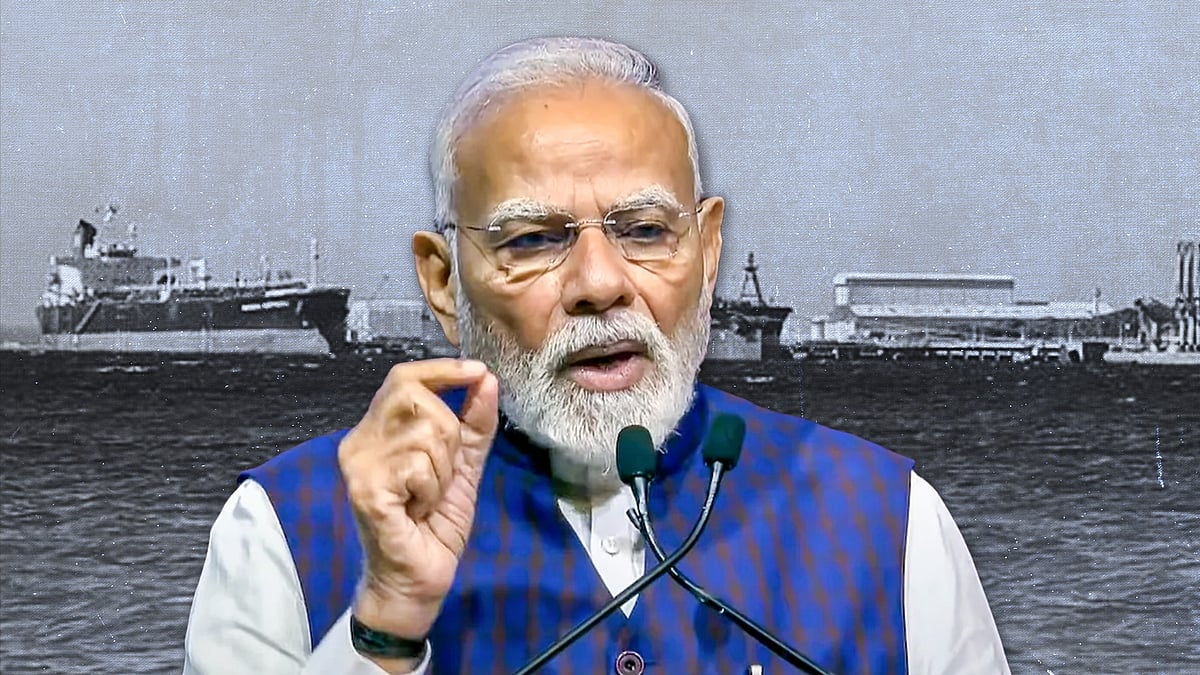
Earlier this month, Prime Minister Narendra Modi asked Indians to rethink some of their habits. Travel abroad less, work from home when possible, reduce unnecessary imports, and buy less gold.
None of these suggestions is unreasonable on its own. After all, governments all over the world ask their citizens to conserve resources during uncertain times. But there was something oddly familiar about the tone of it all. It sounded less like the language of a rising economic power bursting with confidence, and more like the language Indian households have used for decades, while navigating financial constraints.

Maybe that is what stayed with me after the speech. Because the more one looks at India’s current energy and economic anxieties, the harder it becomes to treat them as mere temporary disruptions. Every time oil prices spike, supply chains get disrupted, conflicts disrupt shipping routes, or energy markets tighten, and the country seems to return to the same emotional vocabulary: conservation, resilience, adaptation, sacrifice.
One starts to wonder whether these are truly temporary pressures anymore.
Why does India keep arriving at these moments despite spending decades talking about reform, self-reliance, transition and strategic autonomy?
At first glance, this appears to be an energy story about crude imports, LNG contracts, fuel taxes, and electricity demand. But the more you go through ministry responses, policy amendments, energy reports, and trade data, the conversation slowly begins to drift elsewhere. Toward governance.
It points towards long-term planning, institutional depth, reforms, or the lack of them. This raises the question of whether India has developed a habit of announcing transitions faster than it builds the systems required to support them.
Two simple words seem to enter the picture wherever you look: Majboori and Vikalpheenta. Compulsion and lack of options.
And you see this creep gradually, across sectors.
Energy and the illusion of transition
Earlier this year, BJP MP Maya Naroliya asked the Ministry of Petroleum and Natural Gas whether India’s dependence on imported crude oil had increased in 2025 due to declining production from mature oil fields, what steps were being taken to address delays in refinery expansion projects, and whether progress had been made in attracting foreign investment for upstream oil and gas exploration and expansion of exploration acreage.
The response came from Minister of State for Petroleum and Natural Gas Suresh Gopi on March 9.
Reading through the response is interesting because it reveals the contrast between the ministry’s list of reforms and the trajectory of the numbers sitting beside them. The response references a long list of policy measures introduced over the years: Hydrocarbon Exploration and Licensing Policy 2016 (HELP), the Open Acreage Licensing Policy, fiscal incentives, geological data repositories, and easier approvals.
But according to petroleum ministry data cited in many reports this year, India’s crude oil production fell for the eleventh consecutive year in 2025-26 to around 28 million metric tonnes. Domestic natural gas production declined 3.7 percent to 34,776 million metric standard cubic metres (MMSCM). The stated reasons indicate ageing fields, plateauing output and a lack of major discoveries. Except for the original Mumbai High discovery in 1974 and the fleeting promise of the Krishna-Godavari basin in the early 2000s, we have failed to locate a single major new oil source.
At the same time, India's import dependence continues to expand. Our dependency on foreign crude imports is staggering, having now crossed 88 per cent.
The Ministry of Statistics and Programme Implementation’s Energy Statistics India 2026 report shows how sharply that dependence has grown with time. India imported around 74 million tonnes of crude oil in the early 1990s. Today, the number stands above 270 million tonnes. When you read the admissions from the Petroleum Ministry, the subtext is devastating. It implies that five decades of national oil exploration policy, nine intensive rounds of field licensing, and three major structural reforms bore no substantive results.
After a point, you start to wonder, what exactly does energy security mean in India’s context anymore?
Because India’s current position is oddly layered. India imports crude from 40 countries, refines petroleum products at a globally competitive scale and exports refined fuel to about 150 countries. Indian refiners remain profitable, and refining capability has expanded considerably.
And yet every major geopolitical disruption still appears to arrive at the doorstep of ordinary citizens. All the government seems to be doing is managing when it knocks on people's doors.
If strategic dependence continues deepening, where exactly is energy security? And if citizens repeatedly absorb the uncertainty created by global volatility, then who ultimately benefits from the current structure?
The same tension appears in natural gas policy.
India aims to have natural gas account for 15 per cent of its energy mix by 2030. PNG networks are expanding. LNG terminals are increasing, and long-term import arrangements are being signed in increasing numbers.
In February 2024, Petronet LNG signed a 20-year extension of its LNG purchase agreement with QatarEnergy, effective in 2028. It was presented as a long-term stability measure. But then one returns to the domestic production numbers.
Natural gas output remains under pressure, and our reliance on imports is substantial. Which again raises a question: Is India becoming more dependent on gas faster than it is building the domestic resilience required to sustain that dependence safely?
That concern feels more real in today's world, where even supposedly stable energy relationships now appear vulnerable to geopolitical shocks. Recent uncertainty around Qatar's LNG infrastructure and force majeure concerns reminded many countries that long-term contracts can reduce volatility, but cannot erase exposure.
And then, on March 14, the Ministry of Petroleum and Natural Gas notified changes stating that households with Piped Natural Gas connections would no longer be permitted to retain subsidised domestic LPG connections.
On paper, this seems reasonable enough. If PNG already exists, why maintain two systems simultaneously? This is where the difference between rollout and reliability becomes important.
In March this year, The Economic Times reported that, despite around 1.65 crore PNG meter connections, a significant portion – about 37 per cent – remained inactive or inaccessible in practice. Active connections stand at barely over one crore. Some consumers had meter connections without reliable access to supply, while others continued relying on LPG because the surrounding PNG infrastructure remains inconsistent.
This changes how the policy looks. The total number of LPG connections stands at 33 crore, including over 10.55 crore LPG connections provided under the Pradhan Mantri Ujjwala Yojana (PMUY) to eligible women from low-income households.
Because resilient transitions usually build redundancy before removing fallback options. Older systems and newer systems coexist until the system becomes reliable enough for people to stop worrying about contingency altogether.
Instead, India often appears to move toward administrative streamlining before institutional maturity catches up.
A similar pattern emerges while examining renewable energy.
India’s renewable ambitions are large, necessary and entirely understandable for a country dealing with rising demand, worsening pollution and high import dependence. But increasingly, analysts are pointing toward a less glamorous problem.
Energy generation is no longer the core issue; distribution is.
A recent Citi analysis report warned that evening peak demand is exposing transmission and distribution gaps in India's power transition. Ember, an energy think tank focused on electricity transition research, separately noted that transmission bottlenecks are beginning to constrain renewable integration itself.
Even offshore wind now feels oddly symbolic.
India has more than 7,000 kilometres of coastline and years of policy discussion around offshore wind potential. Yet Dialogue Earth, an environmental reporting platform focused on climate and ecological transitions, recently noted that the country still has virtually no operational offshore wind turbines.
The more one reads through these examples, the harder it becomes to dismiss them as isolated implementation delays. It looks like India's biggest challenge is no longer identifying the future, but perhaps the true challenge is building enough institutional depth beneath the future we hope for.
Economy, policy, and shrinking room for manoeuvre
Take manufacturing.
For well over a decade now, the government has spoken about self-reliance, supply chain diversification, domestic capability building, and industrial depth. None of these ambitions is unrealistic. In many ways, they are unavoidable for a country of India's scale.
But now and then, relatively small policy decisions reveal the gap between rhetoric and ecosystem maturity more effectively than bombastic speeches ever can.
In April this year, the government relaxed quality control norms for the import of certain AC compressors until March 2027, in response to industry demands.
Now, AC compressors are not obscure frontier technology. They are not advanced semiconductor fabrication systems or aerospace engines. They are a fairly standard industrial hardware, connected to predictable demand in a country that has always had severe summers.
Which is precisely why the decision stood out. Not because of imports, every major economy imports. But because the example quietly raises a larger question about the depth of India’s manufacturing ecosystem beneath the language of self-reliance.
At some level, India increasingly speaks the vocabulary of advanced industrial economies, while parts of the supporting ecosystem beneath remain fragmented, dependent, or underdeveloped.
The same fragility shows up in the labour market.
Post-COVID employment data showed agriculture’s share in employment rising again, while manufacturing and services weakened comparatively. Discussions surrounding the Economic Survey 2025 also reflected this shift.
Initially, agriculture's ability to absorb labour during a crisis can sound reassuring. It suggests familiarity, social cushioning, even resilience.
But it has to be asked: why, after decades of economic growth, does agriculture remain the fallback absorber whenever disruption hits? The issue here is not agriculture itself. Millions of Indians depend on it and will continue to do so for the foreseeable future. However, it does raise questions about the depth of India’s transition toward higher-productivity employment.
A developed economy is generally expected to gradually move labour toward manufacturing, specialised industries and services over time. Yet India’s workforce structure still reveals how fragile that transition remains underneath the broader growth story.
Which, in turn, circles back toward skilling our workforce.
Over the years, India’s skilling ecosystem expanded rapidly, with enrolments, centres, certifications, and targets increasing. But reports and investigations have repeatedly raised concerns about uneven training quality, employability gaps, implementation leakages and institutional distortions.
You start wondering whether governments mistake rollout for capability creation.
Because building genuine workforce depth is painfully slow work, it requires institutional continuity, high-quality training, ecosystem maturity, and long-term investment in people. Those things rarely produce dramatic headlines or immediate political mileage.
But without them, ambitious policy eventually begins colliding with structural limits.
Even agriculture now reflects these collisions of competing priorities.
Last month, India lost its position as the leading exporter of corn to Bangladesh, with Brazil overtaking it despite India’s advantage of geographic proximity.
The Daily Star, one of Bangladesh's leading newspapers, reported that India's rising domestic demand, ethanol diversion, pricing pressure and competitiveness concerns played important roles in this shift.
None of those priorities is irrational when considered individually. But together, they reveal how fragile balancing acts become when systems lack enough depth and flexibility.
One ambition begins to strain another sector. One transition weakens another buffer. And across unrelated sectors, a feeling of shrinking room for manoeuvre starts appearing.
Governance, people, and the cost of delayed reform
None of this is new. And that clearly shows this is not about any individual sector, but about governance.
Because if these were policy failures of one government, or one era, you could point at them and move on. But they aren’t. These failures run across administrations, across decades, across ideologies.
Meaning the problem isn’t who's in charge. It’s whether the state, no matter who runs it, does the grunt work that doesn't win elections. Transmission infrastructure. Distribution reform. Building institutions that outlast the people who built them. Developing domestic capacity means that you aren't scrambling every time the world shifts.
None of this fits on a campaign poster.
But here’s what’s striking. Ordinary India understands all of this intuitively, even without the vocabulary for it. A family that keeps a gas cylinder despite having a piped connection isn't being irrational. Similarly, a farmer looking to cut input costs by burning agricultural waste isn't being parochial. The young worker who drifts back to low-paying farm work after a disruption isn’t giving up.
They are all building buffers against a system they can’t fully trust to catch them, in their own way. That instinct should tell you something.
The real question is whether the foundations are being built at the same pace as the projections, or whether the country is slowly learning to manage recurring stress with fewer options each time. They are not the same thing. And the difference shows.
We take no ads, bow to no government or corporation, and answer only to you, the reader. This Press Freedom Month, pay to keep news free.
Newslaundry is a reader-supported, ad-free, independent news outlet based out of New Delhi. Support their journalism, here.