
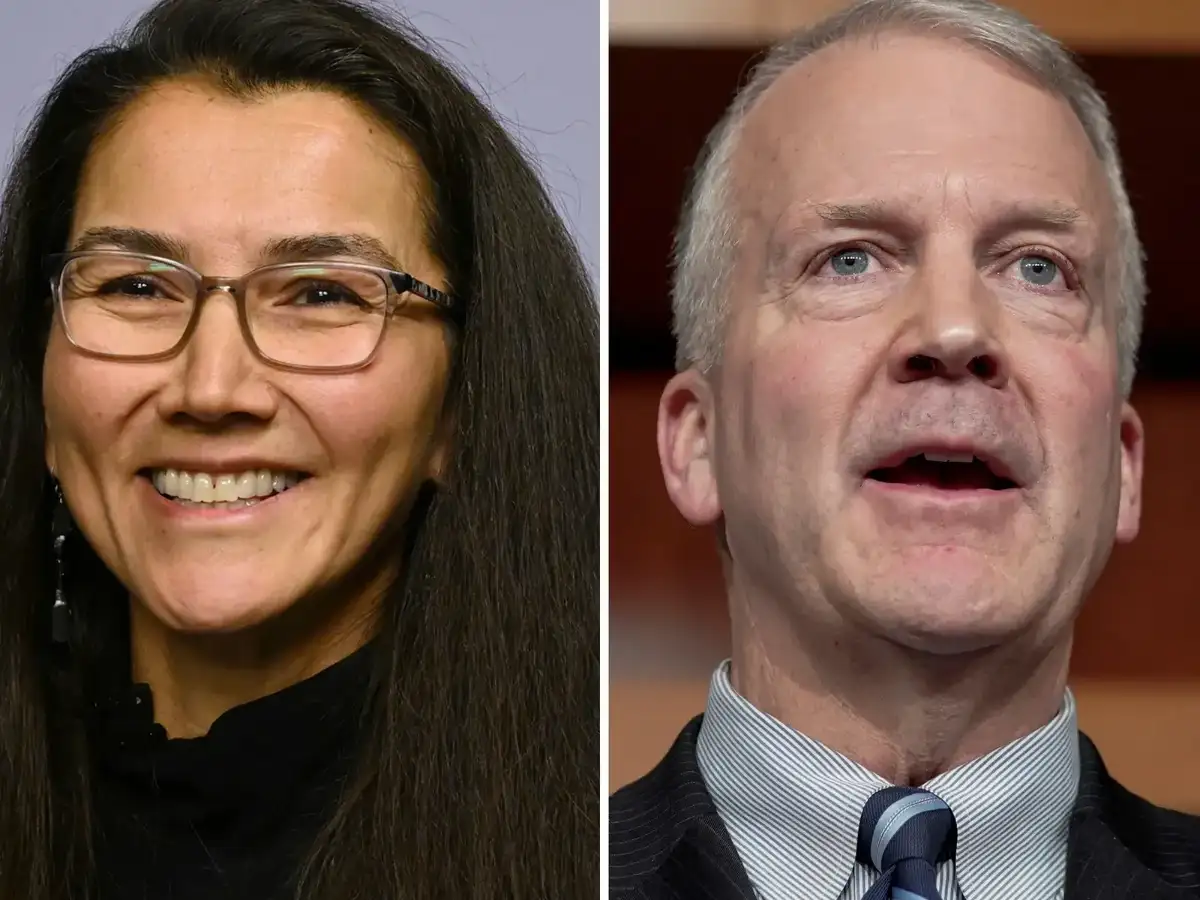
Republican Sen. Dan Sullivan and Democratic former congresswoman Mary Peltola advanced to the November general election on Tuesday, setting up a closely watched contest that could have implications for control of the US Senate.
Sullivan, a two-term Republican and ally of President Donald Trump, targeted Peltola in the final days of the primary, seeking to link her to the Democratic Party's progressive wing and what he called Lower 48 “liberals.”

Peltola, who became the first Alaska Native to serve in Congress in 2022, campaigned as a centrist. She also reshuffled her campaign leadership days before the primary, replacing her campaign manager and elevating a deputy. Her campaign described the move as “staffing updates as we transition into the general election.”
The two have raised substantially more money than their rivals and have the strongest name recognition in the state, making them the leading contenders heading into November.
Two Dan Sullivans add twist to Senate race
The Senate contest drew additional attention because another Republican named Dan Sullivan was also on the ballot.
Dan J. Sullivan, a retired teacher from Petersburg, won a legal challenge to remain on the ballot despite claims from the senator and Republican allies that his candidacy was intended to confuse voters and help Democrats. He denied the allegations and said dissatisfaction with the incumbent motivated him to run.
He appeared on the ballot as Daniel J. Sullivan Jr., with no party affiliation, while the senator was listed as Dan S. Sullivan, Republican and incumbent.
Trump also weighed in on the unusual contest, endorsing the senator and urging supporters to vote for “SULLIVAN, DAN S.”
Dan J. Sullivan criticised the endorsement, saying Trump was “more interested in raising tariffs on our allies than in lowering the cost of groceries, housing and energy” and “more interested in punishing his enemies than bringing Americans together.”
Sullivan, meanwhile, campaigned on support for the military, expanding land available for oil and gas extraction and backing Trump's tax and spending legislation.
Peltola relied on the “fish, family, freedom” slogan that helped propel her to Congress in 2022, while criticising a political system she said was dominated by special interests.
Alaska House race
Republican Rep. Nick Begich advanced to the general election for Alaska's lone US House seat along with independent Bill Hill, a fisherman and former educator.
Hill made affordability a central issue, focusing on the cost of healthcare, gas and groceries.
“Begich and his buddies think they can play by a different set of rules than we do,” he said after advancing Tuesday. “The Alaskans I know don’t think that’s right.”
Begich, who is seeking a second term and was endorsed by Trump, campaigned on his record in Congress. House Speaker Mike Johnson also appeared at a rally for Begich earlier this month.
Open governor's race
The governor's race is also headed for a competitive general election after Republican Gov. Mike Dunleavy was barred from seeking a third consecutive term by term limits.
Two Democrats, former state lawmakers Jonathan Kreiss-Tomkins and Tom Begich, advanced from a crowded field.
If either wins in November, he would become Alaska's first Democratic governor since Tony Knowles left office in 2002.
Republican contenders included businessperson and conservative activist Bernadette Wilson, former state labour commissioner and lawmaker Click Bishop, former Anchorage mayor Dave Bronson, and former Dunleavy administration officials Adam Crum and Treg Taylor. Former Gov. Bill Walker also ran as an independent.
Alaska uses an open primary system in which all candidates compete on the same ballot, with the four highest vote-getters advancing to the ranked-choice general election.
Voters back campaign finance limits
Voters also overwhelmingly approved a ballot measure to restore campaign contribution limits in state and local elections.
The measure sets a $2,000 limit on individual contributions to candidates and a $5,000 cap on contributions to political parties.
It also limits spending by groups outside political parties and restricts contributions to joint campaigns for governor and lieutenant governor.







