
Good morning!
The AI revolution could affect as many as 300 million jobs, according to Goldman Sachs. These days, it seems no role in the corporate food chain is safe—from low-level tech jobs to the CEO role. What's more, AI is poised to disrupt how companies are structured in the future, undoing the typical organizational hierarchy.
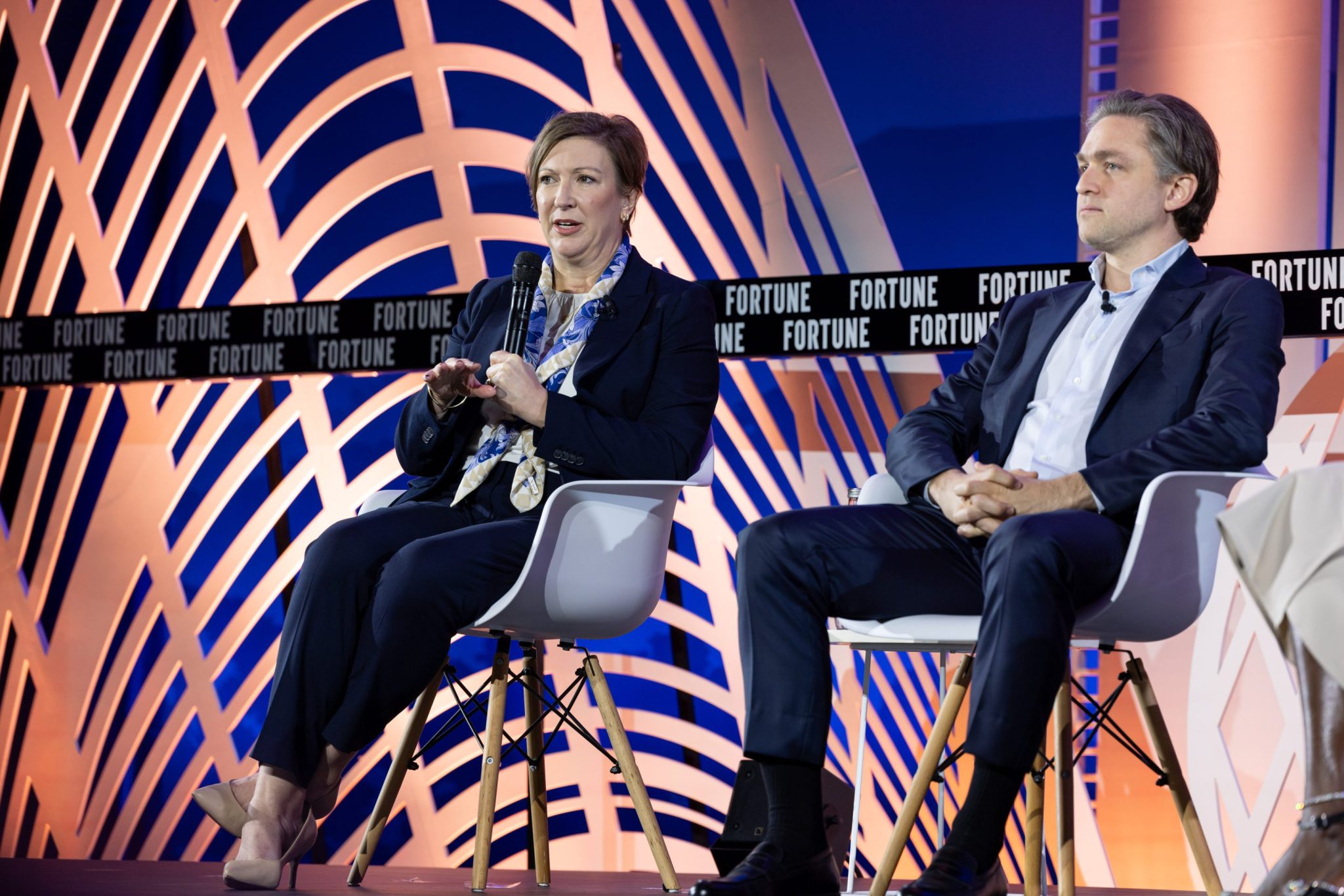
“These hierarchical structures that typify a lot of large organizations around the world will ultimately be replaced with structures that will be far more agile, where there'll be far more fluidity of people doing tasks and skills,” said Renée McGowan, CEO of professional services firm Marsh McLennan’s India, Middle East, and Africa business, during Fortune’s Global Forum conference in Abu Dhabi on Tuesday.
Indeed, some studies have found that supervisory roles, like project managers, will likely see more role displacement from AI than their entry-level counterparts. Luckily for managers, more employers prefer to upskill and reskill employees than find new AI talent, a finding that Taso Du Val, CEO of freelancing platform Toptal, says he found surprising.
"A lot of folks would think, ‘We need a new person or a new set of folks to create AI strategies and execute,’” he said. “In fact, it's a small group that enables everyone to leverage AI and those efficiencies from that strategy in order to benefit the organization.”
Leaders will also need to establish how early-career workers progress through the organization, especially as AI replaces rote tasks that are typically relegated to junior employees.
McGowan says that both employees and managers should ask themselves, "In your early career, what are the skills that you're going to need to learn, and how do we expose you to those skills throughout the organization to map to either the leadership models or the technical models that we need in the future?” Some companies are already doing so, like ServiceNow, which uses generative AI to optimize team performance, identify training needs for employees, and hire for relevant skills.
“It's about redeployment and thinking about work differently,” McGowan says.
Check out more coverage from Fortune’s Global Forum here.
Paige McGlauflin
paige.mcglauflin@fortune.com
@paidion