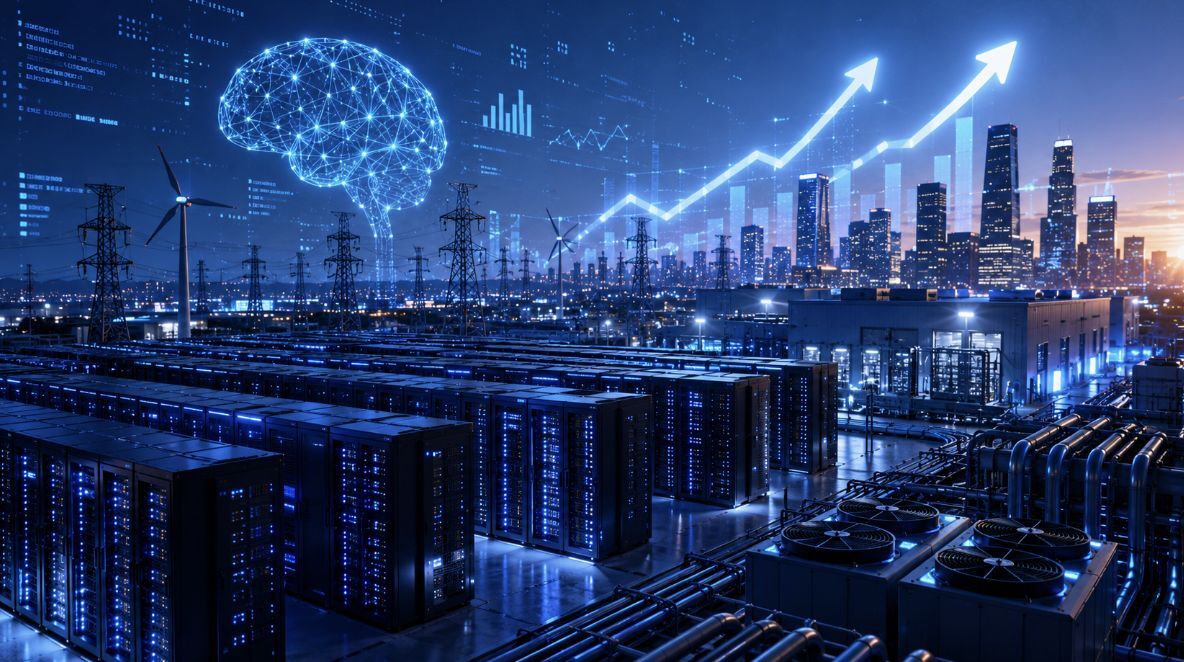
Artificial intelligence remains one of the largest forces shaping capital spending in 2026, but investors have started to examine a much wider group of potential beneficiaries. The first stage of the AI investment cycle concentrated heavily on major technology platforms and advanced processors. The current phase increasingly includes data centers, networking equipment, memory, electricity generation, grid infrastructure, cooling systems, construction, and enterprise software. Gartner expects worldwide AI spending to reach $2.59 trillion in 2026, up 47% from 2025.
The shift also reflects how AI now reaches consumer-facing digital services. Entertainment platforms, games, recommendation systems, customer support, fraud controls, and personalization tools increasingly use automated systems behind the interface. Online gaming represents one part of that wider digital economy. For example, playzini, sits within the adult online casino segment, where players encounter slots and other chance-based games, while searches for best online сasino relate to the same category. Investors, however, increasingly focus on the less visible infrastructure that lets digital services process large quantities of information.
That change does not mean investors have abandoned major technology stocks. Instead, the investment case has expanded. Companies building AI systems need processors, but they also require enormous computing facilities, electricity, storage, high-speed connections, cooling equipment, financing, and physical construction. This has created potential demand across industries that previously received far less attention during discussions about artificial intelligence.
AI spending keeps rising in 2026
The scale of current expenditure explains why investors continue to follow the sector closely.
Gartner forecasts that AI infrastructure will account for more than 45% of worldwide AI expenditure during the next several years. The category includes AI servers, processing semiconductors, network equipment, devices, and AI-focused cloud infrastructure.
Other estimates show how much capital large cloud operators now commit to physical assets. S&P Global Ratings estimated in May that five major cloud service providers could spend about $750 billion on capital expenditure during 2026, equal to roughly 38% of their combined revenue. Not all of that money goes directly toward AI, but computing capacity accounts for a large part of the increase.
This level of spending has consequences far outside the technology sector.
A new data center requires land, transformers, power connections, cooling systems, cables, backup electricity, construction materials, networking hardware, storage equipment, and financing. Every new computing facility therefore creates demand across a long chain of industries.
Investors have started following that chain.
The market is broadening beyond a few technology stocks
For much of the early AI investment cycle, attention concentrated on a relatively small number of companies.
That approach made sense initially. Processor suppliers and large cloud operators occupied obvious positions in the development of generative AI. Investors could see direct demand for computing equipment and cloud capacity.
By 2026, the situation looks more complex.
Market performance has started broadening outside technology. Recent analysis of U.S. equities found stronger participation from industrial, utility, and value-oriented companies as technology shares encountered periods of weakness. The equal-weighted S&P 500 gained 2.5% across June and July even as parts of the technology sector struggled.
AI infrastructure helps explain part of that change.
Investors increasingly examine companies that supply the physical requirements behind computing rather than only businesses that create AI models or sell software.
This creates a larger investment universe, but it also requires more detailed analysis.
Electricity has become a central issue
AI needs large amounts of power.
Training a major model consumes electricity, but so does running that model after deployment. As businesses add AI assistants, automated workflows, search functions, image generation, coding tools, and other services, inference workloads can create persistent electricity demand.
Data centers already represent a major source of consumption in several regions.
UBS Asset Management notes that rapid AI infrastructure construction has created a new investment cycle involving power generation and electric grids alongside data centers. It expects major technology capital spending to exceed $700 billion during 2026.
Investors have therefore started looking at sectors such as:
-
electric utilities;
-
power generation;
-
transformers and grid equipment;
-
backup power systems;
-
cooling technology;
-
energy storage;
-
electrical engineering;
-
data-center construction.
These industries do not need to create an AI model to receive additional demand from artificial intelligence.
They need to supply what computing facilities require.
Power constraints can limit data-center growth
The connection between AI and electricity becomes especially important when supply cannot grow quickly enough.
Building a computing facility does not automatically guarantee access to sufficient power. Grid connections can require years of planning. New generation capacity also takes time to construct.
Recent investment research estimates a possible 40-gigawatt U.S. grid shortfall connected with expanding AI infrastructure demand. That gap has increased interest in local generation, fuel cells, batteries, and other systems that can support data centers when grid expansion cannot match construction schedules.
This changes how investors assess the AI cycle.
Processor production may grow rapidly, but a company cannot operate thousands of advanced processors without electricity. Infrastructure limitations can therefore influence the speed at which computing capacity enters service.
That makes power availability an economic question rather than only an engineering issue.
Networking receives more attention
Processors often dominate discussion about AI hardware, but they do not work independently.
Large AI systems distribute workloads across many machines. Those machines need to exchange information rapidly. As computing clusters grow, networking performance becomes increasingly important.
This creates demand for switches, optical components, cables, network interfaces, and related equipment.
Memory and storage also matter.
AI workloads move enormous quantities of data. Systems need fast access to model parameters and other information during training and inference. Memory suppliers therefore participate in the same capital cycle as processor manufacturers.
Recent market activity illustrates that connection. Memory-related shares rallied in August as investors responded to continued spending on AI data centers. Interest also extended toward storage and optical-networking businesses.
This represents a broader way of thinking about AI investment.
Instead of asking which company makes the most recognizable model, investors can ask what equipment every large computing cluster requires.
Data centers have become an investment category of their own
Physical computing capacity now requires sums that once seemed unusual for software-driven businesses.
Large technology groups spent decades attracting investors partly because digital products could scale without equivalent increases in physical assets. AI changes part of that equation.
Modern computing clusters require expensive servers and large facilities. They also need recurring upgrades because processors and other hardware improve quickly.
UBS describes this as a move away from the traditional asset-light model toward much heavier infrastructure requirements.
The financing structure has changed as a result.
Technology groups can use their own cash flow, but infrastructure investors, private credit funds, real-estate specialists, banks, and other financial institutions can also participate in data-center projects.
That spreads the economic effects of AI spending into financial markets that do not normally receive much attention during discussions about software.
Capital expenditure is creating new risks
Large investment does not guarantee strong returns.
This point has become increasingly important in 2026.
A Reuters analysis found that capital spending by several major U.S. cloud operators could grow faster than their free cash flow through 2027. The analysis estimated that capital expenditure could increase by about $534 billion while operating cash flow rises by roughly $340 billion.
That gap matters.
Companies can sustain heavy spending when future revenue justifies it. Problems emerge if infrastructure grows much faster than demand or if AI services fail to produce sufficient margins.
Investors therefore increasingly ask several practical questions:
|
Question |
Why it matters |
|
How much capital does AI require? |
Higher spending can reduce free cash flow |
|
Who pays for infrastructure? |
Debt can increase financial risk |
|
How quickly does capacity generate revenue? |
Idle assets reduce returns |
|
How long will equipment remain useful? |
Rapid hardware changes affect asset value |
|
Can power supply support expansion? |
Grid limits can delay projects |
|
Are customers signing long contracts? |
Commitments can improve revenue visibility |
These questions mark a shift from the earlier phase of AI enthusiasm.
Investors increasingly want evidence that spending produces measurable economic results.
Enterprise adoption represents the next source of demand
Infrastructure has dominated expenditure so far, but business adoption could create the next major stage.
Gartner argues that technology vendors and hyperscalers have driven much of the spending to date. Enterprises have taken a more cautious approach, often using AI for targeted productivity and efficiency projects rather than large changes to entire organizations.
That distinction matters for investors.
Infrastructure suppliers can benefit while companies build computing capacity. Eventually, however, that capacity needs paying customers.
Enterprises could supply them.
Banks can use AI for document processing and customer service. Manufacturers can apply computer vision and predictive systems. Retailers can improve inventory planning. Media businesses can automate parts of production and distribution. Software providers can add AI functions to existing products.
The investment question then moves from infrastructure construction toward actual use.
Investors want evidence of revenue
The market increasingly distinguishes between AI spending and AI earnings.
A company can announce a large computing project, but investors still need to know whether customers will pay enough to support the cost.
That has changed the discussion around major technology groups.
Earlier in the cycle, announcing higher AI expenditure could signal confidence. In 2026, the same announcement can produce a more cautious response if investors think capital costs are growing faster than revenue.
Goldman Sachs Research has previously noted greater selectivity around AI-related equities, with investors favoring cases where spending has a clearer connection to sales.
This discipline may spread throughout the AI supply chain.
A data-center supplier needs orders. A utility needs contracts. A software company needs paying users. A networking provider needs sustained equipment demand.
The AI label alone cannot answer those questions.
Smaller suppliers can benefit from very large projects
The infrastructure expansion also creates possibilities for businesses that occupy narrow parts of the supply chain.
Consider what goes into one large data center.
It may require transformers, generators, cooling units, power-management equipment, fiber connections, security systems, racks, construction services, and water-management equipment.
No single supplier controls every category.
That distributes spending across many businesses.
A company does not need enormous AI-related revenue in absolute terms for the sector to change its financial results. A smaller industrial supplier may experience a significant effect if data centers become a major new source of orders.
Investors therefore increasingly examine order books, customer concentration, production capacity, and delivery schedules.
These details can matter more than broad statements about exposure to artificial intelligence.
Private capital has entered the infrastructure buildout
Public equities represent only one part of the investment cycle.
Private equity, infrastructure funds, real-estate investors, and private lenders have increased their involvement in AI-related physical assets. Recent reporting shows private capital firms directing money toward data centers, electricity systems, and other infrastructure needed for expanding computing demand.
The reason involves scale.
Building enough computing capacity requires huge amounts of capital. Even large technology businesses may prefer structures that distribute financing across several participants.
Private credit can fund construction. Infrastructure investors can own physical assets. Technology groups can lease capacity rather than financing every facility directly.
This creates additional connections between AI and the broader financial system.
It also creates new risks if projects rely on aggressive assumptions about future demand.
Valuation remains a serious concern
The expansion of the AI investment theme does not remove valuation risk.
It can spread it.
If investors begin pricing every electricity, data-center, networking, or industrial company as a major AI beneficiary, share prices can move ahead of actual earnings.
Recent volatility offers a reminder. Some AI-linked infrastructure shares experienced sharp declines during the summer before recovering part of their losses. Semiconductor indexes also recorded substantial swings.
Investors therefore need to separate structural demand from short-term market pricing.
A business can operate in an attractive industry and still trade at a valuation that assumes extremely strong future growth.
The opposite can also occur. A mature industrial company may receive meaningful new orders from data-center construction without investors immediately treating it as an AI business.
This is one reason the broadening investment cycle requires more research rather than less.
The economy now feels the scale of AI construction
AI expenditure has grown large enough to influence wider economic data.
Goldman Sachs economists estimate that U.S. AI investment could reach about $600 billion in 2026. Their calculations place that figure near 2% of U.S. GDP, 10% of business fixed investment, and 15% of equipment investment.
At that scale, the spending can affect construction labor, borrowing costs, electricity demand, industrial orders, and equipment production.
It can also compete with other projects for resources.
A region building several data centers may need more electricians, construction workers, transformers, and grid connections. Other industries use those same resources.
This explains why the AI investment cycle increasingly matters outside technology portfolios.
Investors face a broader set of choices
The first stage of the AI trade gave investors a relatively simple framework: processors, cloud platforms, and major software businesses.
The next phase looks less concentrated.
Potential exposure now stretches across semiconductors, memory, networking, data centers, utilities, energy equipment, construction, cooling systems, storage, enterprise applications, and finance.
That does not make every company in those sectors an AI investment.
Investors still need to examine how much revenue actually comes from AI-related demand, whether margins can hold, how much capital expansion requires, and whether customers have made long-term commitments.
Those questions can separate genuine business growth from a temporary association with a widely discussed technology.
The AI boom is becoming an infrastructure story
Artificial intelligence remains a technology story, but the investment cycle increasingly looks like a physical infrastructure story as well.
Worldwide AI spending could reach $2.59 trillion this year, while infrastructure accounts for a large share of the total. Major cloud operators continue to commit hundreds of billions of dollars to servers, computing facilities and related equipment. At the same time, electricity constraints, financing needs, networking requirements, and pressure on free cash flow have become harder to ignore.
That explains why investors now look beyond the biggest technology names.
The next group of beneficiaries may include businesses that never create an AI model. They may generate electricity, build cooling systems, manufacture memory, connect servers, construct data centers, or finance the physical assets behind them.
The shift also brings greater scrutiny. Investors want to see revenue, cash flow, contracts, order growth, and returns on invested capital rather than announcements alone.
AI investment has therefore entered a more demanding phase. The market still expects enormous spending, but attention increasingly follows where that money actually goes.