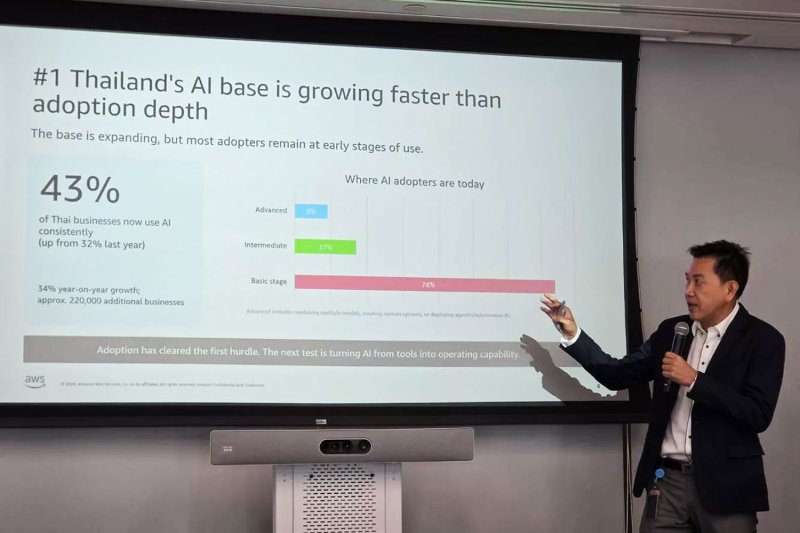
Thailand's artificial intelligence (AI) adoption is growing rapidly, with 43% of surveyed organisations now using AI continuously, up from 32% last year.
This growth represents around 220,000 additional businesses adopting AI, according to Amazon Web Services' (AWS) "Unlocking Thailand's AI Potential 2026" study.

However, adoption is mostly at a basic level. Applications should evolve into advanced systems that create tangible value, the company said.
Human employees must develop "judgement", which means using domain expertise to verify AI outputs, intervening when necessary and eventually fine-tuning custom corporate AI models, said Vatsun Thirapatarapong, country manager of Thailand at AWS.
"Thailand's AI momentum is real, and customers are moving from experimentation to production this year," he said.
Businesses are seeing tangible returns, with 84% of AI adopters reporting productivity gains, 71% reporting increased revenue and 64% saying their innovation timelines have accelerated, according to the survey.
However, 74% of adopters are at a basic level, primarily using the technology as a simple tool for asking questions, conducting basic research and generating short texts or summaries.
Only 17% are in the intermediate phase and 9% are advanced, shifting towards deeper, more integrated use of AI. Advanced use cases in Thailand include using AI to build deep internal knowledge bases, such as a specialised medical database for doctors.
Only 19% of businesses say they feel fully or very ready to adopt next-generation AI technologies, like agentic AI.
In a challenging economic environment, businesses should make strategic use of AI in selected use cases to gain greater value, generate revenue streams and foster innovation rather than focus solely on productivity gains.
Mr Vatsun said more than 70% of frequent AI users now sit in non-IT departments, such as sales, marketing and human resources. However, only 19% of organisations have extended AI governance policies to these non-IT users.
This lack of oversight has led to the emergence of "Shadow AI", a phenomenon where employees purchase personal AI subscriptions and upload sensitive corporate data to public AI models to complete their daily tasks.
He said organisations must implement clear policies, review processes and data infrastructure foundations for all employees, not just the IT team.
Humans in the loop
Readiness is tied to practical execution capacity: 56% cite skills shortages, 48% cite insufficient internal financial resources and 41% cite legal uncertainty arising from AI and digital regulation as barriers to adoption.
In addition, modernising legacy systems to run on the cloud, specifically through "serverless" architectures that only charge when applications are actively running, is a critical step.
Using AI to assist in transforming and modernising outdated code can significantly reduce engineering time and eliminate expensive legacy licensing fees.
Because hiring external AI experts is increasingly difficult and expensive, 72% of organisations recognise the need to reskill their internal workforce, as internal employees already possess crucial organisational knowledge.
In the survey, 61% of businesses identify the ability to interpret, validate and challenge AI-generated outputs as a key future skill.
Yet 52% say employees are unsure when to trust or question outputs.
In complex tasks, AI can make errors, so human oversight remains essential, Mr Vatsun added.
"For businesses, the practical need is clearer guidance on when to rely on AI, when to challenge it and when to escalate," said Mr Vatsun.
When asked about the appropriate electricity pricing level for data centres, he said cloud data centres benefit from massive economies of scale, making them up to four times more energy-efficient than private servers.
Given the country's rising demand for AI, he questioned why businesses would continue relying on such inefficient, power-hungry systems.