Get all your news in one place.
100's of premium titles.
One app.
Start reading
The Economic Times
The Economic Times
Muskan Singh

Against all odds, one of nature’s most colorful little survivors just made an incredible return

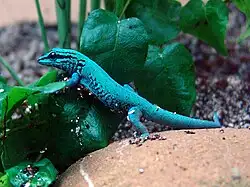
For years, its brilliant color made it one of the world's most sought-after reptiles in the exotic pet trade. Today, that same tiny blue gecko is becoming a symbol of what focused conservation can achieve. Deep in Tanzania's forests, local communities, scientists and wildlife managers have helped turn the tide for a species that seemed to have almost nowhere left to go, as per a report by Eco News.

READ ALSO: Quote of the Day by Ernest Hemingway: 'The world breaks everyone and afterwards many are strong at the broken places'- Valuable life lessons on finding meaning after life's hardest battles by The Old Man and the Sea novelist

The recovery of Williams' electric blue day gecko is a reminder that even the smallest creatures can tell some of conservation's biggest success stories.

Williams' electric blue day gecko has never had the luxury of a wide homeland. The tiny reptile, known scientifically as Lygodactylus williamsi, exists only in a handful of forest areas in Tanzania, making every change in its environment deeply significant.

Yet despite years of pressure from wildlife trafficking and habitat degradation, the species is now showing encouraging signs of recovery.

Conservationists say the turnaround reflects a combination of stronger protections, habitat restoration and local involvement rather than a single breakthrough, as per a report by Eco News.

READ ALSO: African Proverb of the Day: 'He who wants to plant corn must make peace with the monkeys...'- A Timeless lesson on acceptance, wisdom, and living with life’s realities

Why is this gecko so vulnerable?

The gecko inhabits the Kimboza and Ruvu forest reserves near the Uluguru Mountains. According to Protected Planet, the species was classified as Critically Endangered by the IUCN Red List in 2012, with its entire range covering less than roughly 19 square miles.

That limited distribution leaves little room for error. Its dependence on Pandanus rabaiensis adds another challenge. The plant provides shelter, breeding sites, basking locations and food resources. Without it, the gecko's chances of survival quickly diminish, as per a report by Eco News.

For an animal whose existence is tied so closely to one habitat type, even modest environmental disturbances can have major consequences.

READ ALSO: Quote of the Day by Mark Twain: 'It's easier to fool people than to convince them that they have been fooled' - Timeless lessons on self-deception, human nature, and intellectual humility by the greatest humorist of the United States

How did the pet trade change its future?

The gecko's striking appearance became both its greatest asset and its greatest threat. Male Williams' electric blue day geckos are known for their vivid blue coloration and orange undersides, while females display green and bronze tones. Those characteristics made the species highly desirable among collectors in the European exotic pet market. The impact extended beyond removing animals from the wild.

Collectors often damaged or destroyed pandanus plants while capturing geckos hidden among their leaves, eliminating critical habitat in the process.

Conservation reports estimate that between 2004 and 2009, more than ten percent of the wild population entered international trade. In response, CITES placed the species under Appendix I protection in January 2017, effectively banning commercial international trade involving wild specimens. Captive breeding programs later helped reduce pressure on remaining wild populations.

READ ALSO: Quote of the Day by Nobel Prize-winning author Toni Morrison: 'At some point in life the world's beauty becomes enough...'- Life lessons on presence, gratitude, and finding peace in the present moment

What role did local communities play?

Trade restrictions alone could not repair damaged forests. In Kimboza, forest ecologist Charles Kilawe worked alongside nearby communities and rangers to address another growing threat: the spread of invasive Spanish cedar trees.

The non-native species competed directly with native vegetation and altered the forest conditions needed by both the gecko and Pandanus rabaiensis.

Since 2016, conservation teams have removed nearly 100,000 Spanish cedar trees. Reports cited by Mongabay in June 2026 noted that forest fires have declined by roughly 80 percent, while approximately 5,000 native trees are now planted each year, as per a report by Eco News.

The work may not attract daily headlines, but it has fundamentally changed the landscape supporting the species.

Zoo Liberec's Kimboza Forest Gecko Project, active since 2020, has also emphasized community participation. The initiative addresses threats ranging from fires and illegal logging to mining activities, invasive species and unlawful harvesting.

Educational outreach and ranger support form part of the long-term strategy. The involvement of local residents has proven especially important. Conservation efforts are often stronger and more sustainable when nearby communities become active partners rather than passive observers.

Why does removing Spanish cedar matter?

Research published in Global Ecology and Conservation in 2022 examined how Cedrela odorata, commonly known as Spanish cedar, affects gecko habitat within Kimboza Forest Reserve.

Using 107 study plots and observations from 125 pandanus trees, researchers identified a clear inverse relationship between Spanish cedar abundance and native pandanus growth.

The findings suggested that without active management, invasive trees could permanently reduce suitable habitat for an already endangered species.

The lesson extends beyond one reptile. Protecting Williams' electric blue day gecko means restoring the ecological balance of the forest itself.

Who else benefits from the recovery?

The gecko may be the public face of these efforts, but it is far from the only beneficiary. Healthier forests also support blue monkeys, white-chested alethes and trumpeter hornbills. Rebuilding native habitats creates stronger ecosystems that sustain multiple species simultaneously.

That broader impact illustrates an important principle in wildlife conservation: protecting a single vulnerable species often strengthens an entire ecological network.

Still, experts remain cautious. A creature confined to such a small geographic area remains inherently fragile. Illegal collection, invasive plants, fires or renewed market demand could quickly reverse years of progress.

However, Williams' electric blue day gecko stands as an encouraging example of what can happen when scientific research, international protections and local stewardship move in the same direction.

Its remarkable comeback is not simply a story about one tiny reptile. It is proof that even species living on the edge can recover when the right actions arrive at the right time.

FAQs

Where is the blue gecko found?

It lives only in small forest reserves in Tanzania.

What helped the species recover?

Trade controls, habitat restoration and local conservation efforts.

Sign up to read this article
Read news from 100's of titles, curated specifically for you.
Already a member? Sign in here
Related Stories
Top stories on inkl right now
One subscription that gives you access to news from hundreds of sites
Already a member? Sign in here
Our Picks
Fourteen days free
Download the app
One app. One membership.
100+ trusted global sources.