
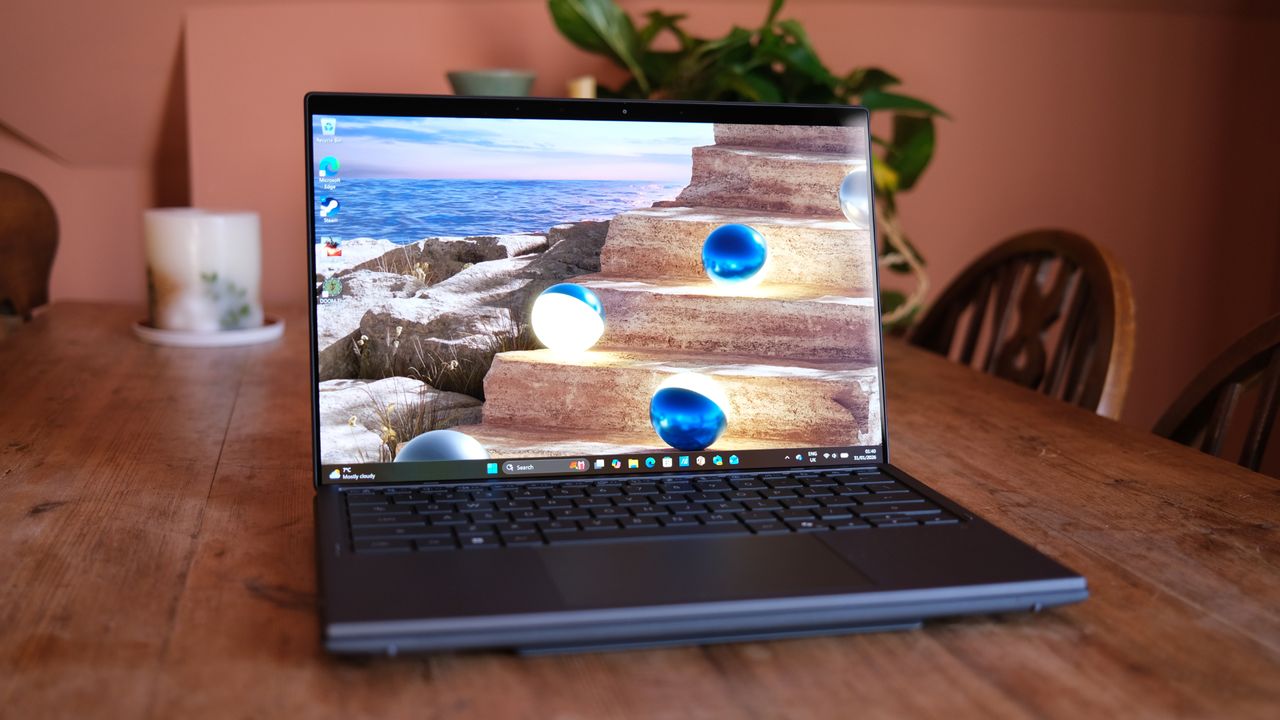
When I sat in on Intel's big showcase and press conference at IFA 2026, right at the start of this year, I left with one big impression – time might be up for gaming laptops pretty soon. The years of integrated graphics basically being a bit of a joke are now long gone, and Intel's Panther Lake chips underline that emphatically.
Where a few years ago you'd struggle to run even really old games well if your laptop wasn't a gaming one, with a dedicated GPU, now the iGPU performance of the Intel Core Ultra Series 3 chips (and Qualcomm and AMD's equivalents) needs to be seen to be believed.

The perfect case in point in the case of Panther Lake is Battlefield 6, the subject of a partnership between Intel and publisher Electronic Arts that makes sure the game has full compatibility with Intel's various systems. These come together to let you use upscaling from XeSS and new frame generation options to run at a genuinely phenomenal level of performance.
I played the game for a few minutes in Las Vegas, but knew I needed to go back for more, and got a few more hours under my belt here in the UK on the new Asus Zenbook Duo (2026) while testing it for review. This just underlined how mad the performance can feel when you're actually playing with it.
For a bit of balance, I headed to a game that hasn't had any specific optimisations, and had a good time with a sampling of Doom: The Dark Ages. Its benchmarking modes showed that I could get really playable framerates on low presets, and I feel confident that a patch could unlock even better performance if desired.
All of this is on an unplugged laptop, to be clear, and while the chips in question aren't exactly cheap, the direction (and speed) of travel in terms of iGPU performance is quite crazy.
This year, I expect to test a whole heap more gaming laptops, as various brands bring out new models featuring Intel's chips, and I don't think we're at the tipping point yet where they no longer represent good value.
In fact, I think that tipping point remains years away. However, we are already at the point where someone who only has a tangential interest in gaming probably no longer needs a GPU in their laptop to be able to enjoy games on the go.
Given that most big gaming laptops turn their discrete GPUs off when unplugged, the case for a normal laptop that can also game is getting more persuasive every year. For now, if you want super-reliable graphics that scale across any and all games, you're still going to want a gaming laptop.
In five years, though, I'll be fascinated to see how small the gap between iGPU performance with upscaling and frame generation tools, compared to a full GPU, will have become. Just as interesting will be the way that a heap of brands navigate that turbulence when it becomes more pressing.