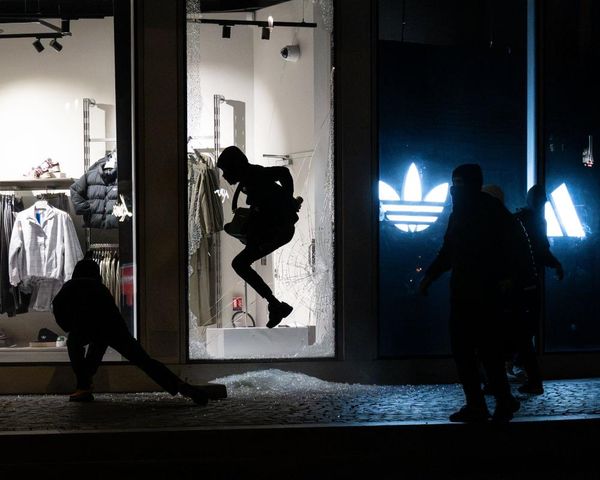
Colombian police removed seven officers from duty on Sept. 23, three days after Donovan Balanta Paz, a 34-year-old Afro-Colombian man, died following a detention on the edge of Bogotá, beside the town of Soacha. The police announced the suspensions that morning. Forensic experts have not said what killed him, and the institution and his relatives describe the encounter in starkly different terms.
Two Accounts of One Sunday
Balanta, a father of two who worked in the pharmaceutical industry and was close to finishing a criminalistics degree, was detained on Sunday, Sept. 20, in Caracolí, a neighborhood of Bogotá's Ciudad Bolívar district that abuts Soacha. Officers had gone there to deal with what police called a brawl, El Espectador reports.
Police say officers used an electronic immobilization device, then took Balanta and a friend, José Luis Guerrero Moreno, to the Cazucá station. In the institution's telling, Balanta's health failed abruptly once he was inside. He was driven to a Soacha hospital, where medical staff reported his death around 7:30 p.m.
His relatives dispute that sequence. They say he was coming back after meeting his girlfriend and had nothing to do with the fight. Accounts within the family differ on the bottle: one relative told El Espectador that he smashed it about 50 meters from the officers without throwing it, while another told Citytv, as relayed by Cambio, that he hurled it before running.
The family alleges that officers caught him roughly a block and a half away and then beat and shocked him while he lay handcuffed. They say he complained of chest pain and trouble breathing and received attention only after he passed out, reaching the hospital without vital signs. They also allege racist insults during the arrest and later threats from officers at his mother's home. According to El Espectador, the police statement did not address those claims. None of these allegations has been independently verified.
What the Suspensions Mean, and What They Don't
The police opened disciplinary file EE-MESOA5-2026-191 and separated seven officers. As El Espectador explains, the step is provisional: it is not a firing, an arrest or a final penalty. Police have not disclosed the officers' names, ranks or badge numbers, how long they will stay away from duty, or whether prosecutors are pursuing a criminal case.
Cambio notes that the disciplinary code the police invoked allows an unpaid suspension of three months, extendable, although the statement did not cite a specific article. It also points out that the move goes further than the police's first public response, which spoke only of a review by the inspector general's office.
Relatives say between 15 and 20 officers took part, well above the number suspended. They want an independent criminal investigation and ask why units from Soacha were operating inside Bogotá. Police maintain that their conduct must conform to the Constitution, the law and international human rights standards on the use of force.
Political Reaction
Former President Gustavo Petro described the death as a killing and urged the Attorney General's Office to investigate thoroughly. Former Vice President Francia Márquez asked authorities to establish the facts and prevent impunity. Rep. Oscar Benavides, who holds the Afro-community seat in Congress, declared that "Being Black cannot keep being a sentence."
Petro ally Gustavo Bolívar used the case to attack the government of President Abelardo de la Espriella. The coverage reviewed for this article included no response from that administration.
Afro-Colombian Groups Allege a Pattern
The Process of Black Communities (PCN) demanded truth and justice and denounced racial profiling of Afro-Colombians. A local Afro-Colombian leader, who asked El Espectador to withhold her name for security reasons, said young Black residents of Soacha and Ciudad Bolívar have reported beatings and discriminatory stops. These are allegations, not findings.
An Echo of the 2020 Ordóñez Case
Balanta's death recalls that of Javier Ordóñez in September 2020, when two officers fired stun weapons at him at least ten times while he was restrained. One patrolman took a 20-year sentence in 2021 under a plea deal, and the disciplinary watchdog dismissed both officers and barred them from public service for 20 years. A second patrolman was later sentenced to 40 years for aggravated homicide and torture.
Counted, Then Erased
Colombia's Black, Afro-Colombian, raizal and palenquera population is estimated at around 4.6 million people. The 2018 census, however, registered about 2.9 million, a 30.8% decline from 2005. The national statistics agency later listed racism, historical discrimination and operational failures among the reasons.
For U.S. Latino readers, the case sits at the crossing of two familiar debates: police force against Black communities, and how visible Afro-Latinos are in official counts and public conversation. The coverage reviewed as of Thursday morning did not document any reaction from Afro-Colombian communities in New York or Miami.
What to Watch
- Medicina Legal's finding on whether the Taser, blows or a medical condition caused the death.
- Whether prosecutors open a criminal case and whether the officers' identities become public.
- Saturday's march, scheduled for 10 a.m. from the San Mateo bus stop to the Soacha police station, with a sit-in and a planned blockade of the Autopista Sur.
Balanta, known to friends as "Piri" and originally from Guachené, Cauca, is survived by a daughter, 12, and a son, 15.