
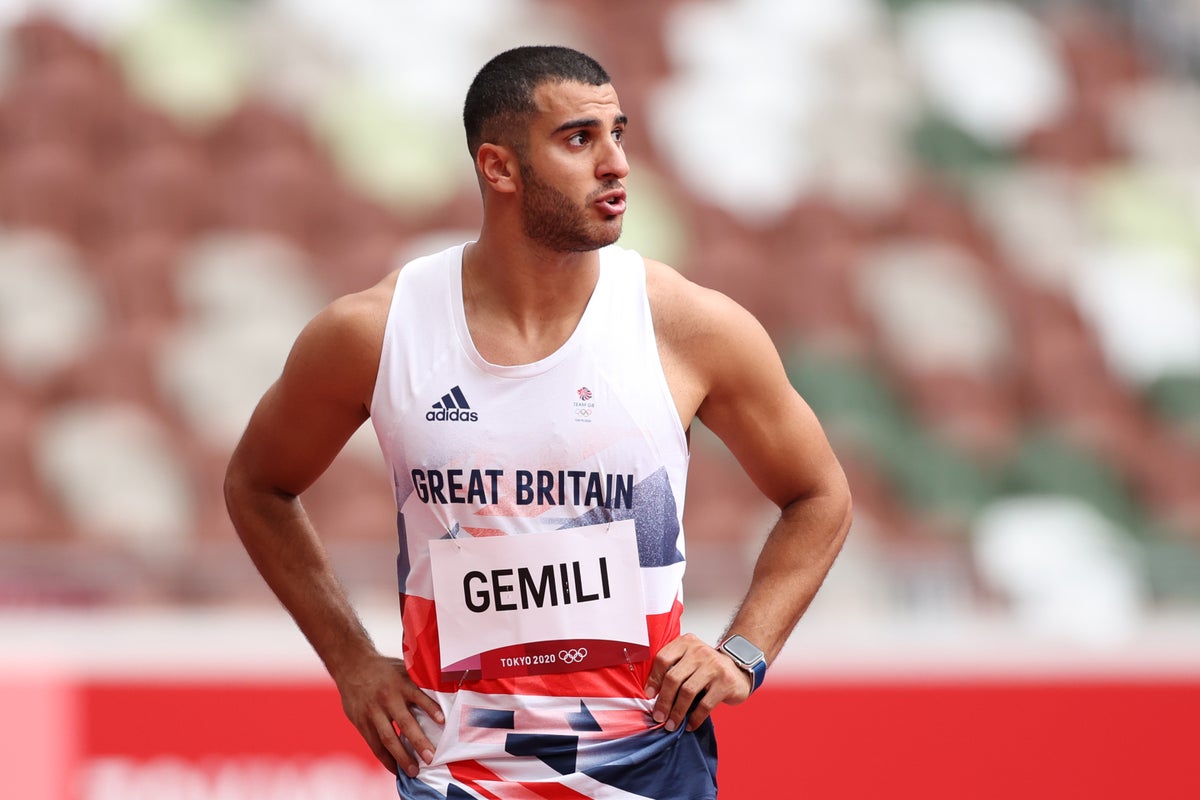
Adam Gemili knows exactly the moment in his career he would transport back to if he had the chance.
It is 12 August 2017, and the World Athletics Championships are coming to a close on a warm evening under the London Stadium’s twinkling lights. The men’s 4x100m final is stacked with talent but the world’s attention is naturally drawn to Usain Bolt, running the final race of his career, against a US team led by Justin Gatlin and Christian Coleman, who beat Bolt to gold and silver respectively in the 100m final a few days earlier.

Gemili is up against the world champion, Gatlin, on the second leg. “If there was one night that I’d love to live again it would be that gold medal in 2017 with the relay boys,” he tells The Independent. The 32-year-old is retiring from athletics after a 15-year career spent battling rivals for the biggest prizes in the sport. And this was the night when he beat them all on the same track.
The 4x100 relay is essentially an absurd endeavour, demanding an athlete explode around the track with every fibre in their body while precisely handing over a slick metal tube inside a 20m box at 25mph. It is run on a knife edge: go too early and you run out of road; leave too late and your teammate must slow down.
Gemili’s work that night should be studied in athletics clubs and PE lessons up and down the country. Stationed on leg two, his changeover from CJ Ujah is immaculate and he tears down the back straight with Britain leading and a stadium going berserk. His pass to Danny Talbot on the top bend is just as clean, and Gemili’s only step out of place is to scream at his teammate with such giddy abandon that he almost clotheslines China’s Su Bingtian in the next lane.
Nethaneel Mitchell-Blake has Bolt and Coleman hunting him on the anchor leg, but Bolt has too much ground to make up and ends in a heap on the track clutching his hamstring. Coleman surges, but Mitchell-Blake holds off the American to win by half a stride.
It was the perfect team performance. Four men ran around a 400m loop and the baton’s speed never dropped. It was Britain’s first men’s 4x100m world title, won in a European record time. On a night when all eyes were on Bolt and the USA, nobody noticed the British quartet until it was too late.
“There were times when I was hugging those guys and I didn’t want to let go,” Gemili says. “In London, at home, racing against the best athletes in the world. Usain’s last race. My family and my friends were all in the crowd watching, too. That whole evening was just such a rollercoaster of emotions.”

Gemili retires from athletics not only as one of Britain’s fastest men – he ran sub-10 and sub-20 times in 100m and 200m – but as one of the most popular athletes of his era, carrying a fierce competitive spirit with humility and humour, and a photogenic smile even Bolt couldn’t match.
Gemili started as a talented footballer in Chelsea’s academy and later had to choose between football and athletics. The lure of an Olympic Games in London helped make the decision for him. A career that saw him become world junior champion in 2012, European champion over 200m in 2014 and a Commonwealth silver medallist the same year, among a string of relay titles, was proof that he chose the right path.
His career collided with four of the fastest humans in history as Bolt, Gatlin, Yohan Blake and Noah Lyles swept up major medals. Gemili remembers his first race against Bolt, aged 19, in the 200m final of the 2013 World Championships in Moscow.
“I’d won my semi-final, I’d just gone sub-20 and I was feeling so confident. I was in lane six and Usain was in lane five. You always have to back yourself and believe. But I remember getting to 50 metres and I put my head up, and all of a sudden this big, tall yellow Jamaican kit just blurred past me. Coming off the bend he just got further and further away.
“I was like, ‘Oh my gosh, this is a different level’. That’s when I realised I’ve got a front-row seat and one day I’ll look back and say, ‘I was there competing with the greatest ever’. I always had that belief – ‘OK, next year I’ll run faster, next year I’ll beat him’. It never happened, but I would never shy away from the fight.”

Bolt spurred Gemili to train harder. His body was constantly pushing the boundary between elite performance and physical breakdown, and injuries struck. “I always used to think I needed to train the hardest to be successful, but it’s actually the athlete that trains the smartest and looks after their body.”
Yet he recovered time and again. Just as his favourite night is clear in his mind, Gemili answers the question of the one race he wishes he could change before it’s finished being asked. If he could rewrite one page in the story, he’d try to find the three thousandths of a seconds that denied him an Olympic medal in Rio de Janeiro, somewhere in his reaction to the gun, or in his lunge for the line, or even in the breakfast he had that morning in June 2016.
Gemili finished fourth in that 200m final, which was inevitably won by Bolt. Hemmed in on lane two, Gemili was well behind after the bend but dragged himself into the medal positions only to wobble slightly in the final metres. He was pipped in a photo finish for bronze by France’s Christophe Lemaitre.
“I’d be lying if I said sometimes I don’t think about it. If I’d just dipped a little bit later, or maybe had a different lane…” Gemili pauses for a moment. “Yeah, that’s the only one missing from my repertoire of medals. I’ve got medals from every champs apart from the Olympics, and having an individual medal for the 200m would have been special. It wasn’t to be, and I can’t ever change it, but I can appreciate it and teach others the lessons I learned.”
He came agonisingly close a few years later at the 2019 World Athletics Championships in Doha, finishing fourth again. Yet Gemili was buoyed and felt like the crowning moment of his career was within his sights, with the Tokyo Olympics around the corner. “I remember looking up at the screen after Rio when I got fourth and I thought, ‘Right, I’ve got to wait four years’. And it ended up being five years before I got a chance to have some redemption.”
The Covid pandemic pushed the Tokyo Games back 12 months and Gemili is convinced that the delay scuppered his best chance of an Olympic medal. When they finally came around, he tore his hamstring in the warm-up. He knew deep down that his Olympic dream was over but he went on anyway, leg heavily strapped, determined to give himself every possible chance. The gun went off and the pain hit instantly. In one of the most moving moments of the Games, Gemili limped all the way to the finish line in tears.
“I was so sad. I was thinking, ‘That is five years of wait gone in an instant’. You’re lucky to get one Olympics, two Olympics – that was my third Olympics. You might not get a fourth. And if you do, you might not be in the same shape. And maybe those tears were like, ‘This was such a good opportunity, and it’s gone’. It was snatched from me.”
The psychological blow lasted well beyond Tokyo.
“It was brutal. That took a real mental toll on me, and I really had to do some work finding myself and finding happiness away from sport. I surrounded myself with my family, my friends, and realised what is important in my life. Sport is good, but there’s no life or death in sport. Everything you do, the wins, the losses, it’s all entertainment.”
For the past few years Gemili has been competing without a sponsor, doing athletics for the love. He has decided the time is right for something new. He has been spending time playing padel and golf, and he has also begun what may bloom into a new career, working at Chelsea Football Club, back where his sporting journey began. Gemili has been training Chelsea youngsters on their speed technique for several months.
He may be on our screens too this summer, as a pundit talking about athletics. The European Championships and Commonwealths are both on home soil and Gemili is buoyant about British chances, led by Keely Hodgkinson after her recent world-record show at the world indoors. “She’s just the queen of athletics. So young, so humble as well. I remember first meeting her at the Doha Diamond League, having lunch with her … she was so nervous. To see where she is now, she’s a brilliant role model.”

For Gemili, the spikes are zipped up and away in the attic. Perhaps, above all, his story is one of faith in the face of logic. Every time he reached a major final, there was Bolt, the fastest man that has ever lived, or Gatlin, or Blake, or Lyles. And through all the triumphs and setbacks and painful near misses, Gemili never stopped believing he could beat them.
“I was fourth at the Olympics in Rio by three thousandths of a second. It takes longer to blink. I’ve definitely had a few close calls but I think they’ve shaped me. I would have loved to have said, ‘I’m a medalist at all these champs individually’, but I always did my best. You can do all the right things, and there’s never a guarantee, but as long as you do your best and you leave it all on the track…
“I competed in an era of the best sprinters in history. And I proved, not just other people but to myself, that I could mix it with the best in the world.” And on a summer’s night in London, with a bit of help from some friends, he finally outdid them.
‘Quad god’ bounces back from Olympic nightmare with huge world championships win
Great Britain’s legendary ex-Olympic champion Mary Rand dies, aged 86
France condemns Olympic genetic testing as a ‘step backwards’
Inside the transformation of the most powerful office in sport
New York Marathon winner Albert Korir banned for five years after doping admission
Mary Rand: Britain’s original golden girl who knocked back Mick Jagger







