
Acuity Inc.'s (NYSE: AYI) stock price is under pressure due to tepid revenue and its impact on analysts' sentiment. The critical takeaway for investors is that this high-quality, cash-producing, capital-return machine trades at a low valuation relative to its growth outlook and ability to drive shareholder value. The stock price may decline in the near term; if it does, good. The value will only deepen, and the potential for rebounding will increase.
Analysts are lowering price targets following the report. However, the lowest targets, including a fresh low of $320, are still well above the early April price action, suggesting not only value, but deep value is present.
Assuming a rebound begins soon, the stock price could rise by 20% and still have an ample upside left. As it is, the consensus of nine tracked by MarketBeat forecasts over a 40% upside from the early April support target, and even higher highs are possible. They rate the stock as a Moderate Buy, and sentiment has been steady for months.
Acuity is well-positioned for the AI age. It doesn’t reflect a boom today, but there is one coming down the pipe. The data centers, AI factories, models, and applications that drive the robust AI outlook are still in the early build-out phase; when reality catches up with the potential, the AYI business will boom alongside the Internet of Things and physical AI. Its Intelligent Spaces segment connects technology with building systems, including occupant interfaces, to enable efficient, AI-assisted operations.
AYI Capital Returns Underpin Stock Price Outlook
Acuity’s capital returns are not robust but include dividends and buybacks, are sustainable, and are on track to grow. The company already exhibits a tendency and commitment to dividend increases, having issued its fourth increase in early fiscal 2026. The yield is low, about 0.3%, but incredibly safe at about 5% of earnings, suggesting the mid-single-digit compound annual growth is also sustainable.
Buybacks are slightly more substantial, having reduced the share count approximately 0.9% on a year-to-date (YTD) basis. They, too, appear to be sustainable with potential for growth, as the year-to-date (YTD) buybacks are less than 50% of free cash flow.
The balance sheet reflects the impact of its capital return, including reduced cash, current and total assets. However, YTD activity also includes strong cash flow generation and debt reduction, resulting in reduced current and total liabilities and long-term debt. The net result is an increase in equity of about 4.25%, leaving the company's leverage very low. Total liabilities are less than 1X equity; long-term debt is less than 0.25X.
Institutional and short-selling activity highlights the quality of capital returns and the potential for a rebound. Short interest is marginal; at 2%, it aligns with the average for other blue-chip-quality names. There is some short interest, but not enough to signal negative sentiment, create a headwind for the market, or cap upward movement. On the flip side, institutions, which control 98% of the stock, have been buying on balance, accumulating at a pace of $2-to-$1, and ramping activity in Q1 2026. They present a solid support base and market tailwind, likely to increase their activity as share prices decline.
Acuity Poised for Big Drop?
Acuity’s stock price action isn’t bullish. The market shows resistance at a critical level, reinforced by a cluster of moving averages, suggesting another drop ahead. However, the market is oversold, so the downside may be limited. The critical target is near $271; if the market fails to reclaim this level, a deeper decline is likely; however, support may appear near $260. If this market can regain the upper $271 level, consolidation will likely ensue, and recovery will begin later this year.
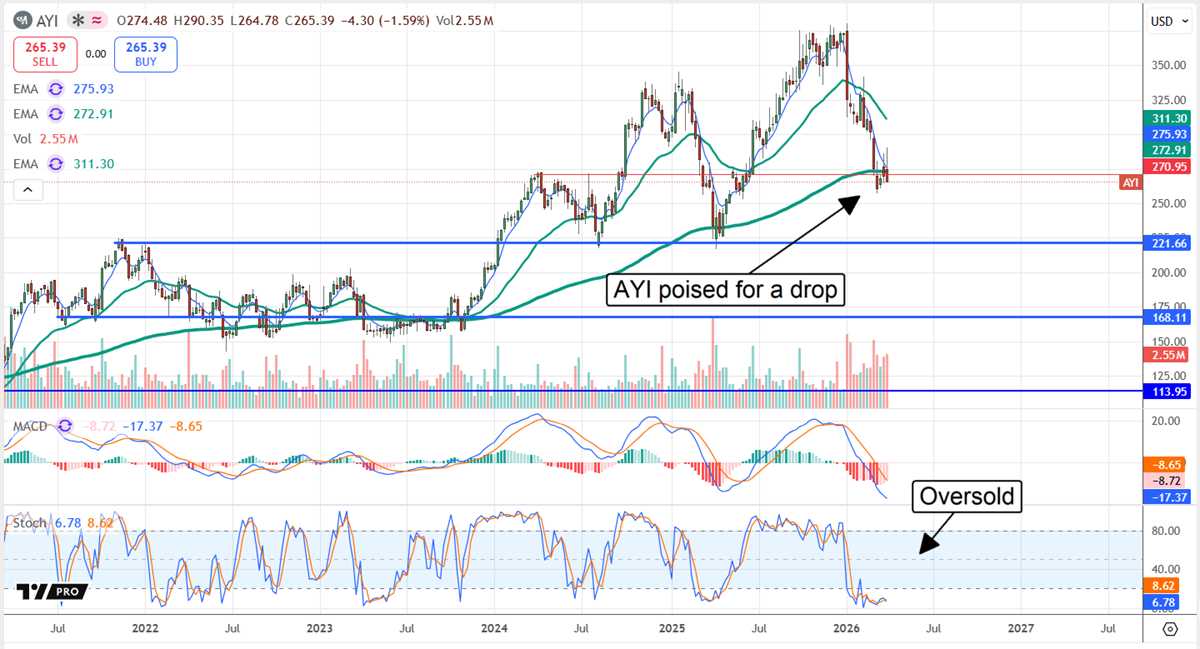
Catalysts include growing its Intelligent Spaces business and margin improvement. The company is leaning into operational efficiency and strategic pricing increases and may outperform expectations. The Intelligent Spaces segment is focusing on higher-margin businesses, including automation and AI. Risks include weakness in the core lighting segment. High interest rates and macro headwinds are sapping demand and undercutting business. The offset is significant, leading to tepid expectations in 2026.
Where Should You Invest $1,000 Right Now?
Before you make your next trade, you'll want to hear this.
MarketBeat keeps track of Wall Street's top-rated and best performing research analysts and the stocks they recommend to their clients on a daily basis.
Our team has identified the five stocks that top analysts are quietly whispering to their clients to buy now before the broader market catches on... and none of the big name stocks were on the list.
They believe these five stocks are the five best companies for investors to buy now...
The article "Acuity Brands Stock Is Dropping—Here's Why That Might Be Good News" first appeared on MarketBeat.