
Get all your news in one place.
100’s of premium titles.
One app.
Start reading
GamesRadar
GamesRadar
Technology
Tabitha Baker

Acer Predator Triton 14 AI vs Razer Blade 14, two slimline gaming laptops but one clear winner

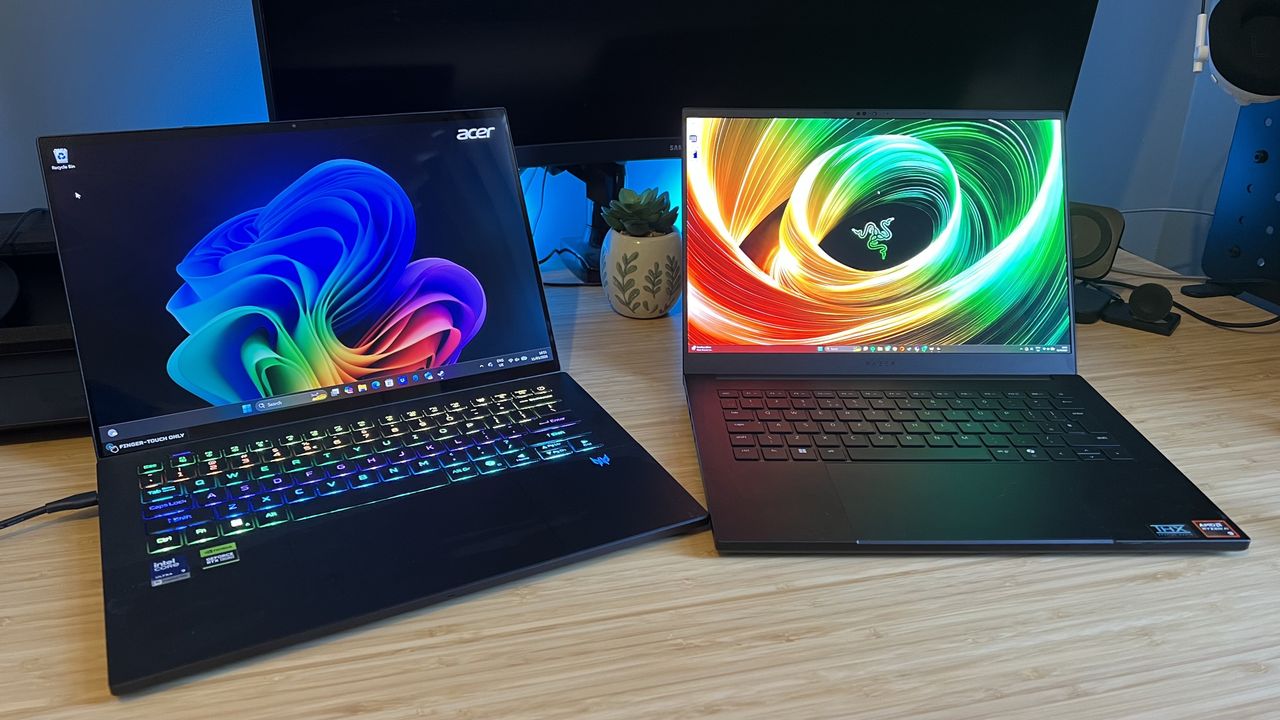
Acer Predator Triton 14 AI and Razer Blade 14 on a wooden desk.

The world of 14-inch gaming laptops is certainly a small one, with only Razer and Asus populating these ultra-portable shelves in recent years. There's one other rookie in the wings, though, and the Acer Predator Triton 14 AI wants a piece of the work-play pie. Going up against some of the best gaming laptops on the market is no easy feat, though.

With a price tag that rivals the very top end of this market, the Predator needs to work hard to justify its position. Unfortunately, with a weaker processor, awkward touchscreen display, and slightly more restrictive supply of components, Sneki wins this Razer Blade 14 vs Acer Predator Triton 14 AI matchup for the majority of gamers. That changes slightly if you're a professional content-creation powerhouse, but overall I'd point most players (and their ~$2,500) in Razer's direction.

Key Specs

Specs

Acer Predator Triton 14 AI

Razer Blade 14

Price

$2,499 (RTX 5070)

$2,699 (RTX 5070)

Display

2880 x 1800 OLED at 120Hz

2880 x 1800 OLED at 120Hz

Processor

Intel Core Ultra 9 288V

AMD Ryzen AI 9 365

GPUs

RTX 5070

RTX 5070 / RTX 5060

RAM

32GB

16GB / 32GB / 64GB

Storage

1TB / 2TB SSD

1TB / 2TB SSD

Connectivity

WiFi 7, Bluetooth 5.4

WiFi 7, Bluetooth 5.4

USB-A

2x USB 3.2 Gen 2 Type-A

2x USB 3.2 Gen 1 Type-A

USB-C

1x USB 3.2 Gen 2 Type-C, 1x Thunderbolt 4

2x USB4 Type-C (100W Power Delivery, DisplayPort 1.2)

Dimensions

12.6 x 8.7 x 0.68 inches

12.23 x 8.83 x 0.64 inches

Weight

1.6kg

1.63kg

TL;DR Acer Predator Triton 14 AI vs Razer Blade 14

Acer Predator Triton 14 AI

  • Ever-so-slightly cheaper
  • Thicker (but not by much)
  • Thunderbolt
  • Weaker processor
  • Fewer configuration options
  • Lower benchmark results
  • Touchscreen

Razer Blade 14

  • Slightly more expensive
  • Thinner
  • USB4
  • Better processor
  • Wider range of configurations
  • Higher benchmark results
  • No touchscreen

Performance

(Image credit: Future)

The Acer Predator Triton 14 AI uses a weaker Intel Core Ultra 9 288V processor, which keeps it restricted in overall performance. The larger L3 cache on the AMD Ryzen AI 9 365 of the Razer Blade 14 is pulling its weight here, giving that RTX 5070 more space to get its engines revved even if Intel's performance cores can move a little faster than AMD (5.1GHz turbo vs. 5GHz).

We're not comparing apples with apples here, though. The Ryzen processor can multithread, running eight threads from its four performance cores - Intel's CPU keeps things like-for-like. The Predator Triton's processor is technically running at a higher clock speed, but Razer's is doing more with its 5GHz.

From my testing, it means a 17.16% performance decrease across PC Mark 10 benchmarks.

That drop makes its way over to more dedicated gaming tests. 3D Mark Steel Nomad represents the most up-to-date run for these systems, testing graphics card performance (and how well the CPU lines up those tasks) across a non ray-traced landscape, rendered internally at 4K.

From my entire testing pool, RTX 5070 gaming laptops typically fall around the 3,200 to 3,300 mark in this test. With their slimmer designs, both the Razer Blade 14 and Acer Predator Triton 14 AI fall below this average, but the Acer is trailing well behind. With a 2593 final score, there's a 17.28% performance disparity here.

Things are similar in-game. Lighter runs like Shadow of the Tomb Raider demonstrate a 19.17% performance decrease when the Acer's running at full QHD+ resolution in max settings. That gap is closed slightly in the more demanding Cyberpunk 2077, with both slimline rigs struggling to keep their heads close to 60fps. Acer's framerates trail by 10.2% in this benchmark.

What does that all mean for you? It means you're going to need to sacrifice more to run more demanding games at 60fps on the Acer Predator Triton 14 AI compared to the Razer Blade 14. That means dropping textures down, killing more advanced lighting effects like ray tracing and ambient occlusion, and possibly scaling back to 1080p in full-throttle titles.

  • Winner: Razer Blade 14

Display

(Image credit: Future)

Both the Razer Blade 14 and Acer Predator Triton 14 AI use use 120Hz OLED panels with a 14-inch 2880 x 1800 display. Both are slightly over-specced in their resolutions, especially if you tend to only play more demanding titles, while both keep their refresh rates a little more conservative.

There's one key difference here. The Acer Predator Triton 14 AI has a touchscreen. If you're buying a productivity laptop first and a gaming machine second, that could well be a benefit. It's rare to find these kinds of panels on rigs with RTX 5070 grunt.

If you want your machine to primarily function as a gaming laptop I'd steer clear. That's because the touchscreen tech enforces a faintly visible series of pixels across the screen. It doesn't get in the way of gameplay too much, but it's certainly noticeable in brighter shots and everyday web browsing. At least, it would be enough to give me pause when considering dropping more than $2,000 on a gaming laptop.

Otherwise both panels match up nicely. There's perhaps a touch more glare on Acer's model, but nothing that's going to shift the dial too much.

  • Winner: Razer Blade 14

Build quality

(Image credit: Future)

Acer has certainly been eyeing up the best Razer laptops from the design room. The Predator Triton 14 AI is almost like-for-like in its CNC-milled, matte black construction. The brand's Predator logo occupies the same spot on the main lid, with the same RGB backlighting. Meanwhile, the inside is similarly barren of stamps, iconography, and additional levelling details.

Acer includes a slightly alternative two-tone internal design, with a lighter gray panel around the keyboard and also adds another logo in the bottom right corner. Other than that, these are very similar machines to look at.

Razer has thickness on its side, but not by much. If you're going for ultimate portability, the discrepancy between the 0.68-inch Blade and 0.64-inch Triton might make for a new point of consideration, but the reality is these are both about as skinny as gaming laptops come. They travel well, sit tucked away on a desk, and both weigh around 1.6kg.

Razer uses a super-strong T6-grade block of aluminum for its main chassis and, while Acer's materials aren't specifically listed, it's ever-so-slightly harder to flex. Really the only difference, though, is when I hold the corner of each machine between my thumb and fingers and push up and down. There's more resistance in Razer's deck than Acer's, but it's an almost insignificant disparity.

  • Winner: Razer Blade 14

Keyboard

This is where Acer might claw back some points. The keyboard on the Predator Triton 14 AI packs a slightly crisper feel than the Razer Blade 14. Combined with larger keycaps, it's taking the lead slightly for those who regularly type for long periods at a time.

Both decks offer a particularly snappy response reserved for high-end machines, but there's an extra sense of energy in Acer's clackers. By contrast, the Razer Blade 14 can feel a little softer under the fingertips.

  • Winner: Acer Predator Triton 14 AI

Extra features

Both machines come with their own software packages, though Razer's is a little more intuitive in its layout and manages to stay less in-your-face than PredatorSense on the Triton. The latter feels a little outdated in its angular, science-fiction design but still gives you access to performance and fan settings as well as key machine metrics.

That Intel processor also means that the Acer Predator Triton 14 AI is able to take advantage of Thunderbolt 4. In short, it's better for high-speed external displays and data transfers, making it a point of note if you're leaning more into the content creation side of this value package.

I also won't be able to live with myself if I don't warn you about that boot up noise. Acer's entry has a particularly booming sound effect running out across its speakers as soon as it powers up. It's not pleasant.

  • Winner: Tie

Razer Blade 14 vs Acer Predator Triton 14 AI

(Image credit: Future)

The Razer Blade 14 is a higher performing laptop than the Acer Predator Triton 14 AI, with a display better suited to gaming and a slightly improved build quality. It's easily the better buy for the majority of players, providing better bang-for-buck power value and a clearer screen to see it all on. It's still got the portable productivity chops most will need, but spans its work/play hybrid philosophy in a more balanced way.

I would only recommend the Acer Predator Triton 14 AI to those primarily buying a productivity machine, and you'd have to be a power user to make the most of it at that. Thunderbolt 4 is going to serve content creators better than USB4 and that touchscreen panel could well be on your hit list as a must-have.

  • Winner: Razer Blade 14

I'm also hunting down the best Asus gaming laptops as well as the best Alienware laptops on the market. For something even more portable, though, check out the best gaming handhelds.

Sign up to read this article
Read news from 100’s of titles, curated specifically for you.
Already a member? Sign in here
Related Stories
Top stories on inkl right now
One subscription that gives you access to news from hundreds of sites
Already a member? Sign in here
Our Picks
Fourteen days free
Download the app
One app. One membership.
100+ trusted global sources.