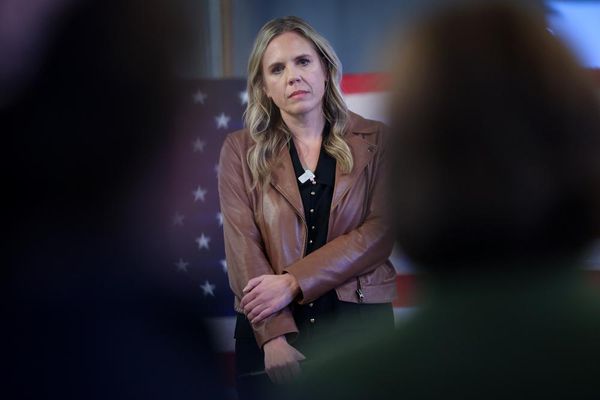
The mask has officially come off. The woman behind the viral fan account for the Hollywood actor Timothée Chalamet is not a 17-year-old girl tapping away on her iPhone, but a 59-year-old full-time healthcare industry worker from California. Simone Cromer, who founded the Twitter account Club Chalamet in 2018, has become a micro-celebrity in niche corners of the internet — oddly adored and often mocked for her dramatic and extensive rants about Chalamet’s career and personal life. When Timmy’s relationship with Keeping Up with the Kardashians star Kylie Jenner was revealed in September 2023, Snow White star Rachel Zegler wrote online: “Is Club Chalamet gonna be ok.” Selfies of Cromer and Chalamet on the red carpet at movie premieres have gone viral; The Hollywood Reporter even covered the news of her home burning down in the Los Angeles wildfires earlier this year.
But Cromer has become a strange source of scrutiny and discomfort, too. In her first profile interview with the Wall Street Journal last week, Cromer — posing awkwardly in the accompanying photographs with one leg up on a bench, wearing black skinny jeans and a T-shirt depicting Chalamet in his role of Bob Dylan — spoke about the backlash she has received, namely the claims that she has an unhealthy romantic interest in Chalamet or that she is too old to be a true part of the fandom. She told the publication: “I can’t change the fact that I was born in 1966. I don’t want to be a 24-year-old white girl running Club Chalamet. I am who I am.” Viral reactions from onlookers ranged from “MY DIVA” to “I’m crying she’s older than both my parents” and then… “Why are they platforming a stalker?”

Why Cromer has become so divisive is down to several factors. Her age — that she is 30 years older than Chalamet — is at the root of this amusement and befuddlement. But then there’s the posts. What started as sincere updates about Chalamet’s latest releases had descended into lengthy, passionate and sometimes overprotective rants about his personal life — leading Cromer’s detractors to label her as “unhinged” and even “dangerous.” When the unlikely romantic pairing between Chalamet and Jenner was revealed, Zegler was clearly onto something — Club Chalamet was not OK. In a live stream, Cromer claimed that the relationship was fake because they had never been to Olive Garden together, and that Jenner was stalking him. After a PDA video of the couple went viral, she told other fans: “If you’re feeling distressed by the video, it’s ok. But please take care of yourself. Step away from social media for a couple of days.” (This post was shared and memed, ad nauseam.)
But if you put aside the tone of her Club Chalamet posts, it’s worth asking that if Cromer were a 17-year-old girl, would she be viewed as such a divisive figure? Fandom discourse is often an excuse to laugh at women. The laughs start to bellow when the women are older, too. Thought-provoking conversations we have about parasocial dynamics and fan entitlement are often washed over by the idea that female fans are simply horny, uncontrollable and obsessed. It’s worth asking whether ageism and misogynoir are at the root of why Cromer specifically is under the spotlight of continuous mockery.

Within Chalamet’s extensive fandom, Cromer has spoken about not being accepted by certain members due to her age. Speaking to the WSJ, Cromer recalled exchanging messages with another fan account owner in 2018 shortly after the release of Chalamet’s career-defining debut in the queer romance film Call Me By Your Name. When the fan asked which high school Cromer had attended and realized she was roughly 30 years older than them, their reaction was: “‘Ew! Oh, my God!’” — before promptly blocking her.
Fan culture has a glaring double standard that creates an unofficial age threshold for participation, according to Dr Lucy Bennett, a lecturer who specialises in media fandom at Cardiff University. “There are powerful cultural perceptions that police who is seen as a ‘legitimate’ fan and who is not,” she tells me. “Older women in particular often face criticism or mockery for enthusiastic participation, even though their engagement is often no different from younger fans,” she says. The idea that some women are “too old” or “inappropriate” for expressing the same kinds of passion as younger fans, Bennett thinks, stems from a “wider cultural discomfort with women displaying visible emotional investment in popular culture”.
Fan accounts have become a fundamental part of contemporary popular culture — and people like Cromer can wield significant power. The biggest accounts in the fandom sphere have become unofficial stakeholders in the celebrity PR landscape, because they “organise information, circulate news, and create shared narratives that help bind the fan community together,” according to Bennett. These people are not just observers; they “actively contribute to shaping the online environment around an artist” and play a “crucial role in helping to amplify artists’ visibility.”

These types of parasocial relationships — a one-sided emotional connection developed towards a celebrity you do not know — are particularly interesting because the fan feels as though they have invested part of their lives into that public figure’s success. Bennett says fans can feel that they have “contributed to the vitality of the fandom” and therefore have a stake in it. “Rightly or wrongly, that sense of labour and dedication can translate into feeling a kind of stewardship or ownership,” she explains. So when something disrupts fans’ expectations — like if their favourite celebrity starts dating a woman they disapprove of — fans can have “very firm opinions about an artist’s career, relationships, and public image.”
While fandoms may form around a shared interest in a celebrity or group, that’s often just a pretext for what truly draws people in: the sense of community. However, fandom culture is not immune to ageism, sexism, racism or homophobia that exists anywhere else, says Suzanne Scott, Associate Professor at Moody College of Communication, The University of Texas at Austin. When it comes to ageism in fandoms, Scott tells me that there is an expectation that women simply grow out of it after their teens and twenties. “Part of this is simply a case of available leisure time, which tends to erode as we get older, and often limits full participation in fan culture even if the emotional investment in the celebrity or media object still exists,” she says. “But culturally, there is also an idea that older people should be focused on less ‘frivolous’ things as they age, and more judgment around devoting time or energy to fannish pursuits.”
While older fans are ridiculed for being automatically cringeworthy or killing the vibe, it goes both ways, as younger fans are also infantilized and dismissed as being naive. The idea that older women can’t participate, Scott says, reflects old-fashioned ideas about how women of a certain age should behave. “There’s something slightly puritan about it, like not wanting to envision our mothers or grandmothers as individuals having a life that precedes their care for us.”
The irony is, though, that the elders in fandom culture are the ones who built it. Scott says that older women “built the infrastructure of fan culture we know and enjoy today from the ground up ... Why wouldn’t they still take pleasure in sharing fan art or theories or writing or reading fanfic just because they’re in their 50s or 60s?”
Of course, we have a right to be concerned about how the boundaries in parasocial relationships have become blurred in recent years. As our virtual access to celebrities’ lives has grown thanks to social media, a small handful of fans have developed a strong sense of ownership and entitlement towards their chosen celebrity. Chappell Roan, the 27-year-old “Pink Pony Club” musician, has been among those to call out disturbing fan behavior — she has spoken of being stalked, of a fan who grabbed her and kissed her, and how they got her dad’s phone number and started calling him. Selena Gomez, Ariana Grande and Doja Cat have also urged their fans to be respectful of their boundaries in recent months. Fan entitlement, then, is at an all-time high.
While Timothée has never publicly acknowledged Club Chalamet beyond the occasional selfie, condemning the account would amount to biting the hand that feeds him. Like it or not, the fan page is part of the PR machinery that ultimately works in his favour. Cromer told WSJ that her sole mission is to help Chalamet win his first Oscar this March for the ping-pong drama Marty Supreme — hardly the agenda of a detractor. Whatever your opinions on Club Chalamet, it’s unlikely Chalamet’s team is losing sleep over her next post; if anything, she amplifies the viral frenzy that routinely surrounds him. And for that very reason, we’ll probably never know what Timmy really thinks of it all.
Timothee Chalamet reveals he was ‘fried’ via text by Leonardo DiCaprio
What is stem cell therapy? Kylie Jenner undergoing the treatment for chronic pain
How Timothée Chalamet is playing a supreme fame game on his own terms
The dangerous habit that two in five young drivers admit to
What is microshifting and how could it transform the workplace
Mpox symptoms explained: From fever to painful skin rash and blisters