
Get all your news in one place.
100’s of premium titles.
One app.
Start reading
Guitar World
Guitar World
Entertainment
Dave Burrluck

“A very good guitar with an evocative backstory”: Gretsch Limited Edition Abbey Road RS201 Studiomatic review

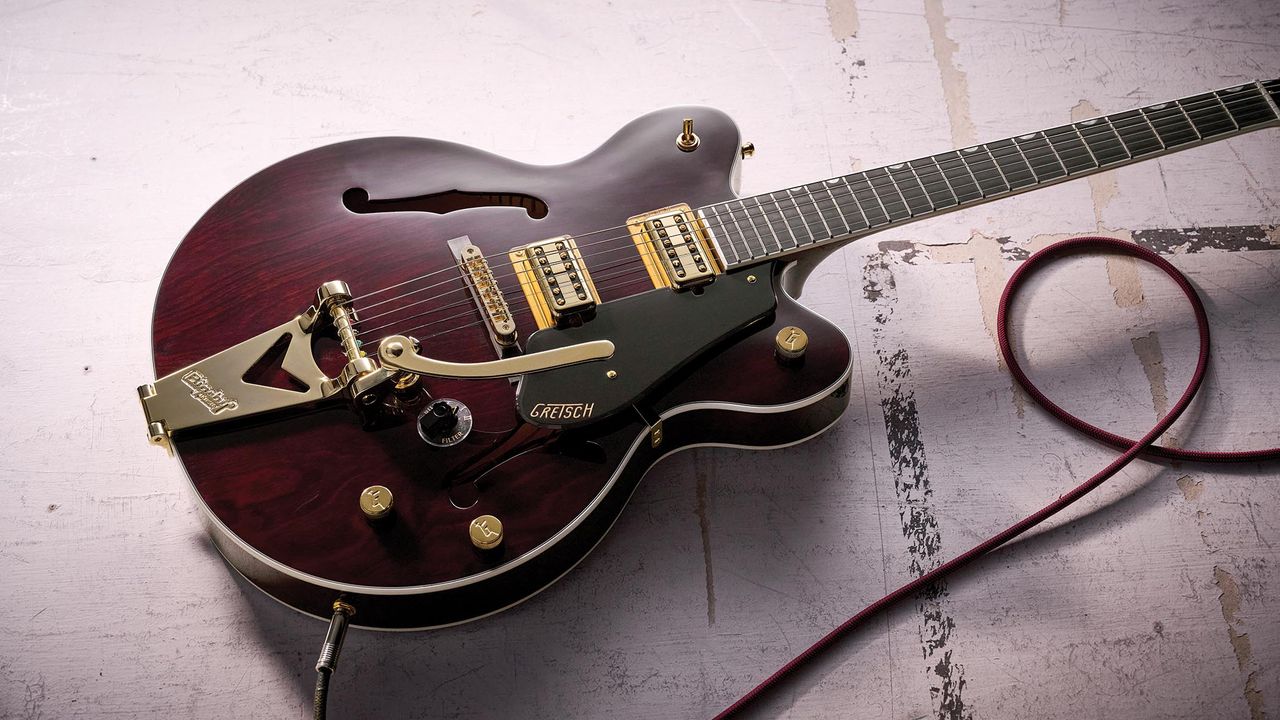
Gretsch Limited Edition Abbey Road RS201 Studiomatic: A tie-up between Abbey Road Studios and Gretsch featuring a recording-aimed circuit inspired by the studios’ Rumble Filter.

What is it?

Abbey Road Studios is probably the most famous recording facility in the world. While it was opened with a concert by Sir Edward Elgar on 12 November 1931, its international fame can be traced back to four Liverpudlians who first entered the building in 1962 and changed everything: The Beatles.

George Harrison’s 1957 black Duo Jet was probably the first Gretsch electric guitar to make music there and was certainly used to record Please Please Me, the band’s first No 1 single (according to some charts, though officially From Me To You takes that honour) and their debut album of the same name. Harrison acquired more Gretsch guitars and The Fabs continued to record at Abbey Road.

While Gretsch still offers the type of guitars that Harrison played all those years ago, the recording studio and the technology within have changed dramatically since those pioneering days.

Today’s ‘studios’ for the vast majority of recording musicians are rather different. And with AI already impacting music creation, not only are recording studios being seen as a thing of antiquity, hey, maybe we don’t even need musicians any more!

It seems, then, an unusual time to celebrate this near-obsolete world, but that’s exactly what we have here with this limited release: a partnering of two very well-known brands. The Studiomatic gets its own ‘RS’ number, “the first time in history that Abbey Road’s legendary ‘RS’ numbering has been awarded to a musical instrument”, says Gretsch.

(Image credit: Future/Matt Lincoln)

Plus, it features “a circuit inspired by the classic RS97 Rumble Filter, a technology designed in the 1950s by the EMI team at Abbey Road to remove very low-frequency and mechanical vibrations from recordings”.

Whatever the backstory, the package is rather good. The hard case – which takes its deep-red outer shade from Abbey Road’s furniture and the blue interior from a paint scrape on a studio door – is pretty classy, as is the timeless elegance and show-off style of the guitar inside.

It might be called the Studiomatic, but there’s no mention of Electromatic anywhere, which is the Gretsch level we’re talking about: a pretty crisply executed Chinese build based on the only double-cut Electromatic in the Hollow Body series, the G5422.

And while we have no idea what ‘limited’ means in numbers, the sense of occasion is nicely referenced by the small nameplate on the headstock bearing the model name, which – like all the hardware – is gleamingly gold-plated.

(Image credit: Future/Matt Lincoln)

Colour-wise, don’t get too excited: it’s Classic Walnut Stain-only. In lower lights, it could be seen as black, but the finish is actually translucent so you can see some subtle wavy grain of the laminate maple body. It’s a big guitar, around 403mm (just under 16 inches) across its lower bouts and about 58mm deep at the rim, which tapers to 53mm by the tip of the rounded horns.

It’s a true hollowbody, too, without any support under the bridge (unlike the Electromatic G5422, which uses the trestle block), having two parallel longitudinal spruce bracing bars – you can just about see them if you peer through the unbound f-holes.

You can also see a very clean internal construction; the neatly kerfed lining strips give more glueing area to join the top and back to the sides. Classic stuff. Outwardly, it’s very clean, too, especially the cream plastic edge-binding around the body with its inner black/white/black purfling strip.

(Image credit: Future/Matt Lincoln)

The neck is spec’d as maple with a headstock that’s scarf-jointed under the 1st and 2nd frets, while the fingerboard is a lightly striped deep brown/black ebony with a single strip of cream binding, just like the headstock, with those classy pearloid thumbnail position markers. The Luminlay side dots give a nod to the modern age.

If the actual finish seems a little dowdy, then remember it’s the perfect backdrop for that gleaming hardware, which includes the licensed Bigsby B60 vibrato, tune-o-matic bridge (Adjusto-Matic in Gretsch-speak), G-Arrow metal knobs and rear-locking tuners.

The gold-plated pickup covers are very visible as they sit some way out of their gold-coloured plastic pickup mounting rings due to the height of the pinned wooden foot-bridge base.

Specs

(Image credit: Gretsch)
  • PRICE:  $1,579 / £1,249 / €1,289 (inc case)
  • ORIGIN: China
  • TYPE: Double-cutaway hollowbody electric
  • BODY: Laminated maple with parallel tone bars to the top
  • neck: Maple, ‘Classic C' profile, glued-in
  • SCALE LENGTH: 625mm (24.6”)
  • NUT/WIDTH: Graph Tech Tusq XL/43mm
  • FINGERBOARD: Bound ebony, pearloid Neo-Classic thumbnail inlays, 305mm (12”) radius
  • FRETS: 22, medium jumbo
  • HARDWARE: Adjusto-Matic bridge (on pinned wooden foot), Bigsby B-60 (with V-cutout) vibrato, enclosed rear-locking tuners – gold-plated
  • STRING SPACING, BRIDGE: 52mm
  • ELECTRICS: 2x Custom Filter’Tron humbuckers, 3-way toggle pickup selector switch, master volume, individual pickup tone controls (w/ pull-switch to engage Rumble Filter), 2-position Rumble Filter selector switch
  • WEIGHT (kg/lb): 3.37/7.4
  • LEFT-HANDERS: Not this model
  • FINISH: Classic Walnut Stain – gloss polyester
  • CONTACT: Gretsch

Playability and sounds

(Image credit: Future/Matt Lincoln)

As an example of just how good Chinese guitars have become, the Studiomaster is pretty much fit for purpose from the off. A quick check reveals the need for a slight truss rod tweak and a slight reset of the string heights, which is easy enough.

While we might be tempted to slightly round the square edges of the fingerboard binding, the overall fretwork is good, aside from a couple of slightly scratchy fret tops and a few sharp ends. There’s good height to the medium-gauge frets, and overall, not least due to the comfortable and well-shaped Classic ‘C’ neck profile, it’s a great player.

Yes, these are bulky guitars, but that’s all part of the appeal. And while plenty of similar builds do feel like bygone ‘jazz’ guitars, the small-travel Bigsby shouts time-warp rockabilly, early rock ’n’ roll and twang. Hey, it’s a Gretsch!

(Image credit: Future/Matt Lincoln)

The hollow construction means it’s reasonably loud unplugged with a practice-aimed archtop-y like quick attack. Plugged in, there’s a good overall depth to the voicing, which gives a solid foundation to the bright and quite attacking bridge pickup. There’s old-school honk here, a good character to the midrange response, and the brightness seems well tamed; the neck pickup retains some of that cut but with more depth.

For many, the classic Gretsch voice is with both pickups on, and here it’s hollowed with rich basses and that classic snap to the highs. Clean and loud with just a little reverb, it produces sounds you’ve heard on plenty of occasions – a sort of Telecaster twang and bounce with pulled-back spike and some added fullness.

(Image credit: Future/Matt Lincoln)

But it’s not a guitar that’s locked in the past: there’s quite a pushy presence to the voicing, less ‘vintage Filter’Tron’ to our ears, a little more standard humbucker perhaps, and one that likes some crunch and fuzz.

Things can get lively with the hollow construction, but musical feedback is easy to coax at relatively low levels, which supports a recording aim.

The two bass-cut tones pull back that depth in different shades. In position II the effect is obvious, pulling down the low-end and into the lower-mids for a leaner, slightly quieter voice.

Position I is more subtle, there’s less effect – in fact, both become a sort of character switch, tailoring those frequency cut areas to suit. There’s no change in the upper-end response, so, like the Jaguar’s bass-cut ‘bright’ switch, the Rumble Filter voices helps focus the voice of the guitar by cutting, not boosting frequencies.

Verdict

Verdict: ★★★★½

(Image credit: Future/Matt Lincoln)

The Studiomaster is well put together and is the most affordable double-cut Gretsch with fully hollow construction and its parallel tone bars.

The double-cutaway style nod to the early ’60s suits the Abbey Road tie-up, although that does elevate the price, of course, as does the posh, considered case.

And while the two levels of bass-cut don’t exactly replicate the original Rumble Filter, the simple circuit (while far from new) works well to clean up and focus the fairly big voice, helping on your recordings and also live.

Guitar World verdict: As many of us record music with little more than an audio interface and a DAW, it does celebrate a bygone time when we trouped off to a recording studio. And nothing quite sounds or looks like a classic Gretsch, does it? This Studiomatic ticks those boxes: a very good guitar with an evocative backstory.

Hands-on videos

Gretsch

Empire Music

Sign up to read this article
Read news from 100’s of titles, curated specifically for you.
Already a member? Sign in here
Related Stories
Top stories on inkl right now
One subscription that gives you access to news from hundreds of sites
Already a member? Sign in here
Our Picks
Fourteen days free
Download the app
One app. One membership.
100+ trusted global sources.