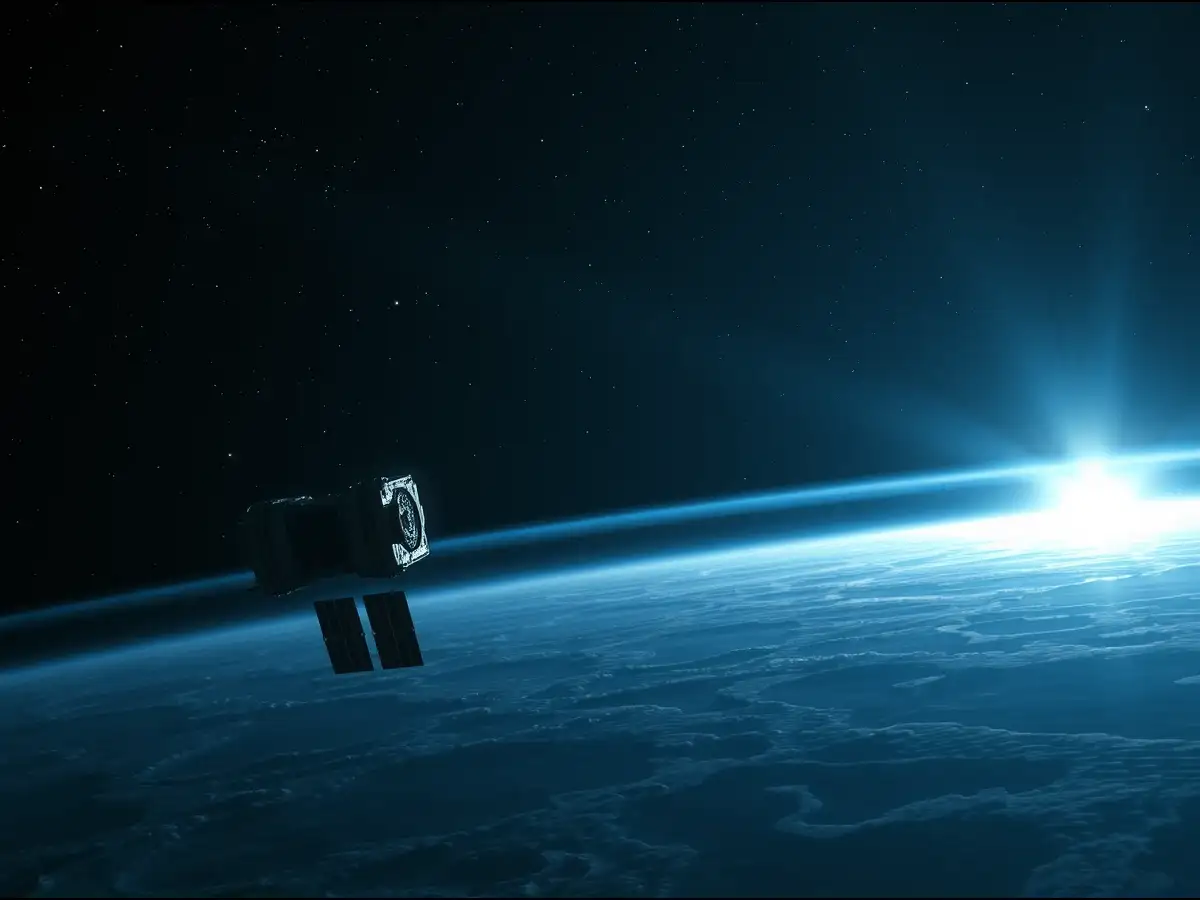
A US satellite on September 22, 1979, detected two brief flashes of light over the remote South Atlantic. The signals were unusual enough to trigger an immediate question inside the US government: had someone secretly detonated a nuclear weapon?
The incident became known as the Vela flash, and more than four decades later, the event remains one of the most intriguing unresolved episodes in the history of nuclear intelligence.

A satellite saw something it was built to detect
The flashes were detected by a US Vela satellite, part of a Cold War-era network designed to monitor nuclear explosions around the world. Its sensors, known as bhangmeters, detected an optical signal consistent with the characteristic pattern associated with a nuclear detonation.
Initial interpretations pointed toward a nuclear test in the far South Atlantic.
The location made the discovery particularly sensitive. At the time, both South Africa and Israel were suspected of pursuing nuclear capabilities, and the possibility of a clandestine test raised serious diplomatic and security concerns.
The CIA put the odds above 90%
The evidence, however, soon became the subject of an extraordinary dispute inside the US government. According to a CIA assessment later made public, the agency estimated the probability that the Vela signal represented a nuclear test at “90% plus.”
Other government agencies and officials also believed a nuclear explosion had occurred.
Additional evidence emerged from the Arecibo Observatory in Puerto Rico. Researchers detected an ionospheric disturbance on the same day that some Department of Energy officials believed resembled effects associated with earlier Soviet nuclear tests. But the White House was not convinced.
A panel rejected the nuclear explanation
President Jimmy Carter's administration established a panel chaired by MIT professor Jack Ruina to investigate the incident. The Ruina panel ultimately concluded that the available evidence could not establish that a nuclear explosion had occurred. One possible explanation was a non-nuclear event in which a meteoroid struck or passed near the satellite.
That interpretation became the semiofficial explanation.
But it did not end the argument. White House science adviser Frank Press strongly favored the Ruina panel's conclusions and remained skeptical of the intelligence agencies' interpretation. According to documents later released by the National Security Archive, some scientific advisers were accused of being so committed to the non-nuclear explanation that they agreed to hear opposing views only so they could “more safely ignore them later.”
Decades later, the mystery remained
The controversy did not disappear with the end of the Carter administration. Later researchers reexamined three major pieces of evidence: the original optical signal detected by Vela, evidence involving iodine-131 and a hydroacoustic signal.
Scientists Lars-Erik De Geer and Christopher M. Wright argued that the combined evidence provided a strong case for a nuclear explosion. Their analysis suggested the event may have occurred near the remote Prince Edward Islands, roughly 955 nautical miles from South Africa.
But the crucial question remained unanswered: who could have conducted such a test?
Israel became the leading suspect in some analyses, with theories suggesting possible logistical assistance from South Africa. Carter himself wrote in his diary in February 1980 that there was a “growing belief” among US scientists that Israel had conducted a nuclear test near southern Africa.
South Africa, meanwhile, was later considered an unlikely candidate for carrying out the test independently.
More than 45 years after those two mysterious flashes appeared over the South Atlantic, the Vela incident remains caught between competing interpretations. Intelligence agencies saw evidence of a nuclear test. White House scientists rejected that conclusion. Later researchers reopened the case.