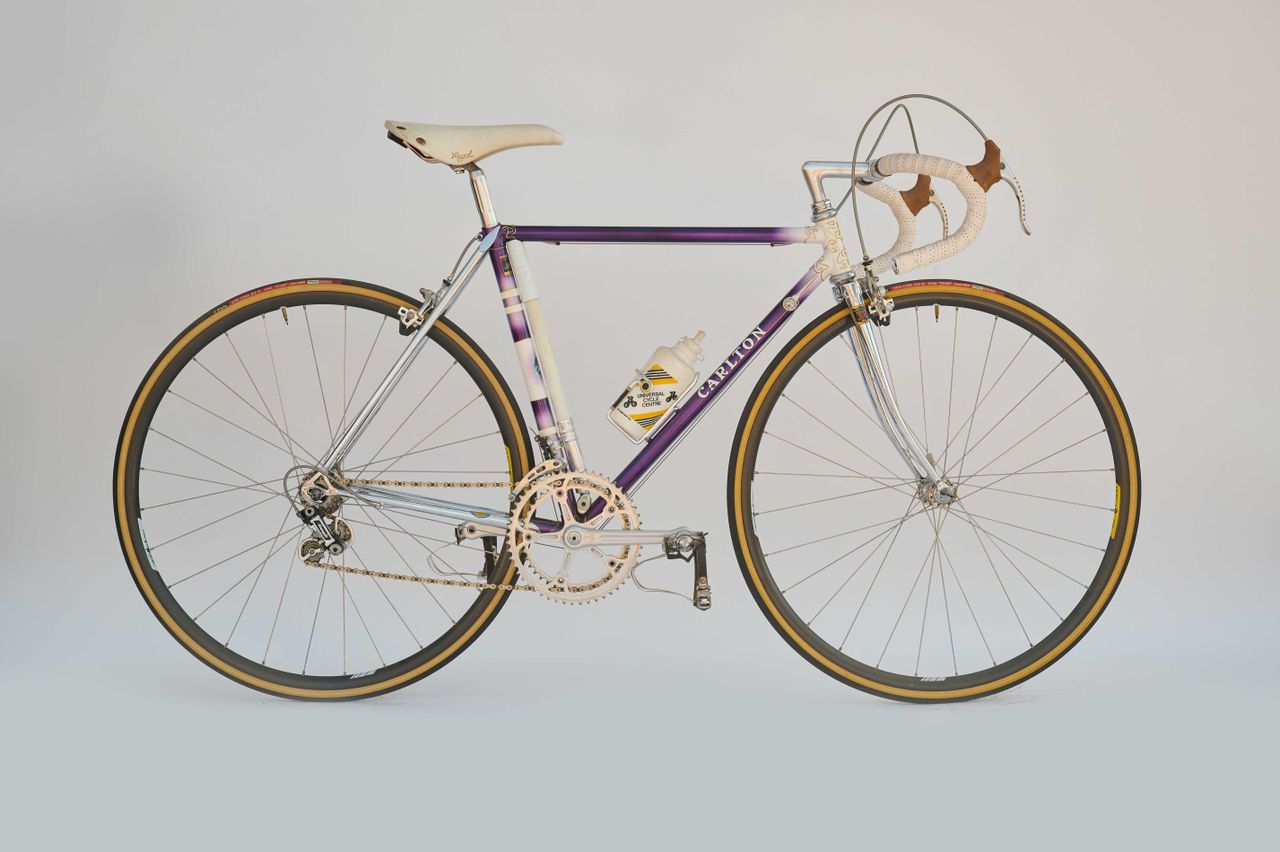
This Carlton International remains in mint condition because, aside from a few brief test outings, it hasn’t been ridden since it left the brand’s Worksop factory fifty years ago. Instead, it has served as a two-wheeled sculpture, a poignant reminder, in these times of identikit carbon frames, of how the steel bike aesthetic, as well as the craftsmanship that spawned it, peaked in the 1970s and early 1980s.
>> The enduring appeal of handbuilt bikes and why we still fall in love with them

The frame’s stand-out feature is, of course, its exquisite lugs. “The ornate lugs were hand-cut by Bob Keeling, a near legendary figure at the Carlton factory at that time,” confirms owner Dave Marsh. When he purchased the bike in 1975, the young Marsh was working at Carlton building bikes.
“The International was my dream bike. Many regard the Jewel as Carlton’s flagship model, but for me, the International is the best; the craftsmanship is just outstanding. Bob worked on the investment cast lugs - he kept drawings of every Carlton lug design and even hand-made the tools he used to cut them – while Rick Powell, another master craftsman at Worksop, made the frame.”

The frame was built from Reynolds 531 ‘Superlight’ tubing, before being hand-painted by Powell in its distinctive ‘flam purple’, white and gold livery.
Cinelli Criterium bars paired with a Cinelli 1R stem form the cockpit, while the groupset is Campagnolo Super Record (what else!) with 52t/42t chainrings. Remarkably, the wheels determined the cassette choice. “I chose a low flange Campagnolo hub for the front wheel,” said Marsh, “opting for a HiLo hub on the rear for improved drive side stiffness.

The cassette is a small 6-speed 13t/18t, solely because anything larger than 18t obscures the view of that beautiful high flange!”
The hubs are laced to Campagnolo Omega V-profile clincher rims (28-hole, front and rear) shod with Vittoria Open Corsa Evo SC amber wall tyres. Marsh fondly recalls that it rides as smooth as it looks…