Get all your news in one place.
100's of premium titles.
One app.
Start reading
The Conversation
The Conversation
Robert Clarke, Senior Lecturer in English, University of Tasmania

A sculpture made from 80 tonnes of sand, Mirrorscape is remarkable – but too much is left unsaid

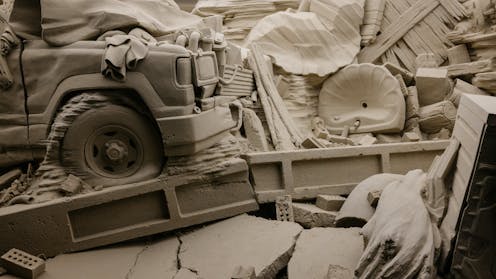
Mirrorscape (detail), 2025, Théo Mercier. Photo credit: Mona/Jesse Hunniford. Image courtesy of the artist and the Museum of Old and New Art, Hobart, Tasmania, Australia.

The first impulse is to kick it. After all, it’s a sand sculpture. And as everyone who has grown up near a beach appreciates, if it’s made of sand, then it’s asking to be kicked. But for the wall-high protective glass, Mirrorscape, by the French artist Théo Mercier, may not have survived my visit to MONA.

On a low, curved stage sits a scene of mundane wreckage. Two utility vehicles serve as centrepieces. One is upturned, its front chassis exposed. It rests on the carcass of a two-seater lounge. A mattress is draped over the upper side of the wreck, a broken log, a signifier of the non-human world in this otherwise secular scene of anthropocentric waste, rests against the lower side.
Sign up to read this article
Read news from 100's of titles, curated specifically for you.
Already a member? Sign in here
Related Stories
Top stories on inkl right now
One subscription that gives you access to news from hundreds of sites
Already a member? Sign in here
Our Picks
Fourteen days free
Download the app
One app. One membership.
100+ trusted global sources.