Get all your news in one place.
100's of premium titles.
One app.
Start reading
Cycling News
Cycling News
Sport
Dani Ostanek

A rare full cancellation, Ethan Hayter's lost points, historical precedent –How the UCI rulebook was applied on the annulled stage 3 of the Vuelta a España

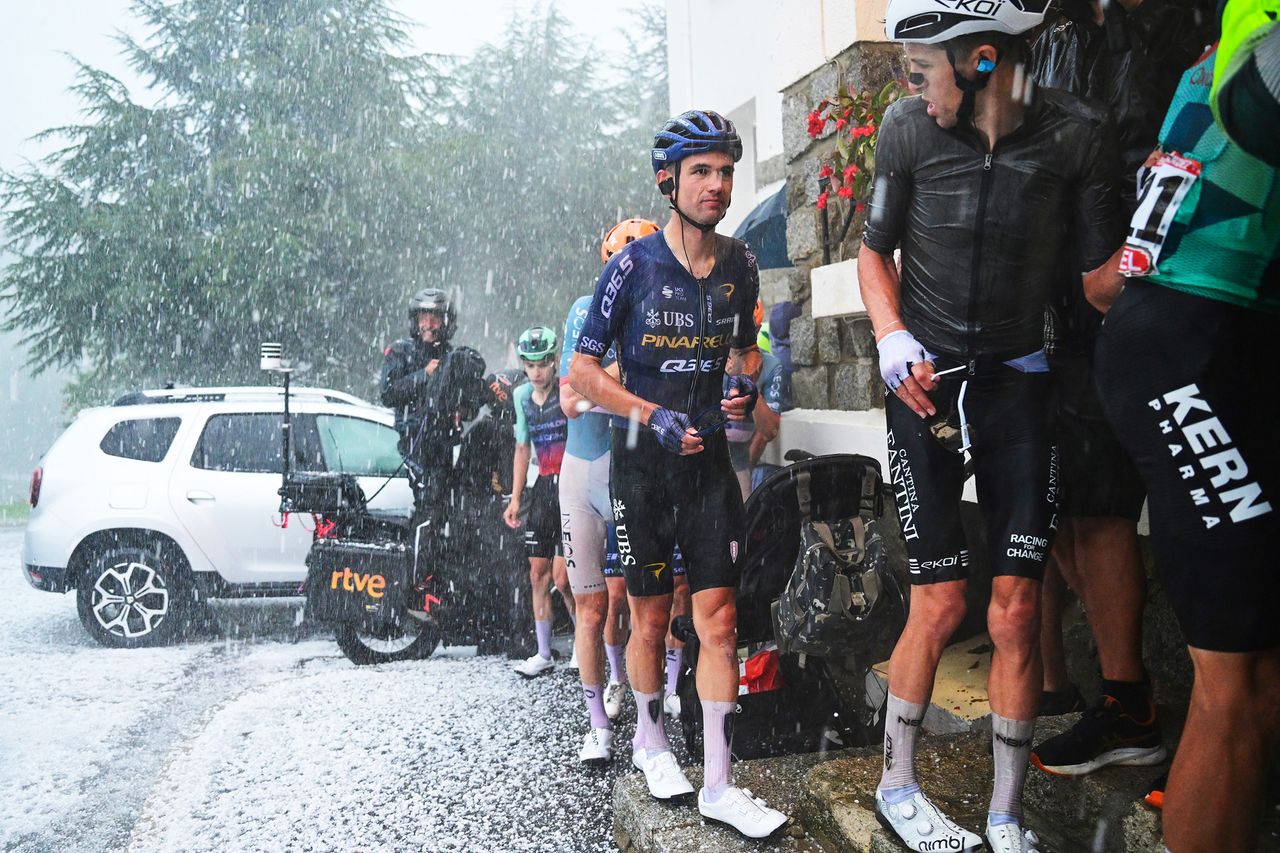
FONT-ROMEU, FRANCE - AUGUST 24: Milan Vader of Netherlands and Team Pinarello - Q36.5 Pro Cycling reacts after the cancellation of the stage due to a hailstorm during the La Vuelta - 81st Tour of Spain 2026, Stage 3 a 174km from Gruissan - Aude to Font Romeu 1941m / The stage is cancelled due to extreme weather conditions / #UCIWT / on August 24, 2026 in Font Romeu, France. (Photo by Tim de Waele/Getty Images).

Monday's third stage of the Vuelta a España was rightfully cancelled after a massive hailstorm pelted the peloton 15km from the finish line in Font Romeu.

As well as the stage being called off with no winner, final result or times taken, the events of the day – including the results of the intermediate sprint – were also wiped from the record.

Ethan Hayter had collected 20 points at the intermediate sprint, a result which would have propelled the green jersey wearer above Tadej Pogačar and into the points classification lead.

Should those points have been taken away? And does the full cancellation mean that riders who hadn't finished the stage are back in the race? We've taken a look at both the rulebook and the history books to find out.

The historical precedents

Of course, the events of stage 3 aren't a first in cycling history. Far from it. Through the years, there have been plenty of Grand Tour stage cancellations, neutralisations, and shortenings.

A total cancellation of a stage while riders are out on course is very rare. Race organisers usually find some way of salvaging the stage – whether through rerouting the race, hastily creating a new finish line, or taking GC times at some point along the route.

Only a handful of stages in recent history have been fully cancelled with all results annulled, as we saw on Monday. The most recent of those came just last year at the Vuelta. The pro-Palestine protests which marked the race saw the final stage to Madrid cancelled with all results annulled before the peloton reached the closing circuit.

At the 2023 Giro d'Italia Donne, the opening time trial in Chianciano was cancelled mid-stage after heavy rain and flash floods struck. Before that, you have to go back to 1988 and stage 11 of that year's Giro d'Italia. Environmental protesters blockaded the final kilometres to Colle Don Bosco, leaving riders unable to reach the hilltop finish. Organisers were forced to cancel and annul the entire stage.

10 years earlier, the Vuelta's stage 19b time trial was similarly cancelled after Basque protesters blocked the road.

Beyond that, a host of other Grand Tour stages have been called off or cancelled for a variety of reasons – extreme weather, protests from riders and outsiders, and rider deaths – with varying applications of the rulebook.

The 2025 Vuelta a España was hit by several neutralisations and cancellations amid mass pro-Palestine protests (Image credit: Getty Images)

Two other stages of last year's Vuelta were also altered by pro-Palestine protests, with stage 11 in Bilbao neutralised with no final result but with GC times recorded, while stage 16 in Mos. Castro de Herville saw the finish line moved and all results, time gains and points kept.

Famously, stage 19 of the 2019 Tour de France was also neutralised mid-race due to a hailstorm and landslides on the descent of the Col d'Iseran. The stage produced no final result, but points and GC times were recorded as a new finish line atop the climb saw Egan Bernal race into the yellow jersey.

No one-size-fits-all rule for race cancellations

It makes sense that there's no one-size-fits-all rule for race cancellations and annulments, given that every race and circumstance is different, with stages subject to rapidly changing events.

As such, UCI regulations are somewhat open-ended, giving commissaires and race organisers broad licence to decide how to cope with race-altering incidents.

Section 2.2.029 of the UCI rulebook states:

"In case of an exceptional accident or incident that could impinge upon the normal conduct of a race in general or a particular stage thereof, the race director may, after obtaining the agreement of the commissaires' panel and having informed the timekeepers, at any moment, decide:
• To modify the course; to temporarily neutralise the race or stage;
• To stop a race or a stage and restart the race or stage;
• To definitively stop the race or stage; To cancel a race or a stage.

"The president of the commissaires’ panel, after consulting the organiser, may take the following sporting decisions:
• Cancel or let the results stand in case the race is temporarily neutralised or stopped, taking account of the gaps recorded at the moment of the incident;
• Cancel or let the results stand of an intermediate sprint, mountain sprint or any classifications;
• Declare a stage or a race null and void,

"If necessary, the commissaires' panel may consult the technical delegate appointed to UCI WorldTour events by the UCI to reach a decision."

As we can see, Vuelta organisers and the UCI's commissaires took the most definitive course of action here, resulting in a total cancellation and wiping the stage from history as if it had never happened.

A statement released by race organisers read: "Stage 3 has been cancelled following consultation between the organiser and the President of the Commissaires' Panel. The decision was taken due to a significant deterioration in weather conditions during the stage, including poor visibility, strong winds and icy road conditions. After consultation with the organiser, the President of the Commissaires' Panel decided that the results of both the intermediate sprint and the mountain sprint has been cancelled."

Lost points

Ethan Hayter was among the riders not entirely pleased with the stage's outcome (Image credit: Getty Images)

Obviously, that decision meant there was no race for the stage win and no hastily drawn finish line earlier in the stage, meaning we'll never know whether Lorenzo Fortunato or Mats Wenzel might have held on, or how the first race's mountain GC showdown might have turned out.

Wenzel's KOM points over the top, which would have put him into the mountain classification lead, were wiped, as were Ethan Hayter's 20 green jersey points at the intermediate sprint. As a result, the Briton lost out on the chance to hold the green jersey outright.

Hayter and Wenzel both expressed confusion and disappointment about the decision at the start of stage 4.

It's worth noting that the organisation's statement placed the decision to scrap these moments from the results sheet at the hands of the UCI commissaires.

The rules are unclear whether Alex Kirsch's DNF is also wiped from the record, giving him a chance to continue the race, but, given the illness that dogged him during the opening stages, it's unlikely he'd be well enough to do so anyway.

In any case, the Vuelta rolls on today, with stage 4 promising the big mountain showdown in Andorra. Let's hope the hail stays away this afternoon. Before all the action begins, take a look back through history at stage cancellations and annulments through the years.

A history of Grand Tour stage cancellations and annulments

Race

Event

Outcome

2026 Vuelta a España, stage 3

Hailstorm

Total cancellation and annulment of all results

2026 Giro d'Italia Women, stage 8

Avalanche/ice sheet fall risk

Finish moved during stage, all results stand

2025 Vuelta a España, stage 21

Pro-Palestine protests

Total cancellation and annulment of all results

2025 Vuelta a España, stage 16

Pro-Palestine protests

Finish moved during stage, all results stand

2025 Vuelta a España, stage 11

Pro-Palestine protests

Neutralised, no stage result, GC times and points stand

2023 Giro d'Italia Donne, stage 1 TT

Heavy rain, flash floods

Total cancellation and annulment of all results

2020 Giro d'Italia, stage 19

Cold weather, rider protest

First half of stage skipped, all results stand

2019 Tour de France, stage 19

Landslide, hailstorm

Neutralised and finish moved, no stage result, GC times and points stand

2013 Giro d'Italia, stage 19

Heavy snow, cold weather

Stage cancelled before start

2013 Giro d'Italia, stage 15

Heavy snow

Finish moved before stage, all results stand

2011 Giro d'Italia, stage 4

Wout Weylandt's death on stage 3

Memorial procession, no stage result/GC times/points

2009 Giro d'Italia, stage 9

Peloton strike after crashes

Stage neutralised with a sprint finish, no GC times or points

2001 Giro d'Italia, stage 18

Peloton boycott after police anti-doping raids

Stage cancelled before start

1998 Tour de France, stage 17

Peloton protest after police anti-doping raids

Stage neutralised with a go-slow, no stage result/GC times/points

1995 Tour de France, stage 16

Fabio Casartelli's death on stage 15

Memorial procession, no stage result/GC times/points

1989 Giro d'Italia, stage 16

Blizzards

Stage cancelled before start

1988 Giro d'Italia, stage 11

Environmental activist protest

Total cancellation and annulment of all results

1983 Giro d'Italia, prologue

Metalworker's union protest

Stage cancelled before start

1978 Vuelta a España, stage 19b TT

Pro-Basque protest

Total cancellation and annulment of all results

For unbeatable coverage across road, gravel and tech, subscribe to Cyclingnews. You'll get comprehensive race coverage of La Vuelta a España, subscriber-exclusive analysis from our expert columnists, in-depth features and industry-leading tech insight. Plus, the Cyclingnews app lets you follow the action wherever you go! Join today.

Sign up to read this article
Read news from 100's of titles, curated specifically for you.

Already a member? Sign in here
Related Stories
Top stories on inkl right now
One subscription that gives you access to news from hundreds of sites
Already a member? Sign in here
Our Picks
Fourteen days free
Download the app
One app. One membership.
100+ trusted global sources.