Becoming a mother changes almost every aspect of a woman’s life, but some of the biggest shifts probably occur in the small, everyday habits that often go unnoticed.
That reality recently became a talking point online after a psychology-focused Facebook page shared the changes 17 fathers noticed in their wives after giving birth.
While some answers centered on the lack of rest or the loss of hobbies, others made far more heartbreaking revelations.
Thousands of people found they could relate to the stories, with many postpartum mothers saying they felt seen by the survey.
“I feel this. It took a long time for me to do things for myself,” one person confessed.
Fathers detailed dramatic changes they noticed in their wives after giving birth

In June 2026, the Facebook page Psychology Treatment, founded by author Arsalan Moin, posted that 17 fathers were asked what their wives had slowly stopped doing for themselves after having kids.
“None of the answers felt small,” the post read. “In fact, most of them were heartbreaking because the changes didn’t happen overnight. They happened gradually. So gradually that many couples didn’t notice until years later.”
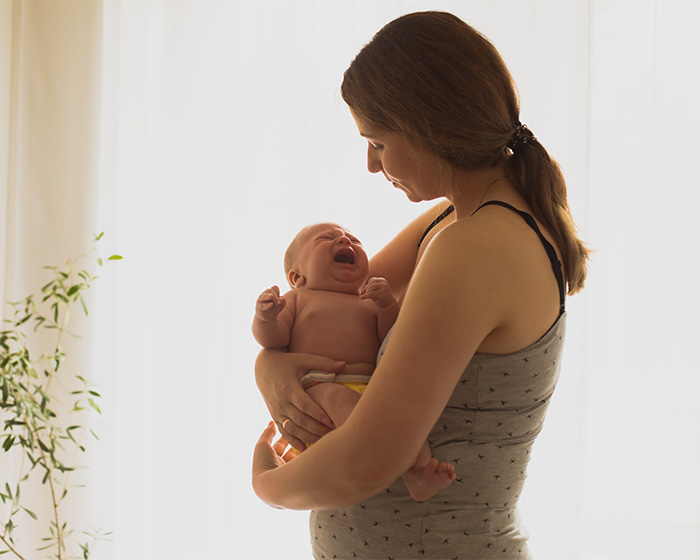
One father said, “She stopped finishing her coffee while it was still hot.”
Another father said, “She stopped buying things without first thinking about everyone else.” Before every purchase, his wife would stop and consider if the kids needed something before she would spend on herself, he added.
Other husbands described how their wives stopped listening to music in the car, stopped pursuing long-nurtured hobbies, or simply stopped taking any time to rest their bodies and minds.
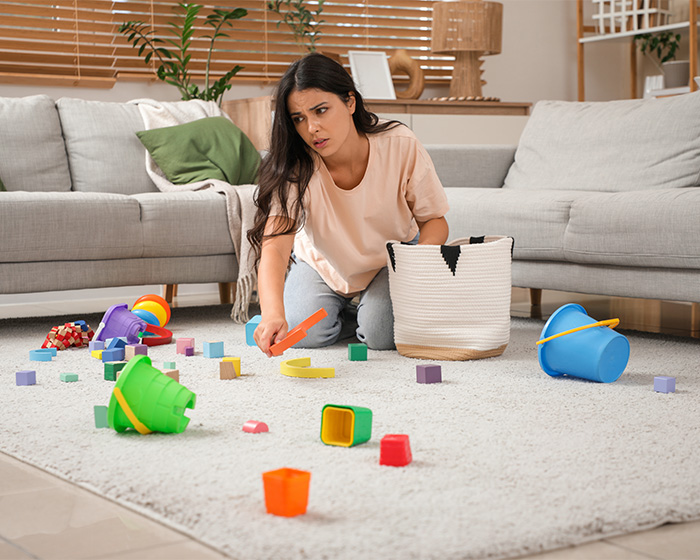
The answer that hit the creator the most was a father’s admission that his wife “stopped being sick.”
“Even when she was exhausted, even when she had a fever, even when she clearly needed rest, she kept going, because motherhood doesn’t always allow people to pause when they need to,” he explained.
The post went on to explain how mothers gradually lose their sense of self, in tiny pieces, by playing the role of planner, organizer, caretaker, and emotional manager for everyone else.


The fathers who noticed the changes said that they wished they had spotted it sooner.
“The strongest thing my wife ever did wasn’t raising our children. It was learning how to matter to herself again,” one father said.
More fathers shared which personality traits of their wives they miss since becoming parents
Other content creators have also conducted similar surveys recently, all with similar answers.
In May 2026, ahead of Mother’s Day, We Are More Than Moms, a platform and community for mothers with 82,000-plus followers run by Annabel Lawee and Dale Stabler, shared one such post.
“She stopped being spontaneous. That used to be her whole personality,” a dad of two said. “Now, she checks everyone’s schedule first and makes excuses for things she actually wants to do.”

“She used to have such strong opinions, even about where we ate,” a first-time dad revealed. “Now, she just says ‘whatever you want.’ I’d give anything to hear her say what she actually wants.”
A dad of three noticed that his wife stopped talking about her dreams: “Not overnight, gradually. Until one day, I realized every conversation was about the kids. I miss hearing about hers.”
A dad of two said his wife used to love working out, but now she does it out of obligation: “The joy went out of it somewhere.”
“She used to laugh at her own jokes — big, full belly laughs,” a father to a newborn said. “She still laughs, but lately it’s quieter. I miss her loud one.”


One mother of two lost the desire to get dressed while going out, and another lost the joy she felt while working out, their husbands said.
One author who goes by “Max” on Instagram, whose account many believe is AI-generated, shared a post on the same topic.
“I can’t remember the last time she ate sitting down,” one father was quoted as saying. Another father said his wife lost a 20-year friendship because she kept canceling plans to meet, and now only texts twice a year.
Studies have stated the near-permanent changes postpartum mothers undergo as part of “matrescence”
Max pointed out in his post that the increased cognitive load and continuous behavioral adaptation that mothers undergo is collectively called matrescence.
First introduced by anthropologist Dana Raphael in her 1975 book Being Female: Reproduction, Power and Change, the word refers to the “dramatic physical, hormonal, and emotional changes as well as changes in her body shape and in her social identity” that mothers experience, according to the British Columbia Medical Journal.

Dr. Aurélie Athan, a clinical psychologist and faculty member at Columbia University, later expanded on it, comparing the physical and psychological changes motherhood brings with those of puberty.
“It’s much like a caterpillar becoming a butterfly,” Athan says on her website, “It undergoes a ‘gooey’ period in which there’s a sense of a breakdown, just like in adolescence.”
A 2025 MRI study found that gray matter volume shrank by 4% to 5% across 94% of the brain, most notably in regions associated with social cognition, among 179 first-time gestational mothers. While some rebounded six months postpartum, the changes weren’t fully reversed.


Other studies show that working mothers continue to shoulder more responsibilities at home, making it ever harder to bounce back postpartum.
A December 2024 study conducted in the U.S. by the University of Bath found that mothers take on 7 in 10 (71%) of all household mental load tasks — 60% more than fathers, who manage just 45%.
“This kind of work is often unseen, but it matters,” said Dr. Ana Catalano Weeks, a political scientist at the institute. “It can lead to stress, burnout, and even impact women’s careers.”

In November 2024, former NFL player Cedric Thompson shared in an Instagram video how difficult it was for him to care for his kids by himself while his wife, Charlotte, was traveling.
“I’ve been a single dad for 8 days because my wife is in the Philippines, and I had no idea it was this tough,” he said with a sleeping child cradled in his arms. “I was prepared for the cleaning, lodging back and forth, the unexpected sickness, the feeding, and the sleeping. But one thing I was not prepared for was the mental load.”
“I had no idea it felt like this. To think about things that need to be done that haven’t been done or things that I need to plan to do is so draining that I don’t even have the energy to take care of myself at all.”
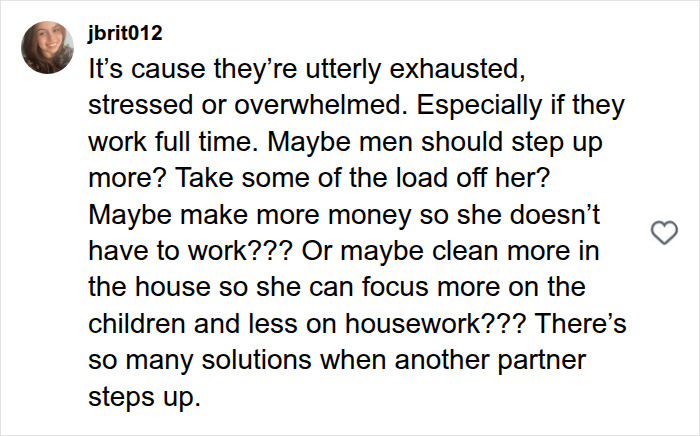
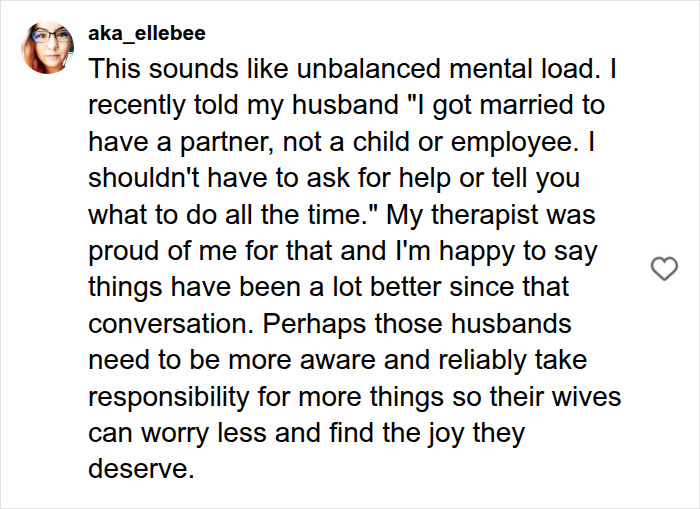
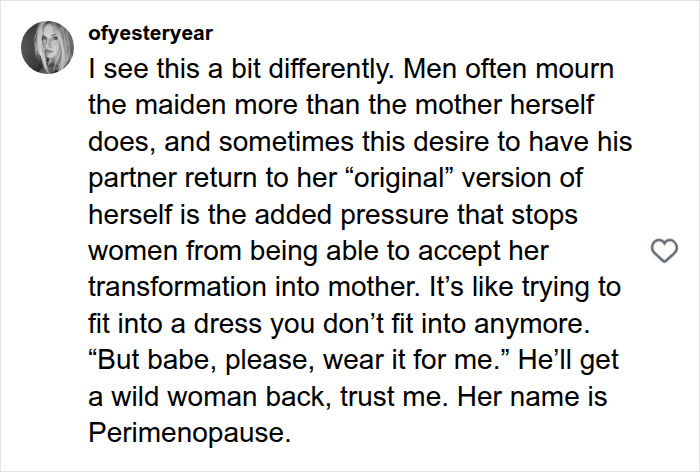
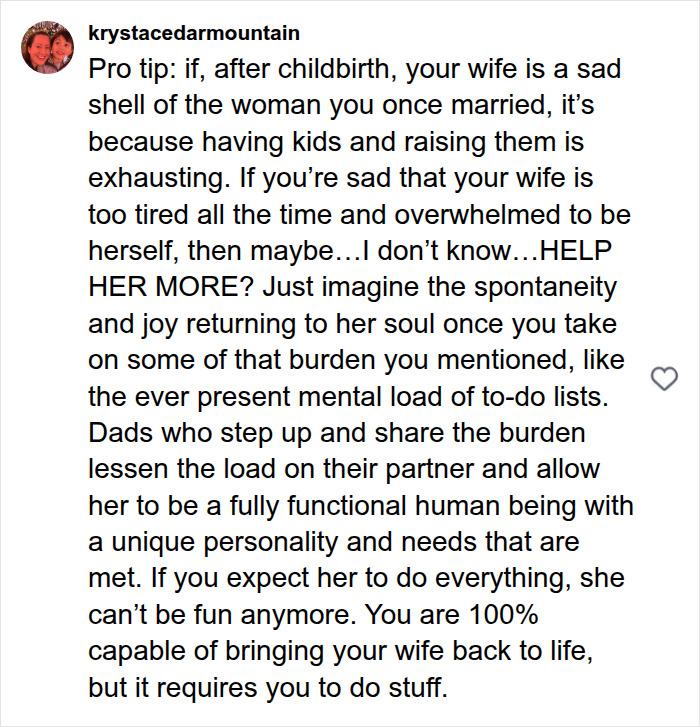
“It takes a village.” Netizens got emotional as fathers shared how their wives changed after childbirth