Get all your news in one place.
100’s of premium titles.
One app.
Start reading
Fit & Well
Fit & Well
Health
Katie Sims

A Pilates instructor’s five go-to moves for runners—the core and glute work that will keep you injury-free

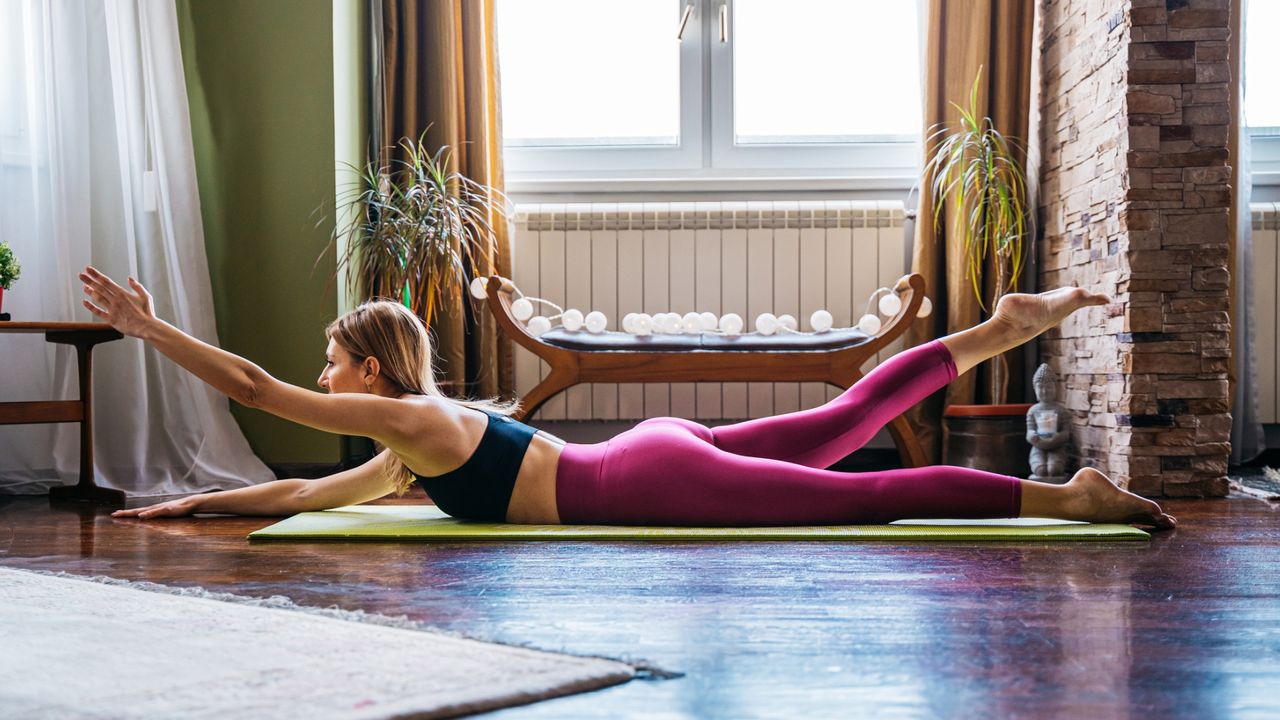
Woman lying on her front on a green exercise mat with one arm and opposite leg raised. she's wearing pink leggings and navy crop top. she's on a dark wooden floor with window and long curtains behind her. .

Pilates can benefit almost anyone, but it can be especially helpful for runners.

Adding Pilates to your training regime is a great way to boost running performance as it helps build stronger core and glute muscles—two essential components for strong running.

That’s why Pilates instructor Jade Winter has designed a go-to sequence specifically for runners, focusing on strengthening the glutes and stabilizing the core.

“As both a former Olympic athlete and the co-founder of Studio Pilates International, I work with countless runners, and one thing is always true: strong glutes and a stable core are the foundation of injury-free, efficient running,” says Winter.

If you’re a keen runner looking for new ways to complement your training and recovery, give it a try—you’ll strengthen your core, glutes, and running performance all at once.

1. Pelvic curl single-leg lift

(Image credit: Studio Pilates)

Sets: 2 Reps: 8-10 each side Rest: 45sec

  • Lie on your back, knees bent, feet hip-width apart and hands by your sides.
  • Extend one leg up, pointing the toes up toward the ceiling
  • Keeping the spine in a neutral position, press through the heel of your grounded foot to lift your hips, keeping your pelvis level.
  • Lift until your knees, hips and shoulders are aligned.
  • Lower with control and repeat.
  • Complete the repetitions on one side then repeat on the other.

How it helps: This one targets the gluteus maximus muscle and pelvic stabilizers. Strengthening these muscles can improve your ability to extend your leg from the hip, which is essential for running power and stride efficiency.

2. Clamshell

(Image credit: Studio Pilates)

Sets: 2 Reps: 15 Rest: 30sec

  • Lie on your side, one leg on top of the other, knees bent and heels together.
  • Raise your top knee while keeping your heels connected and hips level with the floor.
  • Slowly close.
  • Complete the repetitions on one side, then repeat on the other.

How it helps: “Clams are a classic Pilates move for strengthening the glute medius—the muscle responsible for pelvic stability,” Winter says. “Weakness here is one of the biggest contributors to knee collapse and ITB pain.”

ITB, or “runner’s knee”, is a sharp, aching pain on the outside of the knee that can spread up the leg.

Practising clams daily might help if you suffer from this, but you should check with a physiotherapist before doing the move.

3. Swimming

(Image credit: Studio Pilates)

Sets: 2 Reps: 10 Rest: 30sec

  • Lie on your front, legs straight and arms extended forward slightly wider than shoulder-width apart, palms facing down.
  • Raise one arm and the opposite leg a few inches off the floor, keeping your hips grounded and core engaged.
  • Alternate sides and continue for 30 seconds.

How it helps: This swimming exercise strengthens the posterior chain, which includes the glutes, hamstrings, spinal extensors and mid-back muscles, so you’re targeting several areas at once.

4. Horsekick

(Image credit: Studio Pilates)

Sets: 2-3 Reps: 10 each side Rest: 45sec

  • Start on your hands and knees with your hands under your shoulders and knees under your hips.
  • Lift one knee and draw it slightly up and toward your chest.
  • Next, extend it behind you, straightening it in line with your hips and shoulders.
  • Return it to the mat and repeat.
  • Complete all repetitions on one side before repeating on the other.

How it helps: “This is a great exercise to get all stabilizing muscles working together,” Winter notes. “It builds deep core stability, reinforcing the ability to maintain pelvic control.”

5. Hip circle

Sets: 2 Reps: 8 each direction each leg Rest: 20sec

  • Lie on your side, one leg stacked on top of the other, knees bent and heels together.
  • Straighten the top leg, raising it to hip-height and pointing your toes forward.
  • Keeping the leg straight, draw small circles moving from your hip.
  • Complete the repetitions in one direction, then reverse the rotation and repeat.
  • Repeat on the other leg.

How it helps: Hip circles target the hip abductors to build endurance in the muscles around the pelvis.

Sign up to read this article
Read news from 100’s of titles, curated specifically for you.
Already a member? Sign in here
Related Stories
Top stories on inkl right now
One subscription that gives you access to news from hundreds of sites
Already a member? Sign in here
Our Picks
Fourteen days free
Download the app
One app. One membership.
100+ trusted global sources.