
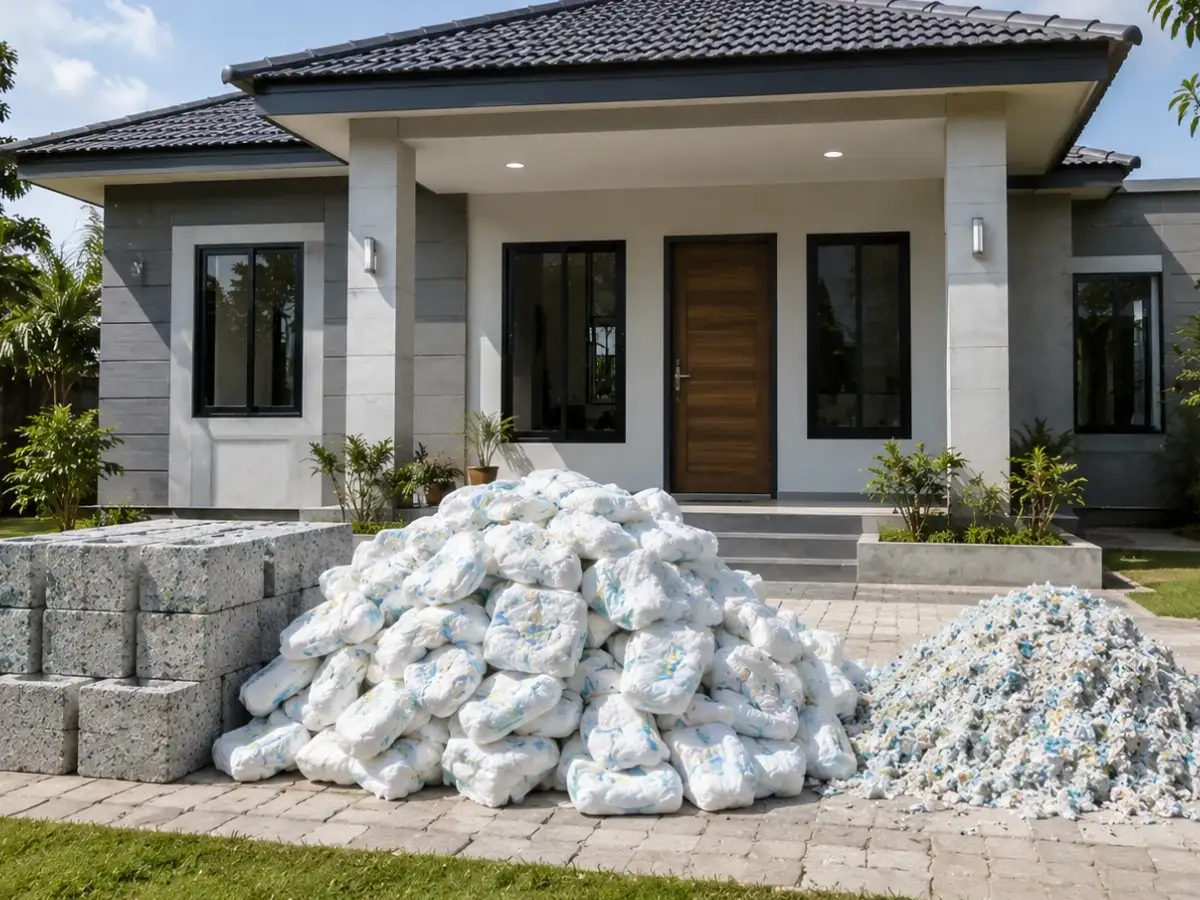
Somewhere in Indonesia is a small, ordinary-looking house, about the size of two parking spots. Two bedrooms, one bathroom, one floor, nothing out of the ordinary. However, inside its walls and concrete blocks is something you would never guess by looking: almost 3,700 pounds of used diapers. Siswanti Zuraida was a PhD student in architectural engineering at the University of Kitakyushu, Japan, when she became the lead author of the 2023 study, 'Application of non-degradable waste as building material for low-cost housing,' published in Scientific Reports. Zuraida started her experiments at home. She washed and dried her baby's used diapers, left them out in the sun for a month, then shredded them by hand with scissors. The concept for the project, and some of its funding, later came from an Indonesian renewable energy and waste-management consultancy that collaborated with her team. That small, odd beginning eventually grew into a full research program, with her team scaling up diaper collection and processing well beyond her own household, and finally resulted in a completed, livable house.
Two problems, one shared root












