
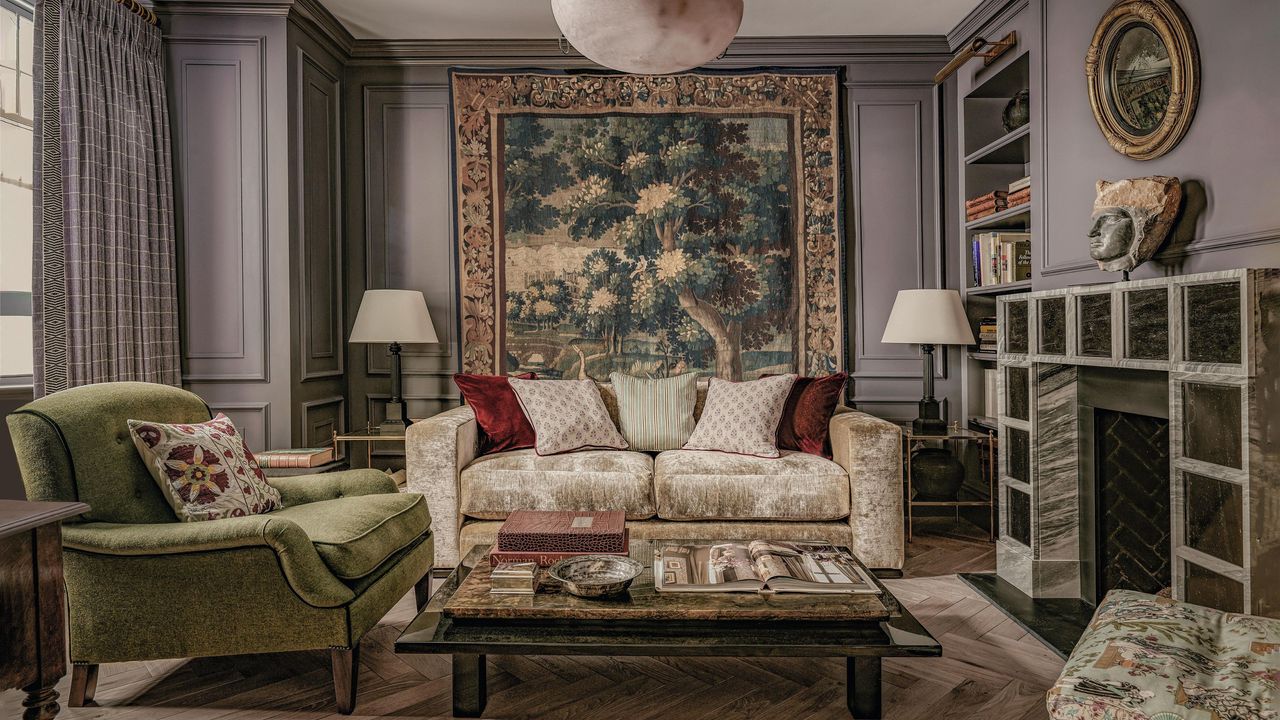
When British global luxury PR consultant Alice Ryan had the chance to modernize her childhood home – a two-bedroom Edwardian townhouse in a leafy London suburb – she called on friend and client Michael Aiduss, an interior designer based in New York.
‘I was incapable of imagining the layout in any other way than how it already existed,’ says Alice. When Michael suggested they establish a more organized floor plan – enlarge the kitchen, move fireplaces, and align doorways to improve the flow between rooms – ‘I couldn’t visualize it,’ she says.

‘That’s often the best part of an interior designer’s job,’ says Michael. ‘To be able to walk into somebody’s home with fresh eyes and see the best way to rearrange and reimagine every space.’

While a place filled with happy memories, Alice held little nostalgia for its details, and it needed a complete house design overhaul.
‘It had become a house that barely functioned,’ Alice says. ‘My mom, a former casting director for Hollywood films like French Lieutenant’s Woman, Braveheart, The Hours, and Mission Impossible, had wonderful style and good taste, but it hadn’t been updated for years.’
In its lifetime, it had been filled with unforgettable character – ‘it was glamorous and layered, always with dozens of candles burning’ – but it would take half an hour to fill the bath. ‘The plumbing was shot, the electrical wiring was shot, everything was shot,’ says Alice.

With only one request to keep the staircase – ‘it felt like the backbone of the house,’ says Alice – Michael set about replacing door trims, door surrounds, baseboards, and cornices.
Paneled moldings were added to the main bedroom to bring order to the space while creating ‘alluring shadow lines,’ says Michael, while the downstairs floors were replaced with white oak in a herringbone pattern, ‘fancier than what would have been there naturally, but it felt like a nice, fresh touch’.

The diagonal corner chimneys in both the home office and living room were relocated and centered in each space; the expanded kitchen, dining space and boot room cum powder room rear addition – fashioned by ‘combining an existing small dining room, small kitchen, laundry and pantry which we pushed out into one space,’ says Michael – leads out into a garden, also accessible via a gate at the back of the house.
‘I wanted to add a little more symmetry and organization to the experience of wandering through the house,’ says Michael.

Despite the home’s modest proportions, Michael didn’t skimp on high style or drama.
To create spaces that felt ‘interesting, warm and inviting’, he played with different atmospheres, from ‘dark and moody’ in the living room, lined with a monochromatic panoramic contrasted with jolts of yellow, to cozy and cocooning in the office, and light and airy in the guest bedroom.

Adding non-structural beams to the kitchen ceiling proved a master stroke, breaking up what would have otherwise been a monotonous, white expanse, explains Michael.
‘Instead, we created a rhythm across the ceiling by allowing the beams to follow the course of the room rather than all going in the same direction.’ It plays with the light, and the softness of the beams complements the pinks and greens in the room, from the walls and tiles to the views outside. ‘It is very captivating.’

Gentle hues, from lavender, sand, and pinkish tan to a serene blue and verdant green, imbue a sense of calm throughout, while antique and vintage furniture, art, and tapestry are teamed with warm textures such as unlacquered brass and vivid marbles.
Contemporary fabrics from Schumacher and Lee Jofa, as well as trims from Michael’s collection of passementerie for Houlès, all work to lend every space an evolved, lived-in feel.

It can also cope with day-to-day living when Alice visits with her husband Kirk, a master tailor, and their three children.
‘I love that there are corners of the house that feel really grown-up, elevated, and special. And others, like the laundry room or kitchen, which have flawless functionality. Michael has elevated the ease and joy of everyday tasks,’ says Alice.

‘The idea was that the house feels generational, all working interestingly together so you can’t necessarily pinpoint a particular era or style in each room,’ says Michael. ‘It just all feels wonderful.’
Love beautiful design ideas, expert advice, and inspiring decor trends? Sign up for our newsletter and get the latest features delivered straight to your inbox.