Get all your news in one place.
100's of premium titles.
One app.
Start reading
The Conversation
The Conversation
Richard Massey, Professor of extragalactic astrophysics (dark matter and cosmology), Durham University

A new generation of telescopes will probe the ‘unknown unknowns’ that could transform our knowledge of the universe

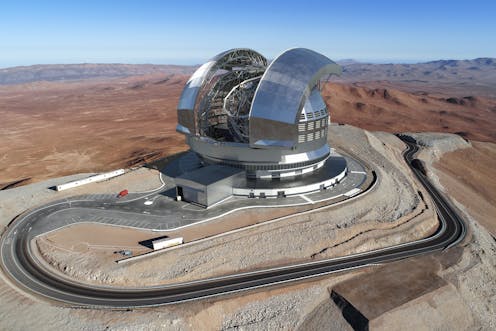
Illustration of the Extremely Large Telescope, currently under construction in Chile's Atacama desert. ESO, CC BY

In recent decades, we’ve learnt huge amounts about the universe and its history. The rapidly developing technology of telescopes – both on Earth and in space – has been a key part of this process, and those that are due to start operating over the next two decades should push the boundaries of our understanding of cosmology much further.

All observatories have a list of science objectives before they switch on, but it is their unexpected discoveries that can have the biggest impact. Many surprise advances in cosmology were driven by new technology, and the next telescopes have powerful capabilities.

Sign up to read this article
Read news from 100's of titles, curated specifically for you.
Already a member? Sign in here
Related Stories
Top stories on inkl right now
One subscription that gives you access to news from hundreds of sites
Already a member? Sign in here
Our Picks
Fourteen days free
Download the app
One app. One membership.
100+ trusted global sources.