Get all your news in one place.
100's of premium titles.
One app.
Start reading
The Conversation
The Conversation
Science
David Wallace, Assistant Clinical Professor of Electrical Engineering, Mississippi State University

A large solar storm could knock out the power grid and the internet – an electrical engineer explains how

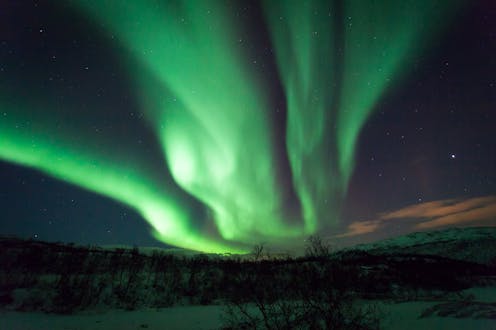
Typical amounts of solar particles hitting the earth's magnetosphere can be beautiful, but too much could be catastrophic. Svein-Magne Tunli - tunliweb.no/Wikimedia, CC BY-NC-SA

On Sept. 1 and 2, 1859, telegraph systems around the world failed catastrophically. The operators of the telegraphs reported receiving electrical shocks, telegraph paper catching fire, and being able to operate equipment with batteries disconnected. During the evenings, the aurora borealis, more commonly known as the northern lights, could be seen as far south as Colombia. Typically, these lights are only visible at higher latitudes, in northern Canada, Scandinavia and Siberia.

What the world experienced that day, now known as the Carrington Event, was a massive geomagnetic storm. These storms occur when a large bubble of superheated gas called plasma is ejected from the surface of the sun and hits the Earth. This bubble is known as a coronal mass ejection.

Sign up to read this article
Read news from 100's of titles, curated specifically for you.
Already a member? Sign in here
Related Stories
Top stories on inkl right now
One subscription that gives you access to news from hundreds of sites
Already a member? Sign in here
Our Picks
Fourteen days free
Download the app
One app. One membership.
100+ trusted global sources.