
Get all your news in one place.
100's of premium titles.
One app.
Start reading
Cycling News
Cycling News
Sport
Matilda Price

A history of the most iconic climbs of the Giro d'Italia Women – Colle delle Finestre joins the list of mythical ascents that have defined this race

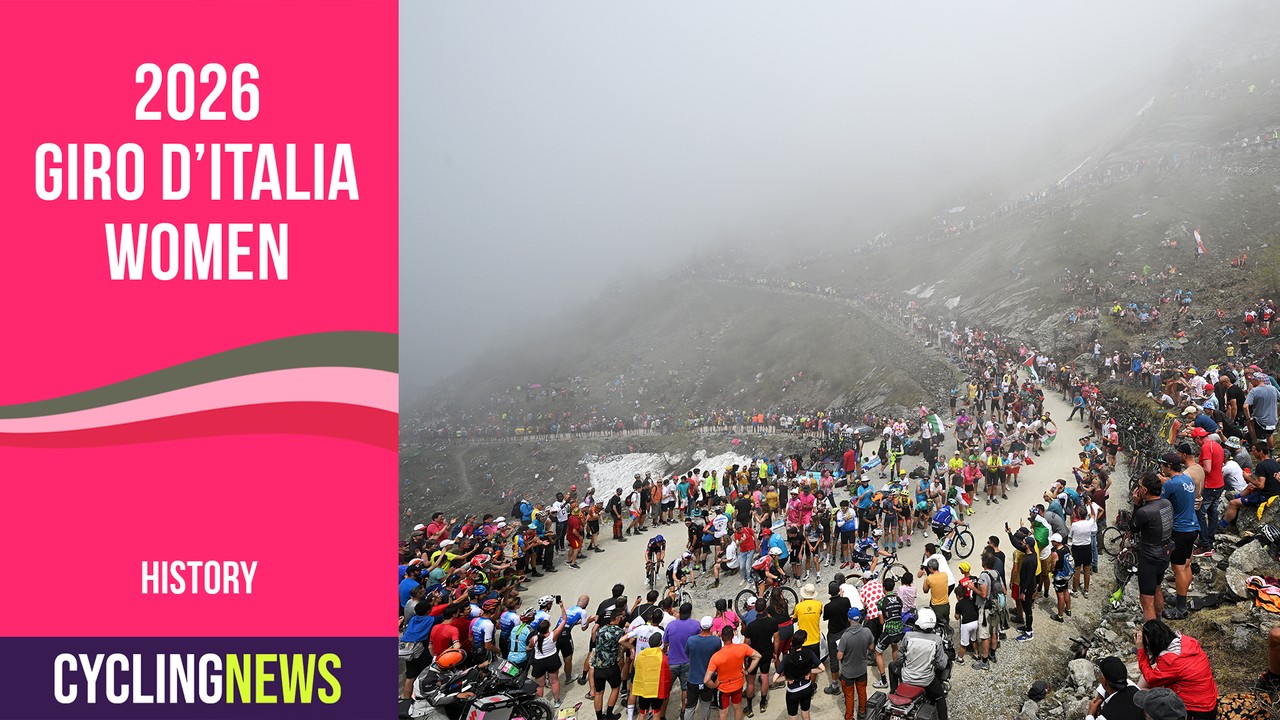
Giro d'Italia Women banner laid over image of Colle Delle Finestre climb.

One of the longest-running and most important races in the history of women's cycling, the Giro d'Italia Women returns this month for its 37th edition, and another new era as the race finally moves from July to the start of June, coming straight after the men's Giro and having its own spot in the calendar.

In its nearly 40-year history, the women's Giro has gone through many guises and eras, from high points to low points, various names and organisational changes, and there hasn’t always been too much consistency for the premier stage race on the women’s calendar.

Its latest chapter only began two years ago, when men's Giro organisers RCS Sport took over the organisation of the race for the first time. That change has brought with it positive shifts, including more professional organisation, better prize money, and a return to some of the Giro's most famous mountains.

However, even though the few years before RCS's takeover were often lacking in big, iconic climbs, that was an anomalous period rather than reflective of the race's history. For decades, the women's race has included hard, high, or otherwise iconic climbs, from the Zoncolan to the Stelvio. With the richness of famous cycling climbs in Italy, some of the country's toughest ascents have come to define the women’s corsa rosa.

Like the Tour de France Femmes avec Zwift and its predecessors, the Giro route has varied in difficulty over the years. Earlier editions took in climbs and stages akin to the men’s race, with some memorable big days in the mountains, and every year there are major climbs on the route, never shying away from difficult stages or big mountains.

This year is of course no different, with the Giro d'Italia Women route tackling one of its biggest mountains yet: the Colle delle Finestre. The Finestre is not a super historic Giro climb, only included in the men's race for the first time in 2005, but it's become a modern legend, thanks to its height and length, but also the gravel roads of the second half which make for some really challenging and seriously picturesque conditions.

In 2025, the women's Giro did not go over 2,000m at any point, with the Monte Nerone and Passo del Tonale marking the race's biggest climbs, but fans were perhaps left wanting a really big mountain. With the introduction of the Colle delle Finestre for 2026, they will certainly be getting that on stage 8 this year.

The Finestre is undoubtedly a blockbuster climb, and a really exciting inclusion in this year's Giro. It's also the latest point in a long tradition of major Italian climbs being included in the women’s race, which has always seen riders tackle some really big mountains.

Before this year's race gets underway, we took a look at some of the most famous and important climbs in Giro history. From the fearsome Monte Zoncolan to the Passo dello Stelvio, here are some of the key mountains in the race’s history.

Colle delle Finestre

Marion Bunel won atop the Colle delle Finestre in the Tour de l'Avenir (Image credit: Tour de l'Avenir Femmes)
  • Length: 18.1km at 9.3% (from Meana di Susa)
  • Altitude : 2,169m
  • Location: Piemonte
  • Last visit: 2026 will mark the Giro Women's first visit

Three years into their guardianship of the Giro d'Italia Women and RCS Sport are pulling out the big guns for 2026, sending the women's race over the iconic Colle delle Finestre with a stage that replicates the finale of stage 20 of the men's Giro. Starting in Rivoli, the 105km stage 8 sees the peloton take on the 18.1km, partly gravel stage up and over the Finestre, and then down to the valley for the final climb back up to Sestriere, where Chris Harper won in 2025 and Simon Yates sealed overall victory.

It's an interesting choice to not finish at the top of the category-1 climb, which stops out at 2,169m at this year's Cima Alfonsina Strada, but arguably this will make the climb and the stage even more interesting, as the gravel section will be the place to make the difference on the stage, but there's a lot of road to come after that and tactics will come into play.

The gravel also adds some difficulty that is rarely seen on mountains, though defending champion Elisa Longo Borghini, who lives near the climb, said it isn't necessarily a definining factor.

"It's a climb, you have to go up. When there is a big Grand Tour passing there they take care of the gravel, and you are uphill, its not a big deal," she recently told Cyclingnews. "Well, unless it's pissing down rain, and then we have a little bit of problems, but I hope for good weather."

Though the Colle delle Finestre hasn't featured in the women's Giro before, it will be a familiar climb for several riders on the start list, as it hosted the finish of a stage of the Tour de l'Avenir Femmes in 2024. They finished atop the climb itself, with Marion Bunel winning in yellow by nearly two minutes to seal her overall victory. Isabella Holmgren took second on that day, and both riders will be back in action at this year's Giro, as well as several other starters from that edition of the Tour de l'Avenir.

Even though the Finestre's inclusion in the Giro comes 21 years after it first featured in the men's race, Longo Borghini urged riders to see the positives and the steps forward for the women's race, reflecting on what the calendar has rather than what it doesn't.

"It's nice that they finally put some mythical climbs in the Grand Tours. I'm glad," she said. "I think these days in the peloton we are always complaining for everything we are missing, but we are never happy for everything that is added. We got Strade, we got Liège, we got Roubaix, we got this and that and that, and still we are complaining that we don't have Lombardy.

"I like to look at the positive, and the women's racing is improving, and we are going through a good period so I also want to appreciate what we have, not only complaining for what we don't have yet, because things will come, but it needs time. So I'm glad that finally we have Mont Ventoux, we have Colle delle Finestre, we have L'Angliru."

Blockhaus

Neve Bradbury won on Blockhaus in 2024 (Image credit: Getty Images)
  • Length: 16.3km at 8% (from Manoppello)
  • Altitude: 1,654m
  • Location: Abruzzo
  • Last visit: 2024, stage 7 won solo by Neve Bradbury

The Blockhaus has long been a staple of the men's Giro d'Italia, so it was no surprise when, in their first year of organising the women's race, RCS Sport picked it as the headline climb for the 2024 Giro d'Italia.

The Abruzzo climb perhaps isn't as famous as the Stelvio or Zoncolan, but over the years it has become a really key Giro climb, known for its challenging and testing gradients.

In 2024, it came at the end of a brutally hard 120km stage, with the riders doing most of the climb twice, going over the Passo Lanciano (11.2km at 8.6%) first and then climbing all the way to the top for the finish at 1,654m. That year it was the race's Cima Alfonsina Strada, the women’s equivalent of the Cima Coppi for the highest point in the race.

Elisa Longo Borghini won that edition of the Giro overall, but it was Australia's Neve Bradbury who won the stage, soloing away from the lead group in the final 15km to claim what remains the biggest win of her career. She completed the climb in 57 minutes and 50 seconds.

Given the women's Giro had already raced on mountains like the Stelvio and the Zoncolan, tackling Blockhaus for the first time was far from unusual in the grand scheme of things, but in the years before 2024 the race had been somewhat bare of big, iconic climbs, and the Blockhaus marked a clear return to that. In line with the Tour de France Femmes tackling Alpe d'Huez and Mont Ventoux and La Vuelta including the Angliru, it's now completely normal – even expected – for women's Grand Tours to visit these iconic climbs too.

Monte Zoncolan

Annemiek van Vleuten celebrates victory atop Zoncolan at the 2018 Giro d'Italia Women (Image credit: Getty Images)
  • Length: 10.1km at 11.4%
  • Altitude: 1,730m
  • Location: Friuli-Venezia
  • Last visit: 2018 , stage 9 won solo by Annemiek van Vleuten in the pink jersey

The Zoncolan is one of the most fearsome and demanding climbs in all of Italy, but that hasn’t deterred Giro organisers over the years, with the Friulian climb featuring twice in the race’s history.

It’s a rare inclusion even in the men’s race - only included there seven times - but has become iconic thanks to its punishingly steep gradients. The 10km ascent has an average gradient of 11.4%, but plenty of sections reach nearly 20%, and it’s a really brutal effort.

It’s perhaps no surprise, then, that the last winner on the Zoncolan was one of the peloton’s best-ever climbers, Annemiek van Vleuten. She attacked halfway up the climb to solo to victory, 40 seconds ahead of Ashleigh Moolman Pasio, for a win that will go down as one of her most memorable.

The first visit was in 1997, and that stage was won by Fabiana Luperini, the five-time winner of the Giro whose name crops up as the winner on many of the race’s most iconic climbs, and she became the first woman to conquer the Zoncolan with a solo win that solidified her overall victory.

Like Alpe d’Huez or Mont Ventoux in the Tour, the Zoncolan is a flagship climb of the Giro, and its two appearances hold a special place in the race’s history.

Mortirolo

Mara Abbott on the Mortirolo at the 2016 Giro d'Italia Women (Image credit: Sean Robinson/Velofocus)
  • Length: 12.2km at 10.8%
  • Altitude: 1,890m
  • Location: Lombardy
  • Last visit: 2016 , won by Mara Abbott in a long solo move

Like the Zoncolan, the Mortirolo is a climb synonymous with the Giro, and has often been the biggest climb and the Cima Coppi in the women’s race.

Its last inclusion came in 2016, where the peloton tackled the 12km ascent in the middle of a short stage, which saw Mara Abbott attack and go on a long solo mission to the finish to take the pink jersey.

Marianne Vos, in the days when she used to be a GC rider, has also won a Mortirolo stage, taking the honours in 2011 with an attack over the climb before descending to victory in Grosotto. She dominated that edition of the Giro, winning no fewer than five stages and the overall.

Prato Nevoso

Anna van der Breggen on Prato Nevoso at the 2021 Giro d'Italia Women (Image credit: Getty Images)

Unlike the previous climbs, Prato Nevoso is not a climb that is synonymous with Italian cycling, but it holds a special place in the recent history of the women’s Giro as one of the toughest climbs amongst some editions that didn’t always include the most famous ascent.

In 2021, the climb cropped up as one of the earliest summit finishes we’ve seen in the race, and saw Anna van der Breggen ride to a dominant solo victory, putting 1:22 into her closest rival and practically sealing her fourth overall victory after just two stages.

That would prove to be her final road victory (she also won the time trial in that race) before retiring and a reminder to the world that she was still the world’s best rider. With the Dutchwoman returning to racing in 2025, this is no longer her final road victory, but the tough climb will remain memorable for her win.

Monte Serra

Mara Abbott (Team Columbia) on the Monte Serra climb at the 2009 Giro d'Italia Women (Image credit: CJ Farquharson/WomensCycling.net)
  • Length: 12.2km at 7.1%
  • Altitude: 873m
  • Location: Tuscany
  • Last visit: 2009 , stage 4 won by Mara Abbott in a mountain-top sprint against Emma Pooley

Despite the Giro’s 37-year history, there are surprisingly few major climbs that have featured in the race more than once, but the most repeatedly visited climb in the corsa rosa is the Monte Serra.

Giro stages have finished atop this climb three times, in 1998, 2008 and 2009, and it has been the site of victories for some of the most famous riders in Giro history.

In 1998, Fabiana Luperini won on her way to her fourth overall victory, and fittingly - or remarkably, to those not familiar with Luperini’s longevity - she repeated that feat ten years later in 2008, winning on Monte Serra before going on to win the race for a record fifth time. Luperini has won on most of the key climbs of the Giro, such was her dominance when she was racing, but the twin wins here are particularly memorable.

The last visit to Monte Serra came in 2009, when stage 4 saw the peloton take on the climb twice in a row. A 23-year-old Mara Abbott took the victory, her first of seven in the Giro, outsprinting Emma Pooley on the line after a gruelling day. She settled for second overall that year, but came back in 2010 to win the race, after first proving herself in the Italian race on the Monte Serra.

Passo dello Stelvio

Mara Abbott races up the Stelvio at the 2010 Giro d'Italia Women (Image credit: CJ Farquharson/WomensCycling.net)
  • Length: 24.1km at 7.6%
  • Altitude: 2,757m
  • Location: South Tyrol
  • Last visit: 2010 , stage 9 won by solo Mara Abbott

When it comes to looking at the winners atop the Giro d’Italia’s key climbs, two names come up again and again: Fabiana Luperini and Mara Abbott. In their time, both were dominant climbers and relished the inclusion of long, difficult climbs, adding some of cycling’s most famous mountains to their palmarès in the way that a rider like Demi Vollering is hoping to do in the modern era.

It’s not surprising, then, that when the Giro visited the Passo dello Stelvio in 2010, it was Mara Abbott who took the win atop one of the hardest and most famous climbs in Italy. The 24km ascent was used in full on the race’s Queen stage, and saw the race blow apart behind Abbott, who was already leading the race. She finished 27 seconds ahead of perennial rival Emma Pooley with an attack in the final 3km and the time gaps, though significant, were not enormous, proving just how closely matched the climbing level in the peloton was at the time, even on one of the sport’s hardest climbs.

Subscribe to Cyclingnews for unlimited access to our Giro d'Italia Women coverage. Don't miss any of the breaking news, reports, and analysis from one of the biggest women's stage races of the season. Find out more.

Sign up to read this article
Read news from 100's of titles, curated specifically for you.
Already a member? Sign in here
Related Stories
Top stories on inkl right now
One subscription that gives you access to news from hundreds of sites
Already a member? Sign in here
Our Picks
Fourteen days free
Download the app
One app. One membership.
100+ trusted global sources.