
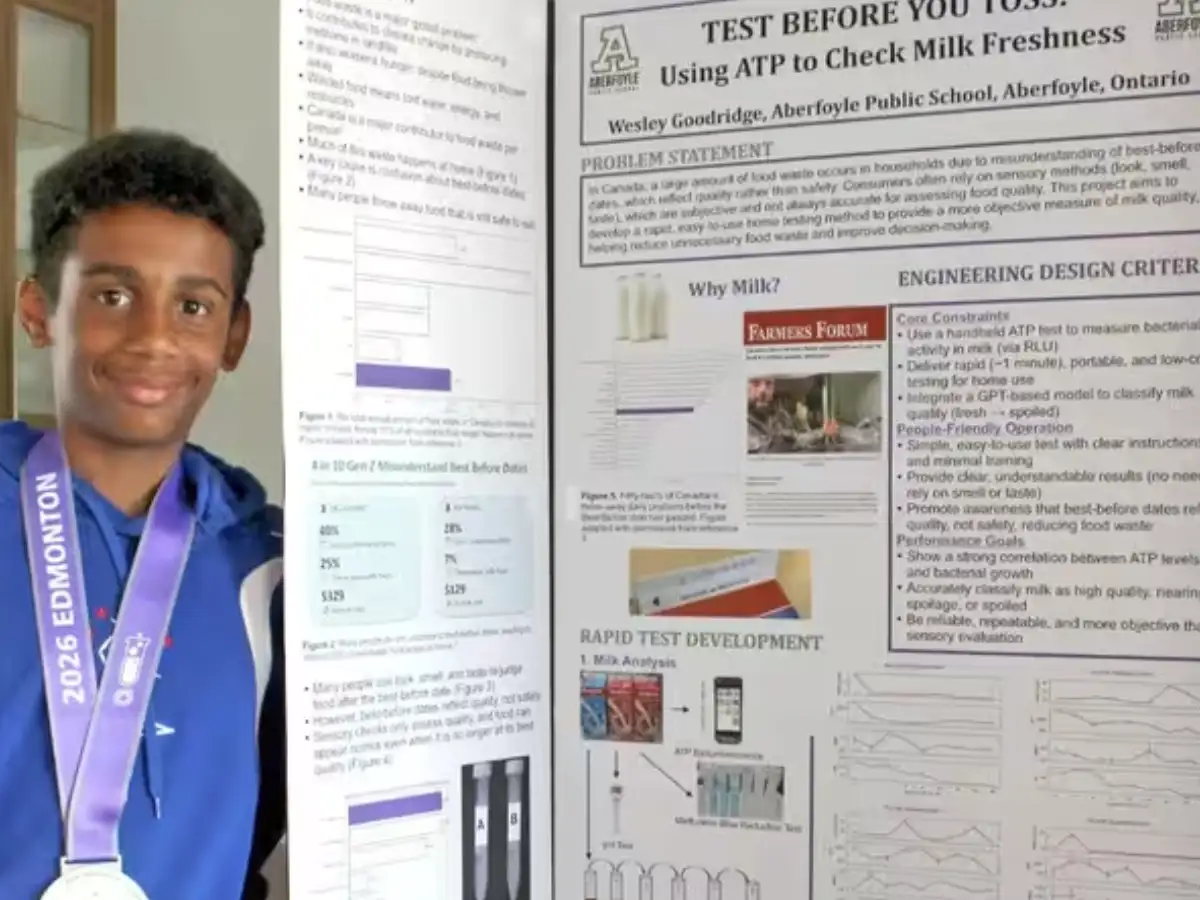
A Grade 7 student's attempt to answer a simple question about milk has earned him one of the biggest honours at Canada's national science fair.
Wesley Goodridge, a student at Aberfoyle Public School in Morriston, Ontario, won a gold medal in the junior category at the 2026 Canada-Wide Science Fair for his project, "Test Before You Toss." His work explores whether science can offer consumers a more objective way to determine the freshness of milk instead of relying only on best-before dates or smell.

Goodridge's project also received the Agriculture, Fisheries and Food Challenge Award and came with a $10,000 university scholarship, recognising the potential practical value of his research.
A question that began with food waste
The idea for the project began during a trip to Rome with his father, Lawrence Goodridge, a food professor and Canada Research Chair in food-borne pathogen dynamics at the University of Guelph.
During the trip, Wesley noticed a large display about food waste in a cafeteria. It made him think about how much food is thrown away simply because people are uncertain whether it is still safe or usable.
That observation eventually led to a straightforward question: could science provide a better answer before someone decides to throw food away?
The question became the foundation for "Test Before You Toss."
Science has been a familiar part of Wesley's life because of his father's work. But rather than simply learning about food science, the Grade 7 student turned his curiosity into an experiment focused on something found in refrigerators around the world: milk.
Instead of smelling milk, he looked at ATP
One of the most interesting aspects of Goodridge's project is the way he approached the problem.
People commonly judge milk by its printed date, smell, appearance or taste. But those methods have limitations. A best-before date does not necessarily mean that a food becomes spoiled on that exact day, while sensory checks can be subjective.
Goodridge investigated whether adenosine triphosphate, or ATP, could provide another way to assess milk freshness.
ATP is found in living cells, including microorganisms. Measuring ATP can therefore provide an indication of biological activity in a sample.
Rather than trying to identify individual bacteria, Goodridge's approach focuses on measuring ATP as a broader indicator of microbial activity.
The idea is relatively simple: instead of asking only whether milk has passed the date on the carton or whether it smells unusual, a measurement could potentially provide additional scientific information about what is happening in the milk.
His experiments looked at different types of milk
Goodridge has already tested milk with three different fat percentages, allowing him to examine whether the composition of milk affects ATP measurements.
That detail is important because turning an intriguing scientific idea into something useful requires understanding how different variables influence the results.
The project is still being developed, and Goodridge hopes to investigate whether the approach could eventually be applied beyond milk and to a broader range of food products.
He has also explored the possibility of a photo-based app that could make the technology easier for consumers to use outside a laboratory.
If such a system could eventually provide reliable information through a simple consumer-friendly test, it could make the underlying science considerably more accessible.
Why the project matters beyond the science fair
Food waste is a huge problem, and uncertainty plays a role in what consumers decide to discard.
People may throw away food because they are unsure whether it is still usable, even when the printed date does not necessarily mean the food has spoiled. A tool capable of providing additional information could potentially help people make more informed decisions.
That is what makes Goodridge's project particularly interesting. It takes a question that appears ordinary — "Is this milk still good?" — and turns it into a scientific investigation.
The project earned the Agriculture, Fisheries and Food Challenge Award at the Canada-Wide Science Fair, highlighting its connection to a practical food-related problem.
From Rome to Canada's national science fair
Goodridge's journey from noticing a food-waste display in Rome to winning a national science fair gold medal took him through regional science competitions before reaching the Canada-Wide Science Fair.
The 2026 national event was held in Edmonton from May 23 to 30, bringing together young researchers from across Canada.
His work at the national level was supported by the Canadian Black Scientists Network, following his success at regional science fairs.
For Goodridge, however, the project is not finished.
He plans to continue refining "Test Before You Toss" and explore whether the method can be expanded to other foods.
What began with a display about discarded food has therefore evolved into an experiment with a much bigger question behind it: can a simple scientific measurement help people make smarter decisions about the food they are about to throw away?
For a Grade 7 student, that is an unusually practical problem to tackle — and one that could have implications far beyond the science fair.







