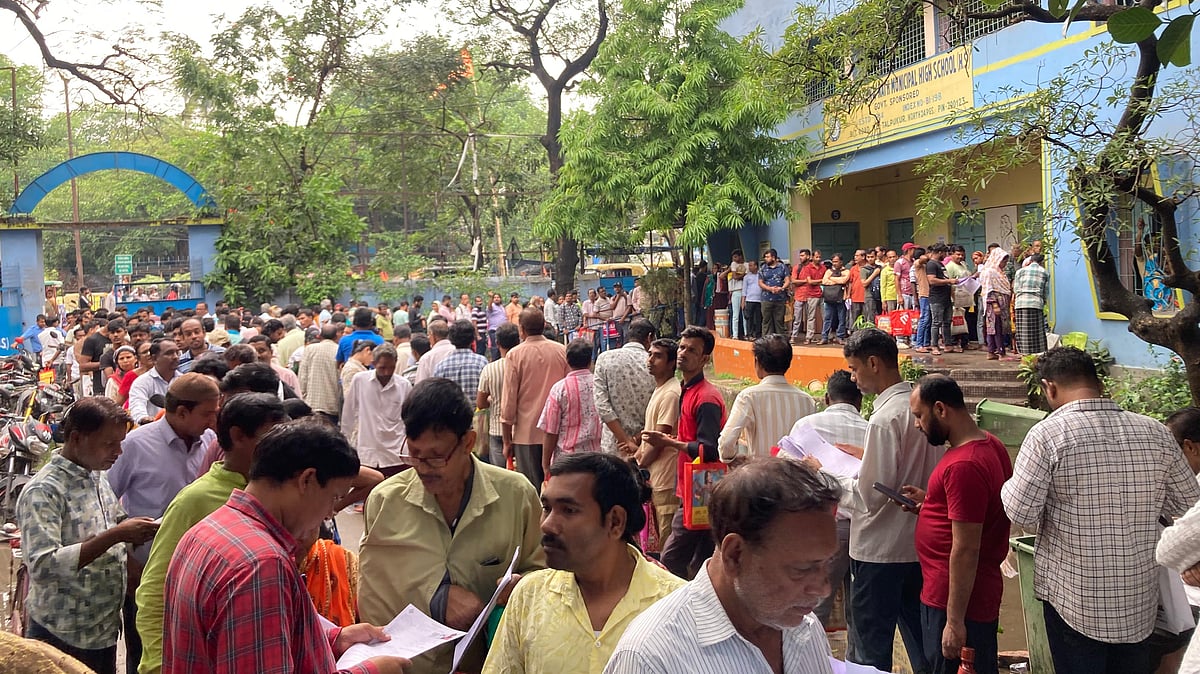
Aftab Alam gave his primary school examination at Krishnanath School in Titagarh in 1976. He is 64 now. Today, he was back at the same school. It was not for any reunion, but to prove he has the right to vote.

He had been waiting for over two hours when this reporter met him, a sheaf of documents under his arm, standing in a queue that snaked through a compound still waterlogged from the previous night’s rain.

He was one of nearly 500 residents who descended on the school – acting as tribunal centres – that morning from localities across North 24 Parganas – Patulia, Suryapur, Rahara, Mohanpur, Bandipur: each carrying some version of the same problem. Their names had either been deleted or placed under adjudication following West Bengal’s Special Intensive Revision of electoral rolls. At the end of their wait, most received a stamped acknowledgement.

North 24 Parganas is among the hardest-hit districts in the state. The district lost 12.6 lakh voters from its rolls, South 24 Parganas 10.9 lakh, Murshidabad 7.5 lakh. All three border Bangladesh. Malda and East Burdwan were also among the heavily affected. Murshidabad and Malda are Muslim-majority districts; North 24 Parganas has a substantial Matua population. The pattern has sharpened the political argument over whether the revision was applied evenly.
A father who came for his daughter
Mohammed Hadis, a resident of Suryapur in Rahara, had wrapped his right foot in a black polythene bag before leaving home. “I have a diabetic leg so three of my fingers have been cut off so I wrapped this plastic bag to prevent any infection,” he said, nodding toward the standing water inside the school premises.
He had not come for himself. His daughter Shabana Paveen had been flagged in the SIR, but she had just delivered a baby and could not make the trip. His wife was at her shift in an ice cream factory.

Shabana’s case fell under what the Election Commission calls a “logical discrepancy” – her voter entry listed a father who, according to the system, had six other children also claiming him as their father. The implication was that the family link was implausible. Hadis said he had five children: three daughters, two sons. Not seven.
Logical discrepancies are among the most commonly cited reasons for adjudication under the SIR. The system flags entries where family relationships appear statistically impossible – for example, the parent’s name does not match, the parent-child age gap is unrealistically small (less than 15 years) or too large (over 50 years), or the grandparent-grandchild age gap is too small. They also include cases where one voter is linked to a ‘high number’ or more than six descendants or successors, raising doubts about whether those family relationships are genuine.
For those whose names have been flagged or deleted, the official process runs as follows: voters can check their status on the Chief Electoral Officer's website (ceowestbengal.wb.gov.in) or the ECI portal (voters.eci.gov.in), or through their Booth Level Officer. If deleted, they can file Form 6 for re-inclusion – along with a declaration under Annexure IV – within 15 days of the roll's publication, either online or at the District Magistrate’s office. Appeals thereafter go to the DM and then to the CEO within 30 days. The national helpline is 1950.
There is confusion on the ground. Many are unaware of the process and are bringing all their documents to ensure their name is not struck off.

Sheikh Shah Jahan, a farmer from Bandipur, had his name deleted on March 27. The stated reason: his father’s name did not match across documents. His father was Chhabiulla Sheikh — but in older records, the surname appeared as Sekh, a transliteration difference routine in Bengali paperwork. Shah Jahan had anticipated the objection. He brought an affidavit from a Judicial Magistrate First Class in Alipore attesting that both names referred to the same person.
Sushil Kumar Saha, a 59-year-old van driver from Mohanpur in Barrackpore, received a notice saying the system could not place him or any family member in the 2002 electoral rolls. He did not deny it: he had been admitted at RG Kar Hospital that year for an ulcer and had missed the voter registration window. But he came to the school with the 2002 rolls in hand, pointing to the entry for his brother, Sudhanshu Saha, as proof the family had roots here.
Among those who had come to file petitions was a former Booth Level Officer, now attached to the Barrackpore Ramakrishna Mission. He was there on behalf of two monks: voters whose cards he had personally issued during his time as BLO. He blamed the Election Commission for the mess.
Doubts about pension, scheme
Aftab Alam spent his working years at the National Jute Manufactures Corporation Limited. His father and grandfather worked there too. He now draws a monthly pension of Rs 931. He had waited more than two hours by the time his turn came, and one question had been circling in his head the whole while: if his name is removed from the voter roll, does he lose the pension?
It is not a question with a straightforward answer. But he was not the only one asking it. Poona (name changed) receives Rs 1,500 a month under the Lakshmir Bhandar scheme, the state government’s direct transfer programme for women. She stood in the same queue with her husband Shashi, who sells vegetables each morning for roughly Rs 300 a day. They arrived at 10.30 am. It was past 1 pm before their paperwork was done. Shashi had skipped work. Between the lost earnings and the cost of commuting and photocopying, the day had cost them close to Rs 500.
When asked about the political back-and-forth – TMC blaming BJP for engineering the deletions – Shashi said he agreed with the governing party’s reading of things. Alam was more direct. “Mera bhi anuman hai divide karke vote ko kam kiya jaay taki vartaman me jo sarkar hai wo failure ban jaaye,” he said. (My impression too is that the votes are being split and reduced so that the government currently in power is made to fail.)
Nitai Mondal, a mason who works in Palpara, Nadia, had already come the previous day and been turned back. He returned again, spent another two hours in the queue, and calculated that across both days he had lost Rs 1,400 in wages he would not recover.
“Ei party ra guto guti kore, public more jaay,” he said. (While these parties keep fighting and brawling among themselves, ordinary people end up dying.)
Elections are not just about who wins, but about the questions that often go unasked – and this time, they matter more than ever. Support our new NL Sena on the five upcoming assembly polls to help us follow the missing voters, the shifting politics, and the stories that could shape India’s future.
Complaining about the media is easy. Why not do something to make it better? Support independent media and subscribe to Newslaundry today.
Newslaundry is a reader-supported, ad-free, independent news outlet based out of New Delhi. Support their journalism, here.