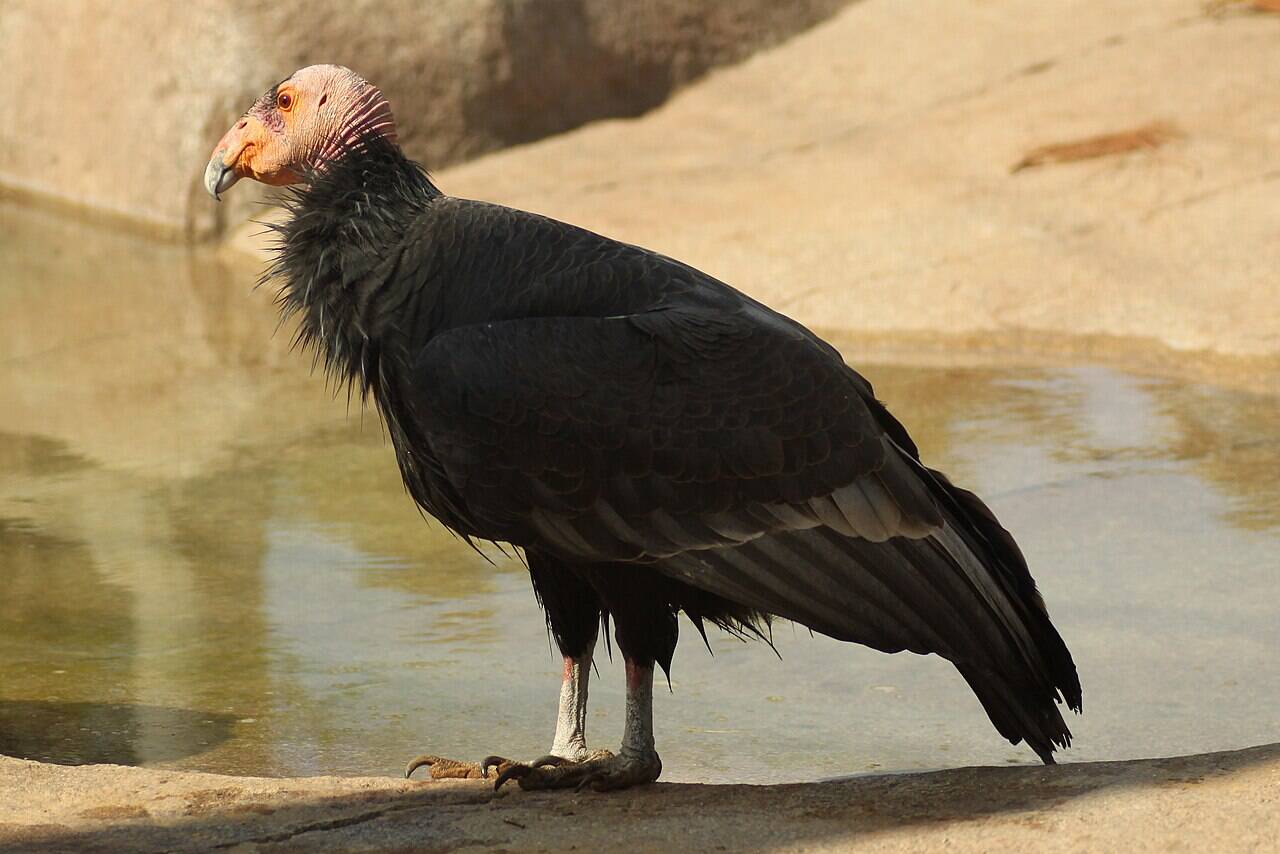
Before satellite tracking, camera traps and modern conservation programs, conservation often began with a notebook, binoculars and patience. That was true of scientists studying the California condor, whose population was difficult to estimate because the birds ranged across rugged landscapes and population counts were often inconsistent.
Get breaking news anytime, anywhere. Download the TOI app now!

Fossil evidence shows that the species was present across large parts of North America during the Pleistocene era. By historical times, however, its range had contracted dramatically, leaving the birds largely confined to portions of the Pacific Coast.
In the The California Condor recovery programme study, published in Raptors at Risk, Lloyd Kiff outlines the California condor's decline, the conservation measures developed to prevent its extinction, and the progress of the recovery programme. The study compiles decades of research into the causes of the birds' decline. Among the key contributors was Carl Koford, who estimated the total population at no more than 60 birds after several months of observing California condors in the wild in the 1940s. Koford later said his estimate was conservative and that the population may have been closer to 100 birds, underscoring how small it had become by the mid-twentieth century.
A species on the decline despite its protection
Concern about the California condor population had been growing for decades before the end of the 20th century. In the 1930s, efforts were made to protect the bird in California by establishing a protected area with nesting and feeding sites.
For a time, scientists saw habitat protection as the most practical conservation strategy. Scientists gradually learned where condors nested, roosted and travelled through California’s rugged landscapes.
Despite these efforts, later surveys suggested that the decline continued. Estimates varied because condors ranged across vast territories and individual birds were difficult to track reliably. Even so, the trend remained alarming. By the 1960s and 1970s, many experts believed the species remained at dangerously low numbers despite decades of conservation work.
Growing concern led researchers to look beyond habitat loss and human disturbance. Historical records showed that direct persecution played a major role in the species' decline. Shooting was widely regarded as one of the major causes of condor mortality during earlier periods, while egg collecting, capture and other human-related pressures also contributed to losses. Although some of these threats had diminished over time, the population had never fully recovered from their impact.
As researchers learned more, it became clear that protecting land alone would not save the bird. Researchers concluded that several factors, many difficult to study in the wild, were driving the species toward extinction. That led conservationists to adopt a more intensive approach.
When conservation became a race against time
In 1980, conservation organisations and wildlife agencies launched a recovery program. Scientists began observing individual birds with radio telemetry and field studies to better understand condor behaviour.
One major development was the use of photographic identification techniques. By analysing distinctive wing-feather patterns, researchers were able to recognise individual birds with far greater accuracy than before. According to The California Condor Recovery Programme, photographic analyses of individual wing patterns showed that the wild population had fallen to just 22 birds in 1982, the lowest recorded number in the species' history.
The intensive monitoring also revealed more about condor behaviour. Individual birds could travel remarkable distances across their range, sometimes moving between widely separated areas within a single day. The findings showed that protecting the species required conserving a broad landscape rather than isolated reserves.
Researchers also identified the main dangers facing the remaining birds. Several condors that died during the 1980s were found to have suffered from lead poisoning after ingesting fragments of ammunition present in animal carcasses. The finding showed that birds could still face danger inside protected areas. Researchers also documented eggshell thinning, which had affected reproduction during the era of widespread DDT use.
The situation worsened in the winter of 1984-85, when several birds disappeared or died in quick succession, leaving a population many biologists feared was unsustainable. Realising the birds' chances of survival were shrinking, conservationists decided more drastic action was needed.
Bringing a species back from the brink
The situation worsened during the winter of 1984-85, when six of the remaining 15 wild condors were lost, reducing the number of known breeding pairs to one. The decline prompted the U.S. Fish and Wildlife Service to recommend capturing the remaining free-flying birds for their protection.
Captive breeding became the main part of the recovery effort. Breeding facilities worked to increase the population while preserving as much genetic diversity as possible among the surviving birds. Researchers also took advantage of the species' ability to lay replacement eggs, which helped increase the number of chicks produced each year. These efforts gradually increased the population after decades of decline.
The first successful captive breeding took place in 1983 at the Los Angeles Zoo, marking an important milestone in efforts to prevent the California condor's extinction. As more birds were bred, wildlife managers began preparing for eventual reintroductions into suitable areas of California and Arizona. Managers refined release techniques by keeping young birds in acclimatisation enclosures before release.
Reintroduction brought new challenges for conservation teams. Some released birds interacted with human structures, while others faced risks from power lines and other hazards. Conservation teams responded by adapting their management strategies, including behavioural training to reduce risky interactions. Although setbacks continued, refinements to release methods and behavioural training helped reduce fatalities from power line collisions and improved the management of released birds.
By the end of 1998, the recovery programme reported 147 California condors: 42 in the wild and 105 in captivity. Although the species was still not secure, the increase marked a major improvement on the critically low numbers of the early 1980s.
The revival of the California condor was a major challenge in wildlife conservation. Early naturalists documented the California condor's decline, and later conservation programmes, including captive breeding and reintroduction efforts, helped prevent the species' extinction.