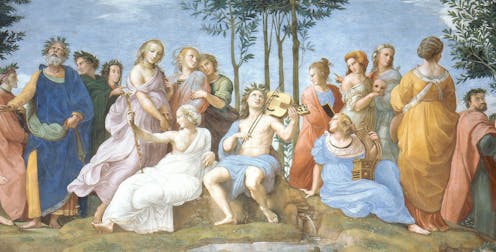
In the beginning, there was just one, unnamed, muse. The blind bard Homer (a poet born around around 850BC) invoked her with the words “Sing, daughter of Zeus” in the first lines of his epic poem, the Odyssey.
Then there were said to be three: Melete (practice), Mneme (memory) and Aoede (song), perhaps embodying the basic creative process of early humanity. Eventually, nine muses were identified, covering every branch of the arts, in the ancient Greek poet Hesiod’s introduction to Theogony, his epic poem about mythical stories and characters (circa 730–700BC). Hesiod, formerly an illiterate shepherd, claimed that he was inspired to write the poem when a beautiful goddess whispered the story in his ear.