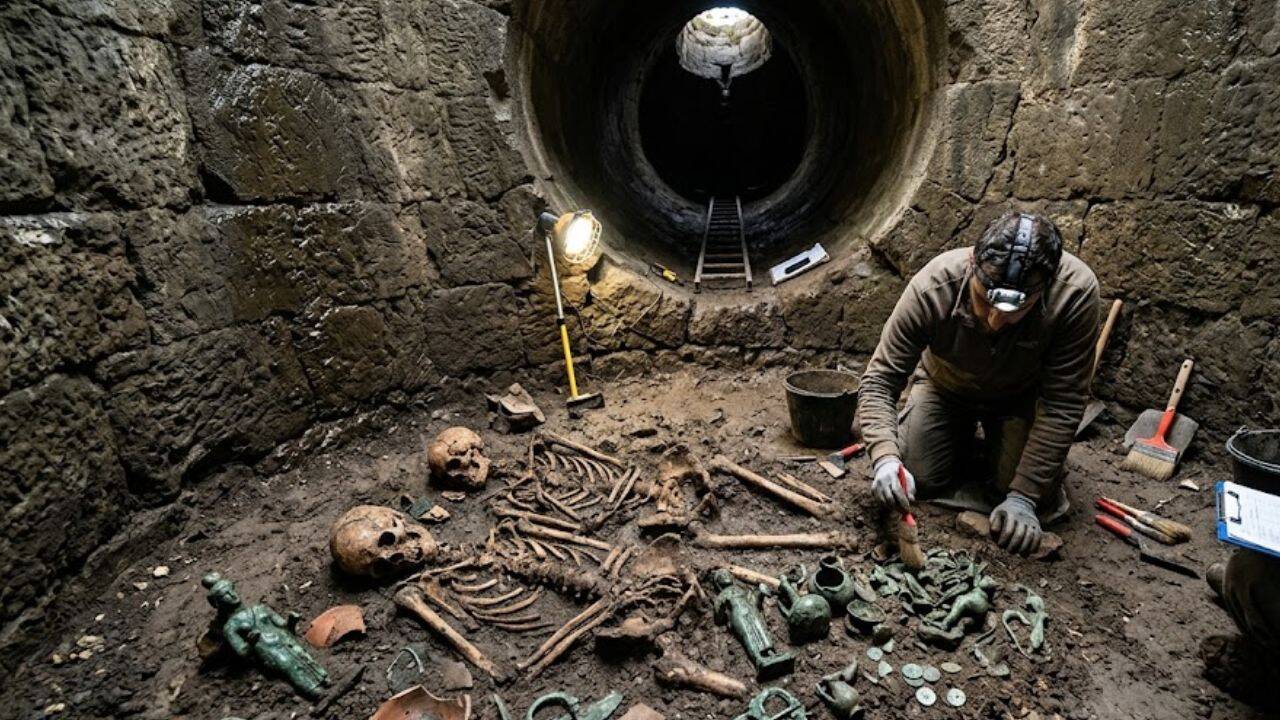
Archaeologists have uncovered an unusual ritual well at Kainua, an ancient Etruscan city near Marzabotto in northern Italy, offering new insights into the rituals surrounding its foundation. The remarkable discovery was first made during the University of Bologna’s 39th excavation campaign in the city’s sacred urban area, dedicated to the goddess Uni. At the bottom of the well, researchers found two bronze female statuettes and a rare bronze plate, all remarkably well preserved. According to Alma Mater Studiorum, Università di Bologna (University of Bologna, Italy), these objects are interpreted as votive offerings placed during a foundation ritual between the end of the 6th and the first decades of the 5th century BC. Two adult human skeletons were also discovered and are associated with the ritual closing of the structure. The findings suggest that the well was far more than a simple source of water for the community. Instead, it formed part of a complex religious practice connected with water, sacred urban space and the foundation of the Etruscan city.
Get breaking news anytime, anywhere. Download the TOI app now!