
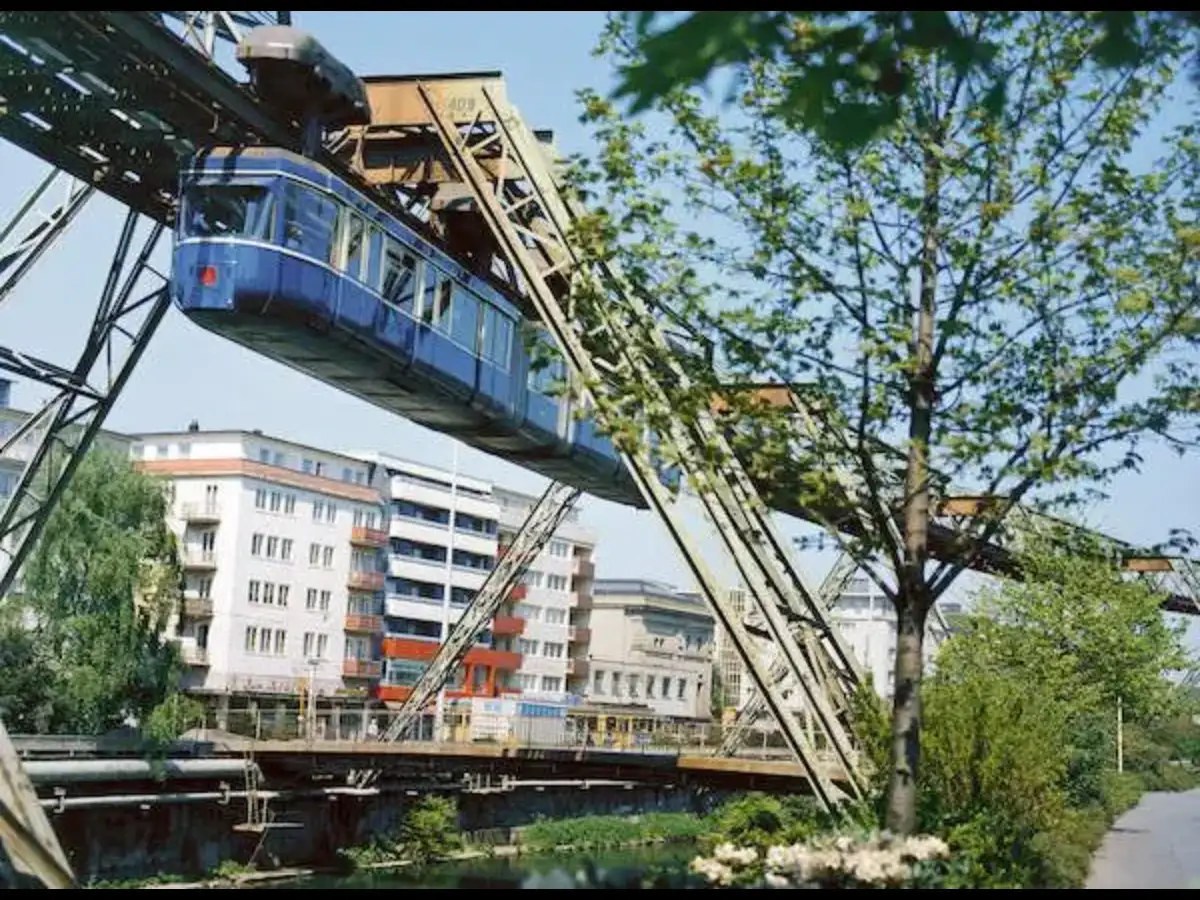
A train that looks as though it belongs in a science-fiction film has been crossing a German city for 125 years. But when the Wuppertal Schwebebahn began carrying passengers in 1901, its unusual appearance was not meant to impress. It was an answer to a very practical problem: there was scarcely any space left on the ground for another major transport route.
Today, the railway runs for about 13 kilometres through Wuppertal, mostly above the River Wupper, and connects more than 80,000 people each day, according to its operator Wuppertaler Stadtwerke (WSW). With 20 stations, it remains part of the city's everyday transport system rather than merely a surviving piece of industrial history.

A city running out of room
The story begins in the rapidly industrialising Wupper Valley of the late 19th century. Barmen and Elberfeld, two separate towns in Germany’s Wupper Valley that later became part of the city of Wuppertal, were expanding manufacturing centres, and factories and housing had spread along the narrow valley.
Wuppertal's official heritage register says the region's industrial growth caused Barmen and Elberfeld to grow rapidly toward one another, while traffic increased with the expanding urban area. The densely built valley left little room for another major road also made an underground railway impractical.
That constraint pushed engineers to consider something that sounds obvious only after seeing it: if the ground was already crowded, why not use the space above it?
Engineer and entrepreneur Eugen Langen had been involved in developing the idea during the 1880s. In 1894, the municipal authorities of Barmen and Elberfeld accepted his system and construction eventually began in 1898.
Instead of putting the train on the ground, the cars would hang beneath the route, leaving roads and the river below largely unobstructed.
The strange railway becomes reality
The first test runs took place in December 1898, initially at just 16 km/h. By the following spring, tests had reached 40 km/h as the experimental section was extended.
The railway's first public passengers were carried on March 1, 1901, when the 4.59-kilometre section between Kluse and the Zoo opened. The response was immediate: according to the operator's historical record, crowds were so large that the planned 10-minute intervals were shortened to five minutes that afternoon.
The railway was still being extended. The western section to Vohwinkel opened in May 1901, while the remaining section toward Oberbarmen was completed in 1903. The finished system had consumed about 19,200 tonnes of iron and used 472 supports, according to WSW's historical account.
An emperor tried it before everyone else
Before ordinary passengers officially began riding, the railway received an extraordinary early visitor. On October 24, 1900, Kaiser Wilhelm II, the last German Emperor, his wife Auguste Viktoria and their entourage took a trial journey from Döppersberg to Vohwinkel.
The carriage used for that journey became known as the Kaiserwagen and has survived as a preserved piece of Wuppertal's transport history.
The railway soon became inseparable from the identity of the city. More than 1.5 billion passenger journeys have been made on it over its lifetime, while train can reach 60 km/h today.
From engineering experiment to daily commute
What makes the railway particularly unusual today is not simply that it survived 125 years. It is that people still use it to get around.
The current journey between Vohwinkel and Oberbarmen takes about 30 minutes, with the trains travelling roughly eight to 12 metres above the Wupper depending on the section. Only four of the 20 stations are on land; most of the route follows the river corridor.
The elephant that became part of its legend
The Schwebebahn has also accumulated stories that have little to do with engineering. In 1950, a four-year-old elephant named Tuffi was placed aboard the railway as part of a circus publicity stunt. During the journey, she panicked, broke through the side of the carriage and fell into the Wupper. The railway operator says she survived with only minor injuries.
The bizarre episode became part of Wuppertal folklore, but the railway's most significant achievement is considerably less dramatic: an idea conceived for a crowded industrial valley remains useful to the people living there.







