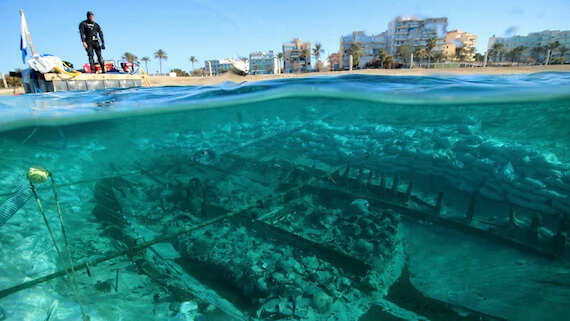
One of the best-preserved Roman shipwrecks located under the sea off the coast of Mallorca has been recovered from the depths of the water after many years of meticulous excavations carried out by archaeologists.
Get breaking news anytime, anywhere. Download the TOI app now!

According to a study available through Springer Nature , the ship called the Ses Fontanelles shipwreck was first discovered in 2019, a few hundred meters from Playa de Palma, located on the island of Mallorca, Spain. The shipwreck is believed to have occurred in the 4th century AD, and it is considered to be one of the better-preserved Late Roman merchant ships found in the western Mediterranean.
Radio Mallorca , citing the Consell de Mallorca, reported that the excavation and recovery of the Ses Fontanelles shipwreck has been completed, paving the way for its restoration and scientific analysis.
Underwater preservation
While most of the ancient ships have survived in fragments, this particular ship was well preserved by the layers of underwater sediment. It provided protection for the wooden structure of the ship and an amazing range of cargoes and artifacts transported on board. Hundreds of objects were found during excavations, including ceramic amphorae used to transport food and other goods throughout the Mediterranean. Also, the archaeologists discovered nearly 90 meters of ropes, fragments of linen sails, woven baskets, two anchors, shoes, coins, and even a drill – an object that is thought to have been used by the crew.
Archaeologists at the University of Barcelona’s Institute of Archaeology noted that ropes and linen survived because the underwater sediment lacked oxygen.
This discovery will shed light on Roman shipbuilding, navigation, and life aboard merchant ships.
Amphorae can point to long-lost trade routes
Included among the most important artifacts are hundreds of amphorae, the large pottery jars which were common throughout the Roman Empire for the transportation of goods including olive oil, wine, and fish sauce. Some of the jars have painted inscriptions on them, which can allow scientists to figure out the place of origin and destination of the shipment. Such inscriptions usually served as a label indicating the producer, merchant, or the cargo itself.
Scientists hope that an in-depth study of the amphorae can help reconstruct the routes used for trading during the Late Roman era, which was a time of great changes for the empire.
According to UNESCO, underwater archaeological sites hold unique traces of the past trade, technology, and cultural contacts that are not always available in written sources. This especially concerns shipwrecks, as they provide snapshots of trade at a certain point in time since both ships and cargo tend to sink together.
Careful recovery process
The recovery of a wooden ship that has been submerged for close to 1,700 years requires much care. As soon as it is brought to the surface, it is likely to deteriorate due to the waterlogged wood drying. That is why the team included archaeologists, conservators, marine biologists, and specialists in preserving ancient organic material. Each piece of the ship was catalogued, mapped, and photographed before it was brought to the surface.
As reported by the Consell de Mallorca, the artefacts will be cleaned, preserved, and scientifically analyzed for years before the ship is reconstructed.
The analysis is also expected to provide information regarding the cause of the sinking of the ship, its course, and the reasons behind the accident.
What the wreck can reveal about Late Roman society
The Roman Empire underwent major changes in the 4th century AD. Political instability, administrative reforms, and different economic systems were becoming dominant at this time in Europe and Mediterranean countries.
At the same time, there were still certain requirements for the transportation of food supplies, natural resources, and different goods between the provinces of the Roman Empire. Ships like Ses Fontanelles are believed to have been important for maintaining commercial ties across the Mediterranean. According to historians, due to the lack of surviving ships from this time, this discovery can be very valuable for archaeology.
All these factors together give an insight into Roman society at sea, from technologies used for ship-building to tools used by sailors. With further research, the findings are expected to clarify Late Roman trade routes and trading practices. Although the ship’s voyage ended off Mallorca almost 1,700 years ago, this discovery marks the start of another journey. With thorough scientific study, this ancient wreck could become an important source for studying the late Roman Empire.