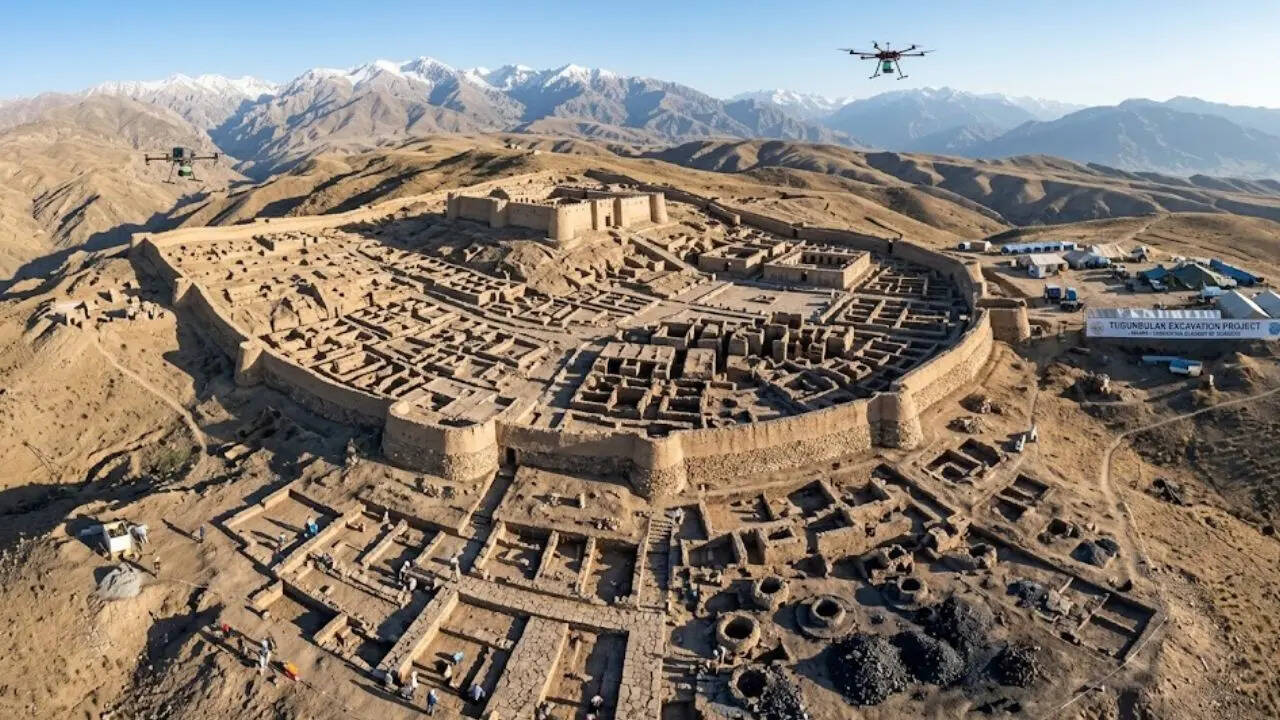
The discovery of a large 120-hectare ancient city located in the Malguzar mountains of Uzbekistan has shed new light on Uzbekistan's history. The city, which has been named Tugunbulak by archaeologists, is unique in that it is situated at an altitude of 2000 meters (6,600 feet), and was formerly thought to have been built solely in lowland areas along the Silk Road. The study on Tugunbulak's past, published in the journal Nature, further demonstrates the importance of the mountainous regions of Central Asia as major contributors to industrial development during this time. The fierce mountain winds acted as natural bellows, providing the high-oxygen airflow necessary for large-scale iron and steel production. This high-altitude industrial hub redefines Silk Road geography, proving that medieval mountain communities harnessed extreme environments to dominate metallurgy and reshape the global trade landscape.

‘City of Iron’ was found in Uzbekistan with the help of lasers
For centuries, the extensive grounds of Tugunbulak were hidden from the human eye, shown only as grassy mounds. It wasn’t until researchers used UAV-LiDAR (drone-based laser scanning), which effectively ‘saw’ through the earth, that over 300 distinct structures, including watchtowers, plazas, and a fortress with walls three meters thick, were identified.
According to the research of Washington University in St. Louis, using this method, LiDAR technology allowed researchers to map the 120-hectare landscape in just three weeks- a feat that would have taken over a decade using traditional ground surveys.
An iron factory used to run at 6,600 feet height
Initial testing performed on the central citadel demonstrates that it was much more than a fortification; it actually functioned as a factory on an immense scale. The excavators discovered massive quantities of iron slag (the waste product of the smelting process) and furnace remnants, suggesting that metallurgy was the primary economic driver of the city. This discovery proves that medieval mountain societies were sophisticated industrial hubs, effectively rewriting the history of the Silk Road as a vertical network.
Why did this city of Uzbekistan vanish
The success of the city's iron industry lasted hundreds of years; however, ultimately, its own strength was also its biggest weakness. Smelting large amounts of iron requires huge quantities of charcoal, and research indicates that the city's 500-year industrial boom caused extreme deforestation of the surrounding juniper forests. Without trees to retain moisture and stabilise the soil, the mountainside became susceptible to the effects of rain or melting snow. As a consequence, many people fled from their ‘Iron Empire’ due to frequent flash floods and mudslides.
The mystery of the 400 graves
Tashbulak is a smaller sister site located just three miles from Tugunbulak in the Malguzar mountain range, which houses a disproportionately large cemetery of over 400 graves. These graves are among the earliest signs of Islam's arrival in the high-altitude regions of Central Asia. The astoundingly large size of this cemetery, in comparison to the very small size of Tashbulak and its surrounding villages, implies that Tashbulak served as a central point for worship and other ideological activities for many tribes in the region.