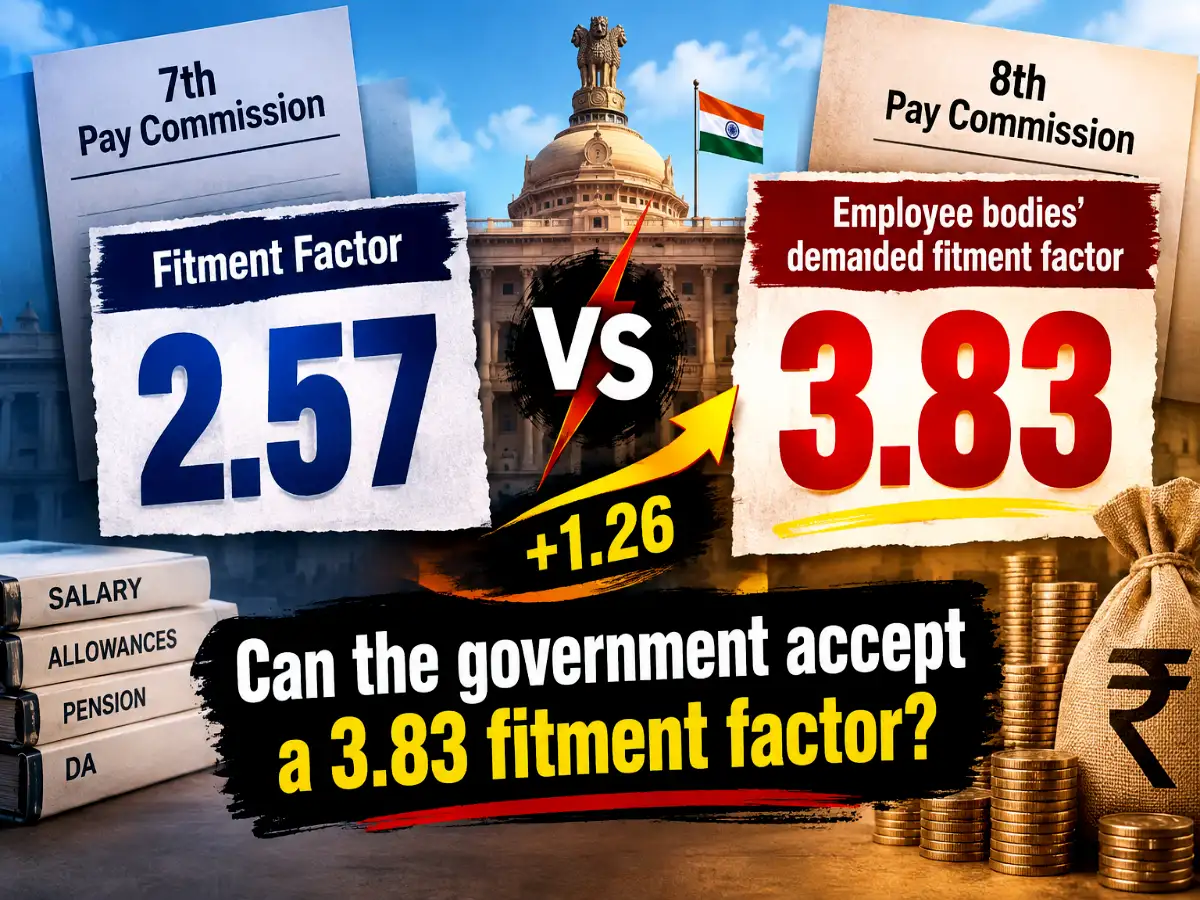
The All India Federation of Pensioners Association, in its presentation to the 8th Pay Commission in Chennai this week, demanded a minimum basic pay of Rs 69,000, an increase of Rs 51,000 over the minimum basic pay of Rs 18,000 set by the 7th Pay Commission. A minimum basic pay of Rs 69,000 also means a 3.83 fitment factor, which is also 1.26 higher than the 2.57 multiplier of the 7th Pay Commission.
This is not the only employee association that is demanding such a high fitment factor for the 8th Pay Commission. The National Council of the Joint Consultative Machinery (NC-JCM), the All India Defence Employees Federation (AIDEF), and the All India New Pension Scheme Employees Federation have also proposed a minimum basic pay of Rs 69,000 and a 3.833 fitment factor. The Indian Railways Technical Supervisors Association (IRTSA) has proposed fitment factors of 2.92, 3.5, and 3.80.

For the 7th Pay Commission, the NC-JCM, the main central government employee body, in its recommendation had suggested a 3.71 fitment factor, but the government decided on a 2.57 multiplier.
Also Read: 8th Pay Commission: How basic salary of Level 6 employees may double in 7 years after DA merger?
Amid similar recommendations of high fitment factors this time too, can the 8th Pay Commission deliver a multiplier of 3.833 and pay a minimum basic salary of Rs 69,000?
Salary and fitment factor recommendations for 8 th Pay Commission
| Organisation | Proposed minimum pay for 8th CPC | Proposed fitment factor for 8th CPC |
| National Council of the Joint Consultative Machinery (NC-JCM) | Rs 69,000 | 3.833 |
| All India Defence Employees' Federation (AIDEF) | Rs 69,000 | 3.833 |
| Federation of National Postal Organisations (FNPO) | Rs 69,000 | 3.833 |
| All India New Pension Scheme Employees Federation (AINPSEF) | Rs 69,000 | 3.833 |
| Indian Railways' Technical Supervisors' Association (IRTSA) | Multiple with minimum at Rs 52,560 | Multiple with minimum at 2.92 |
| Delhi government school teachers | Rs 47,210 | 2.62 |
| Chennai GPO Pensioners | Rs 68,000 | 3.77 |
| Bharat Pensioners Samaj (BPS) | Rs 69,000 | 3.833 |
Most employee and pensioner bodies have recommended increasing the number of family unit counts from 3 in the 7th Pay Commission to 4-5 in the 8th CPC, which can help increase the current basic pay of central government employees substantially.
For calculating the minimum basic salary in a pay commission, employee bodies refer to the price of a consumption basket (according to the 15th ILC norms) as the benchmark.
The basket includes the quantity and price of essentials such as rice, vegetables, fruits, milk, clothing, fuel, electricity, water charges, and recreation for the family unit of an employee.
Also Read: 8th Pay Commission news: Pensioners' body seeks clarity on pension revision from PM Modi
It only accounts for essential and non-discretionary expenditure, deliberately leaving out all luxury or optional items, which helps maintain a conservative and realistic approach to the calculations.Employee unions calculate how much these essentials will cost in different cities in India.Based on these calculations, employee bodies set high minimum basic pay and fitment factor.
Can 8 th Pay Commission give a 3.83 fitment factor?
Adhil Shetty, CEO, BankBazaar.com, told ET Wealth Online that while the fitment factor will determine the extent to which the basic pay of central government employees is revised under the 8th Pay Commission, its impact also needs to be seen alongside how allowances and other components of the salary structure are revised.
“Ultimately, it is the combined effect of these changes that will determine the increase in overall earnings and how it influences employees’ wider personal finance decisions, including spending, saving, and borrowing,” said Shetty.
Manjeet Singh Patel, National President, AINSPEF, told ET Wealth Online that as per the DA rate of December 31, 2025, the estimated fitment factor in the 8th Pay Commission can be 2.06, which, based on the upcoming DA hikes, may reach up to 2.10.
“Even if we get a 2.10 fitment factor in the 8th Pay Commission, the gross pay hike will be 32%, which will be higher compared to the 14.14% gross salary hike we got in the 7th Pay Commission,” said Patel.
Patel presents an illustration of the 8th Pay Commission fitment factor. It is as follows:
Basic pay as of December 31, 2025 (the last day of the 7th Pay Commission) = Rs 18,000
Dearness allowance (DA) 58% (as of December 31, 2025) = Rs 10,800
House rent allowance (HRA) 30% (X category city) = Rs 5,400
Travel allowance (TPTA) Rs 1,800+58% of 1,800 (because of 58% DA) = Rs 1,800+Rs 1,080 = Rs 2,880
Gross pay (basic+HRA+TPTA) = Rs 37,080
Fitment factor= Rs 37,080/18,000= 2.06
However, these are estimates as the real fitment factor will be known only after the government approves the 8th Pay Commission report.