
Get all your news in one place.
100's of premium titles.
One app.
Start reading
Inverse
Inverse
Entertainment
Kayleigh Donaldson

85 Years Later, A Forgotten Horror Remake Tried, And Failed, To Rejuvenate The Genre

Universal/Kobal/Shutterstock

The Hollywood horror boom of the early 1930s gave birth to some of the most beloved and influential films in the genre. While every studio in town tried its hand at horror, it was Universal, home of the legendary monsters, who made the formula their own. Everyone knows about Dracula, Frankenstein, the Mummy, and company. But nestled in among those creatures were plenty of hidden gems, like 1934's The Black Cat. It's one of the best of its era. The 1941 remake? Less so.

Based on an Edgar Allan Poe short story, the original film of The Black Cat follows a pair of wide-eyed American newlyweds on honeymoon in Hungary. They encounter Dr. Vitus Werdegast, a psychiatrist with a dark past, and together, they end up taking refuge in the house of the famed architect Hjalmar Poelzig, with whom Werdegast has an agenda of vengeance to wreak.

Marketed heavily at the time as the long-awaited face-off between Boris Karloff and Béla Lugosi, two of Universal's biggest horror stars, The Black Cat is a surprisingly perverse affair. It's far darker than many of its contemporaries, with a story of illicit substances, kidnapping, torture, and human sacrifice that culminates in Lugosi skinning Karloff alive (a scene shown entirely in shadow and somehow all the more disturbing for it.) It's remarkable that The Black Cat was released in this state given that the Hays Code was rapidly being enforced at this time and typically wouldn't have allowed something this demented to go uncensored.

The film was a big hit, but as the decade rolled on and the Hays Code made it harder for the genre to be as twisted as it needed to be, horror films saw a dip in their popularity. They didn’t disappear, but between the Code and audiences’ fatigue with market oversaturation, things needed a shakeup. Over at Paramount, executives were seeing success with a blend of horror and comedy. The 1939 film The Cat and the Canary, starring Bob Hope, was a big hit for them. Universal had some experience in this field. 1933's The Invisible Man is a horror, yes, but it's also a slapstick picture featuring lots of black comedy and nudity jokes. So, the studio decided to see if they could make lightning strike twice, recycling the Poe story that had given them a hit barely a decade prior. They would also bring back Lugosi for a supporting role, to encourage audiences to make the cross-studio connection.

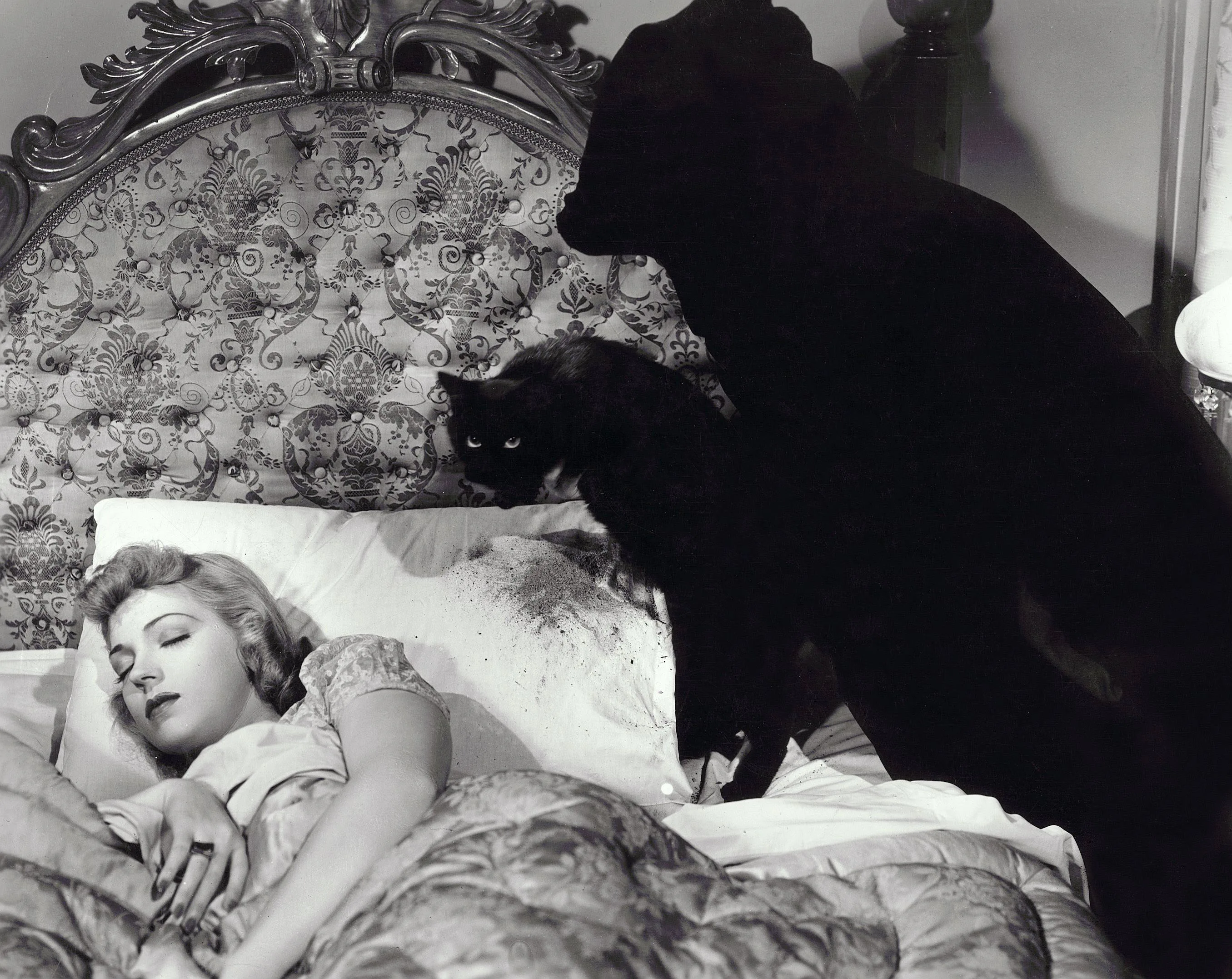
1941's The Black Cat is barely an adaptation of the Poe story. Henrietta Winslow, a cat lady, calls her greedy family to her estate so that she can sort out her will. Her niece, granddaughters, and their spouses want the money now, and will do anything to get their hands on it. Cue shenanigans. And cats, of course.

The Black Cat barely resembles the Poe story, much less the much-better 1934 film. | Moviestore/Shutterstock

There are fun ideas in this version of The Black Cat, which plays around with some classic theatrical tropes and a classic creepy house set. But the script is a mess, a patchy rush-job that feels as though it never got past the drafting stage. It’s slow, the horror isn’t very scary, and the jokes aren’t very funny. Each of its disparate genre elements is lazily executed, a far cry from what Universal was capable of during this time. It seems ill-advised to turn your horror-comedy into a murder mystery when the big reveal is so rushed and unsatisfying. The only thing keeping it all vaguely upright is the cast, which includes Lugosi, Basil Rathbone (best known at the time for playing Sherlock Holmes), Oscar winner Gale Sondergaard, and Anne Gwynne, an early scream queen (and also Chris Pine's grandmother!). Making the film, however, was not a thrill for them. Sondergaard would later admit that she "hated doing the thing. It was beneath me." The reviews certainly agreed.

The same year of The Black Cat remake, Universal released Hold That Ghost, another horror-comedy that starred the popular comedic duo Abbott and Costello. This one was a far bigger success and led to an entire franchise of the pair starring alongside Universal monsters, from Frankenstein to the Invisible Man to Jekyll and Hyde. Those movies are star vehicles for an established act with a set-in-stone schtick, so audiences were primed to love them. They were built around their talents, whereas The Black Cat felt like an obvious copycat of something nobody had an appetite for.

Comedy-horror is a great combination when it’s done properly. Just look at the films of Jordan Peele, The Evil Dead series, or the new Apple TV series Widow’s Bay. There's a ton of material to be mined from finding the humor in darkness and vice versa. Universal had pulled it off before and would do it again after The Black Cat. Sadly, with this movie, the studio just didn't have the courage to commit to its genre blend, and the end result is a minor Universal monster effort that pales in comparison to its truly weird predecessor.

Sign up to read this article
Read news from 100's of titles, curated specifically for you.
Already a member? Sign in here
Related Stories
Top stories on inkl right now
One subscription that gives you access to news from hundreds of sites
Already a member? Sign in here
Our Picks
Fourteen days free
Download the app
One app. One membership.
100+ trusted global sources.